Mistakes When Installing Security Cameras
Installing security cameras may seem simple at first. However, a good commercial video surveillance system needs much more than a few cameras mounted on a wall.
Businesses often spend money on cameras and later discover major problems. For example, important areas may still have blind spots. Night video may look poor. Recordings may not go back far enough. In other cases, the network may not support the system well.
At Midwest Security & Integration (MSI), we provide professional commercial security camera installation and system design throughout Southeastern Ohio.
We do more than mount cameras. Instead, we look at the full system. That includes camera placement, lighting, lenses, storage, cabling, networking, recording needs, and future expansion.
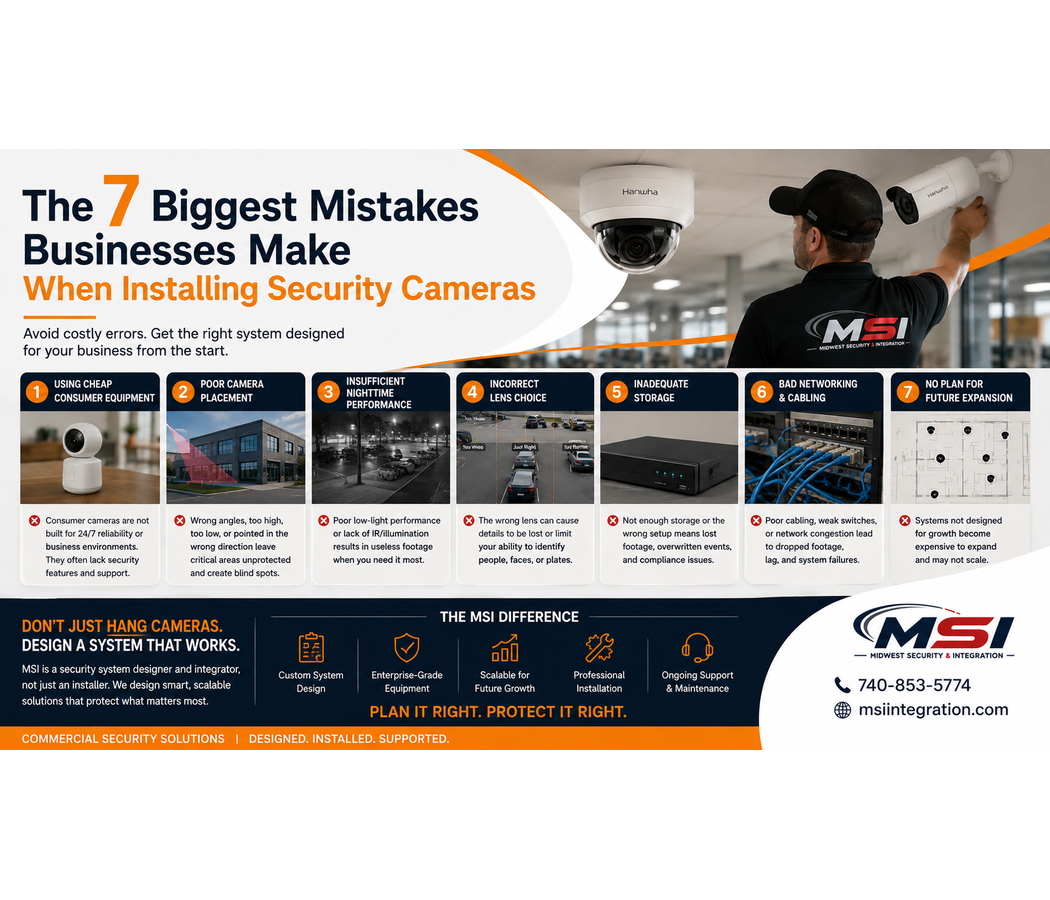
Here are seven of the biggest mistakes businesses make when installing security cameras.
1. Choosing Cheap Consumer Cameras
One of the most common mistakes is choosing cameras based only on price.
Consumer cameras may work well for some homes and small spaces. However, commercial properties often need stronger and more reliable equipment.
A business may need cameras that work:
- 24 hours a day
- In hot and cold weather
- In rain or snow
- In dark parking lots
- Around bright headlights
- Across large warehouses
- Near busy entrances
- Around valuable inventory
For that reason, commercial-grade equipment is often the better choice.
At Midwest Security & Integration (MSI), we work with professional security brands, including Hanwha Vision.
The goal is not to buy the cheapest camera. Instead, the goal is to choose the right camera for the job.
2. Poor Camera Placement
Even a great camera can perform poorly if it is placed in the wrong location.
Camera placement is one of the most important parts of commercial security system design.
For example, a camera mounted too high may not capture enough facial detail. A camera pointed at a bright light may struggle with image quality. In addition, shelves, walls, equipment, and landscaping can block important views.
A camera may show a full parking lot but still fail to capture useful detail.
That is why the question should not be:
“Can the camera see the area?”
Instead, ask:
“Will this camera show the detail we need if something happens?”
3. Ignoring Nighttime Performance
Many cameras look good during the day. However, nighttime performance can be very different.
This matters for businesses with parking lots, gas stations, warehouses, loading docks, construction sites, employee parking areas, and building perimeters.
Low-light performance can change because of:
- Poor lighting
- Vehicle headlights
- Reflections
- Camera placement
- Infrared lighting
- Weather
- Distance from the target
Therefore, a commercial security system should be designed for both daytime and nighttime use.
At MSI, we consider the real conditions around the property. This helps us choose cameras that fit the location.
4. Using the Wrong Lens
Not every camera should have the same lens or field of view.
A wide-angle camera can show a large area. However, objects farther away may appear very small.
On the other hand, a narrower view can provide more detail in a specific area.
For example, a wide camera may work well for an overview of a store. Meanwhile, a more focused camera may work better at an entrance or checkout area.
Commercial systems may use:
- Fixed-lens cameras
- Varifocal cameras
- PTZ cameras
- Multi-sensor cameras
- License plate cameras
Because of this, lens choice should match the distance, viewing area, and level of detail needed.
5. Not Planning Enough Video Storage
Another common mistake is not installing enough video storage.
A business may expect to keep several weeks of video. However, the system may overwrite recordings after only a few days if storage was not planned correctly.
Video storage depends on several things, including:
- Number of cameras
- Camera resolution
- Frame rate
- Recording settings
- Amount of motion
- Desired retention time
Higher-resolution cameras usually need more storage. Likewise, adding more cameras increases storage needs.
Therefore, storage should be calculated during the system design process.
If your business wants 30 days of recorded video, the system should be designed around that goal.
6. Using Poor Networking or Cabling
Modern IP security cameras depend on a reliable network.
Even expensive cameras can have problems when the cabling or network is poorly designed.
Common problems include:
- Low-quality network cable
- Poor cable terminations
- Not enough PoE power
- Overloaded network switches
- Weak wireless links
- Poor network setup
- Cable runs that are too long
- Messy equipment racks
- Poor surge protection
Commercial security cameras are network devices. Therefore, the network behind them matters.
Midwest Security & Integration (MSI) provides professional structured cabling, network infrastructure, commercial Wi-Fi, and point-to-point wireless installation.
As a result, we can design the full system instead of treating the cameras and network as separate projects.
7. Forgetting About Future Expansion
Businesses change over time.
A company may add another building. A parking lot may grow. A warehouse may expand. New entrances may be added. In addition, more cameras may be needed later.
Unfortunately, some systems are installed with no room to grow.
For example, the NVR may already be full. The network switch may have no open ports. The equipment rack may have no extra space.
Because of that, future expansion should be part of the original design.
At MSI, we look at what your business needs today and what it may need later.
Planning ahead can save time and money when the system grows.
More Cameras Do Not Always Mean Better Security
Another mistake is assuming that more cameras always create a better system.
That is not always true.
A poorly designed 30-camera system may provide less useful video than a well-designed 15-camera system.
Each camera should have a clear purpose.
For example, one camera may cover an entrance. Another may watch a loading dock. A different camera may provide a parking lot overview.
Therefore, good system design starts with the goal of each camera.
A Security Camera System Is More Than Cameras
A professional commercial surveillance system includes more than cameras.
It may also include:
- NVRs
- Cloud video surveillance
- VSaaS
- Network switches
- Structured cabling
- Fiber
- Wireless bridges
- Equipment racks
- Video storage
- AI analytics
- Remote access
- Access control
- Future expansion planning
All of these parts need to work together.
That is why Midwest Security & Integration (MSI) approaches commercial security as a complete system.
Why Professional System Design Matters
A professional site assessment can help answer important questions before installation begins.
For example:
Where are your main entrances?
Where are the blind spots?
Which areas hold valuable inventory?
What does the parking lot look like at night?
How much video do you want to keep?
Can your current network support the cameras?
Will the system need to grow later?
Do multiple buildings need to connect?
Would AI analytics help your business?
Would local recording, cloud video, or a hybrid option work best?
These questions help shape the final system.
Commercial Security Camera Installation in Southeastern Ohio
If you are looking for commercial security camera installation, business security cameras, structured cabling, or network infrastructure in Southeastern Ohio, Midwest Security & Integration can help.
MSI serves businesses and organizations throughout Chillicothe, Waverly, Jackson, Portsmouth, Circleville, Washington Court House, Athens, Gallipolis, Logan, Ironton, McArthur, Pomeroy, New Lexington, Caldwell, Woodsfield, McConnelsville, Marietta, and surrounding communities.
We also serve Ross County, Pike County, Jackson County, Scioto County, Athens County, Gallia County, Hocking County, Lawrence County, Meigs County, Monroe County, Morgan County, Noble County, Perry County, Vinton County, Washington County, and nearby areas of Southeastern Ohio.
What Types of Businesses Does MSI Work With?
Midwest Security & Integration provides commercial security solutions for many types of properties.
These include retail stores, grocery stores, gas stations, convenience stores, restaurants, car dealerships, warehouses, manufacturing plants, industrial facilities, schools, government buildings, parks, offices, healthcare facilities, apartment properties, storage facilities, construction sites, road construction projects, temporary work sites, utilities, and other commercial locations.
Every property is different. Therefore, every system should be designed around the customer’s actual needs.
Don’t Just Install Cameras. Build the Right System.
The biggest mistake a business can make is treating security cameras like a simple equipment purchase.
A good commercial video surveillance system needs planning.
You need the right cameras, the right placement, enough storage, reliable cabling, proper networking, and room to grow.
That is where professional system design makes a difference.
Midwest Security & Integration (MSI) provides commercial security camera installation, access control, commercial Wi-Fi, structured cabling, and network infrastructure throughout Southeastern Ohio.
If you are considering a new system or want to improve your current one, MSI can help design a solution around your property.
Check us out here: https://msiintegration.com/
Call Midwest Security & Integration (MSI): 740-853-5774