FCC Camera Restrictions in 2026: What Ohio Businesses and Government Agencies Need to Know
Businesses, government agencies, and organizations using commercial security cameras in Ohio should be aware of an important federal compliance change involving certain communications and video-surveillance equipment.
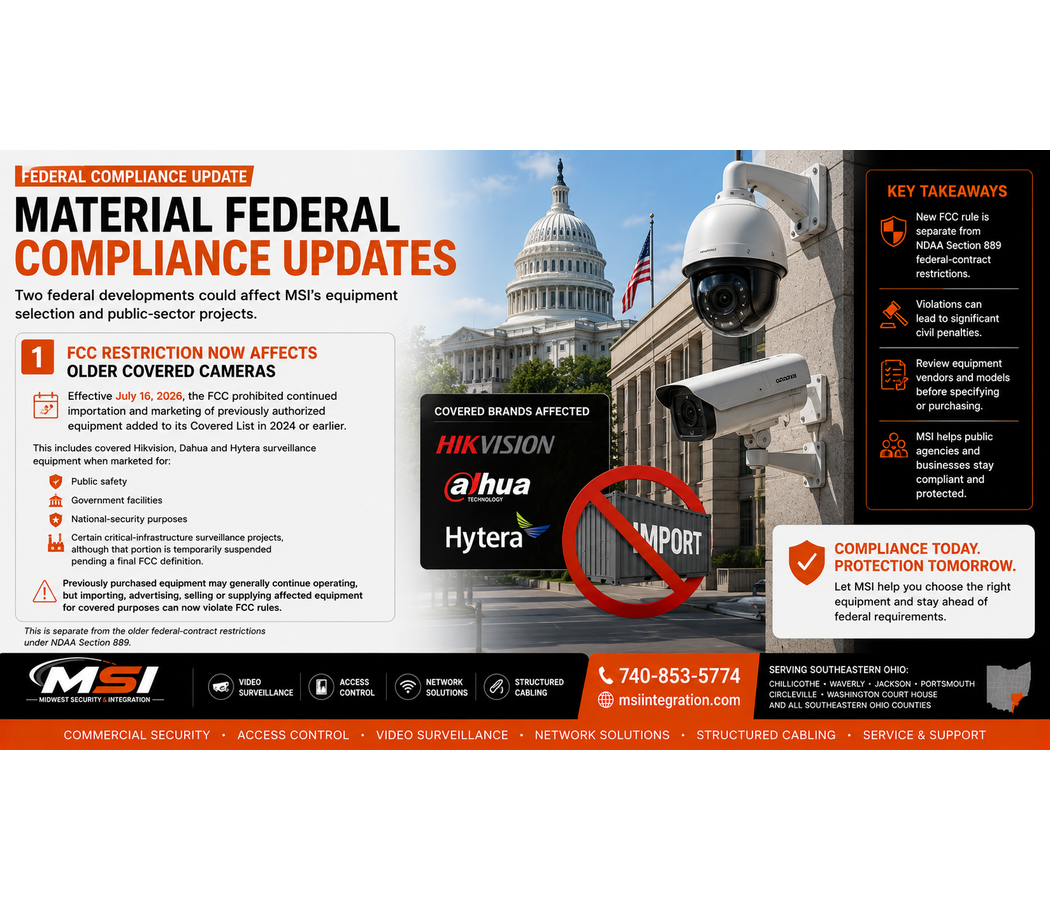
Effective July 16, 2026, new FCC rules expanded restrictions involving previously authorized equipment on the FCC’s Covered List.
This matters for organizations purchasing security cameras, planning surveillance upgrades, issuing public-sector bids, or deciding whether older equipment should remain part of a future security system.
At Midwest Security & Integration (MSI), we design and install commercial security camera systems throughout Southeastern Ohio. As federal requirements continue to change, equipment selection is becoming about more than image quality and price.
For some customers, compliance and equipment eligibility now need to be part of the system design.
What Changed With the FCC Rules in July 2026?
Historically, some equipment already had an FCC authorization even though the manufacturer or equipment later became subject to Covered List restrictions.
The FCC has now tightened that situation.
Effective July 16, 2026, the FCC prohibited continued importation and marketing of certain previously authorized equipment that had been added to the Covered List in 2024 or earlier.
In simple terms, an older FCC authorization does not necessarily provide a path for continued importation or marketing of equipment now subject to these Covered List restrictions.
That can matter to manufacturers, distributors, resellers, integrators, and organizations purchasing surveillance equipment.
Are Hikvision, Dahua, and Hytera on the FCC Covered List?
Yes.
The FCC’s current Covered List identifies video-surveillance and telecommunications equipment produced or provided by:
- Hangzhou Hikvision Digital Technology Company
- Dahua Technology Company
- Hytera Communications Corporation
The Covered List applies to that equipment to the extent it is used for specified purposes, including public safety, security of government facilities, physical-security surveillance of critical infrastructure, and other national-security purposes.
The FCC list also states that named producers or providers should be read to include their subsidiaries and affiliates.
This is an important detail when businesses evaluate manufacturers and product lines.
Does This Mean Every Hikvision or Dahua Camera Is Illegal?
No.
This distinction is extremely important.
Businesses should not interpret the FCC rules as saying that every existing Hikvision or Dahua camera installed at every privately owned business suddenly became illegal to operate.
The federal rules involve specific equipment, activities, and covered purposes.
Therefore, statements such as:
“Hikvision cameras are now illegal everywhere.”
or
“Every business has to remove Dahua cameras immediately.”
would be misleading.
The compliance question depends on the equipment, its status, how it is being marketed or supplied, its intended use, and the requirements applying to the particular project.
What Does “Marketing” Mean?
Another point that can confuse customers is the word marketing.
In FCC equipment rules, marketing is broader than simply running an advertisement.
It can include activities associated with selling, leasing, offering for sale, or distributing regulated equipment.
Therefore, these rules can affect more than manufacturers.
Security integrators, distributors, suppliers, and other organizations in the equipment chain need to understand whether the products they offer remain eligible for the intended application.
Can Previously Installed Cameras Keep Operating?
Previously purchased or installed equipment is a different issue from importing or marketing newly restricted equipment.
The July 2026 rule should not be interpreted as a universal federal order requiring every private owner to immediately disconnect all previously installed covered cameras.
However, an existing system can still create concerns when an organization:
- Expands the system
- Replaces cameras
- Purchases additional equipment
- Moves into government contracting
- Works on covered public-sector projects
- Must meet specific procurement requirements
- Has contractual compliance obligations
Therefore, businesses with older equipment should understand what they own before planning an expansion or upgrade.
FCC Covered List and NDAA Section 889 Are Not the Same Thing
This is another important distinction.
The FCC Covered List rules and NDAA Section 889 are related to federal security concerns, but they are not the same requirement.
Section 889 has long affected federal contracting and the use or procurement of certain covered telecommunications and video-surveillance equipment.
The FCC rules involve communications equipment authorization, importation, marketing, and Covered List requirements.
A project may therefore require reviewing more than one federal rule or contract requirement.
Businesses should not assume:
“It’s NDAA compliant, so every federal compliance question is automatically solved.”
Likewise, being affected by an FCC rule does not necessarily mean the exact same requirements apply under every federal contract.
Why This Matters for Government Security Camera Projects
Government and public-sector projects deserve particular attention.
The FCC Covered List specifically addresses certain equipment used for public safety and security of government facilities, among other covered purposes.
Organizations planning surveillance for locations such as:
- County facilities
- Municipal buildings
- Public parks
- Public-safety facilities
- Government offices
- Public infrastructure
- Other government properties
should evaluate equipment eligibility before purchasing cameras.
Replacing equipment after a project has already been designed can be expensive.
It is better to address compliance during system design.
What About Critical Infrastructure?
Critical infrastructure is another area businesses should approach carefully.
The FCC Covered List language includes physical-security surveillance of critical infrastructure among the specified uses for Hikvision, Dahua, and Hytera equipment.
However, federal implementation and definitions can be detailed and may change.
Therefore, an organization operating infrastructure that may fall into a regulated category should review the current FCC rules and applicable federal requirements rather than relying on a general internet summary.
Why Equipment Selection Matters More in 2026
For years, businesses often chose security cameras primarily by comparing:
Price.
Resolution.
Storage.
Nighttime image quality.
Those factors still matter.
However, certain customers now need to add another question:
Is this equipment appropriate and compliant for our intended application?
That is especially important for government agencies, public-sector contractors, critical-infrastructure organizations, and businesses that may participate in government projects.
Cheap Cameras Can Create Expensive Problems Later
Buying inexpensive surveillance equipment can look attractive upfront.
However, equipment choice can create problems later if a business discovers that the cameras do not meet the requirements of a future project.
Imagine installing 60 cameras throughout a commercial property.
Two years later, the organization receives a government contract with security requirements that make portions of the existing equipment unsuitable.
Now the organization may face another major investment.
This is why commercial surveillance should be planned around both current needs and reasonable future requirements.
Should My Business Replace Existing Hikvision or Dahua Cameras?
Not automatically.
The correct answer depends on your organization and the system.
A private business with an existing surveillance system may be in a very different position from a county government facility planning a new installation.
Before replacing equipment, determine:
What manufacturer and models do we currently have?
When were they installed?
What will the cameras be used for?
Are we planning to expand the system?
Do we participate in government contracts?
Do specific procurement or compliance rules apply to us?
Will future projects require different equipment?
Those answers can help determine whether an upgrade makes sense.
How Do I Know What Cameras My Business Currently Has?
Many businesses don’t know.
The cameras may have been installed years ago.
Management may have changed.
Documentation may be missing.
Some equipment may even have been installed under another brand name.
A professional system assessment can identify important components such as:
- Camera manufacturer
- Camera models
- NVR or server
- Network switches
- Existing cabling
- Storage
- Firmware
- System age
- Camera condition
That information provides a starting point for planning an upgrade.
Can My Existing Cabling Be Reused?
Possibly.
Replacing cameras does not automatically mean every cable needs to be replaced.
For example, an existing IP camera system may already use structured Ethernet cabling.
If that cabling is in good condition and appropriate for the new system, portions may potentially remain.
Older coax systems may require a different evaluation.
At Midwest Security & Integration (MSI), we can inspect the existing infrastructure before recommending whether cabling should stay or be replaced.
Compliance Isn’t the Only Reason to Upgrade
Federal compliance may start the conversation, but older camera systems can have other weaknesses.
Businesses should also consider:
- Poor nighttime footage
- Low resolution
- Failed cameras
- Outdated recorders
- Limited storage
- Weak cybersecurity
- Difficult remote access
- Lack of AI analytics
- Poor camera placement
- Limited expansion options
If the system already needs an upgrade, compliance considerations can become part of the new design.
Commercial Security Camera Compliance in Chillicothe and Ross County
Midwest Security & Integration (MSI) provides commercial security camera installation throughout Chillicothe and Ross County, Ohio.
Businesses and public-sector organizations planning new surveillance projects can work with MSI to evaluate camera technology, network infrastructure, storage, and project requirements.
Security Camera Installation in Waverly and Pike County
MSI also serves Waverly and Pike County, Ohio.
We provide commercial security cameras, access control, structured cabling, commercial Wi-Fi, and network infrastructure for businesses and qualifying public-sector projects.
Commercial Security Cameras in Jackson, Ohio
Businesses and organizations throughout Jackson and Jackson County, Ohio can contact Midwest Security & Integration for commercial surveillance installation and system upgrades.
If your organization has an older surveillance system, MSI can also evaluate the existing cameras and infrastructure before designing a replacement.
Government and Commercial Security Cameras in Portsmouth and Scioto County
MSI provides commercial security camera solutions throughout Portsmouth and Scioto County, Ohio.
This includes professional system design for commercial properties, government facilities, industrial sites, parking areas, and other organizations with more advanced surveillance requirements.
Security Camera Installation in Circleville and Washington Court House
Midwest Security & Integration also serves businesses and organizations throughout Circleville and Washington Court House, Ohio.
Our commercial services include security cameras, access control, structured cabling, commercial Wi-Fi, wireless networking, and network infrastructure.
Commercial Security Camera Installation Throughout Southeastern Ohio
Midwest Security & Integration (MSI) serves commercial and public-sector customers throughout Southeastern Ohio.
Our service area includes:
- Ross County — Chillicothe
- Pike County — Waverly
- Jackson County — Jackson
- Scioto County — Portsmouth
- Athens County — Athens
- Gallia County — Gallipolis
- Hocking County — Logan
- Lawrence County — Ironton
- Meigs County — Pomeroy
- Monroe County — Woodsfield
- Morgan County — McConnelsville
- Noble County — Caldwell
- Perry County — New Lexington
- Vinton County — McArthur
- Washington County
We also serve Circleville, Washington Court House, and surrounding Southern and Southeastern Ohio communities.
What Types of Organizations Does MSI Serve?
Midwest Security & Integration works with commercial and public-sector properties such as:
- Retail stores
- Grocery stores
- Gas stations
- Convenience stores
- Car dealerships
- Warehouses
- Manufacturing facilities
- Industrial properties
- Government facilities
- Offices
- Healthcare facilities
- Parks and public facilities
- Storage facilities
- Construction sites
- Road construction projects
- Temporary work sites
- Equipment yards
- Utilities
- Multi-location businesses
Each organization has different security and compliance requirements.
Therefore, MSI designs systems around the actual customer and project.
More Than Commercial Security Cameras
Midwest Security & Integration provides complete commercial security and technology solutions throughout Southeastern Ohio.
Our services include:
- Commercial security camera installation
- Hanwha Vision security cameras
- NVR systems
- Cloud video surveillance
- VSaaS
- AI video analytics
- PTZ cameras
- License plate cameras
- Commercial access control
- Commercial Wi-Fi
- Point-to-point wireless bridges
- Structured cabling
- Fiber
- Network infrastructure
That allows MSI to consider the cameras, recording equipment, access control, cabling, and network as parts of one complete system.
What Should Ohio Businesses Do About the 2026 FCC Camera Rules?
First, don’t panic and start removing cameras based on a social-media post.
Instead, determine what equipment your organization currently uses and what requirements apply to your project.
If you’re planning a new government, public-sector, or other compliance-sensitive surveillance installation, equipment selection should be addressed before the project is purchased and installed.
The FCC’s current Covered List continues to identify Hikvision, Dahua, and Hytera surveillance equipment for specified covered purposes involving public safety, government facilities, critical-infrastructure surveillance, and other national-security uses.
The 2026 changes also make it increasingly important for integrators, suppliers, and customers to understand whether equipment can legally be imported, marketed, sold, or supplied for its intended application.
For the official rules and current requirements, businesses should review information directly from the Federal Communications Commission and the July 2026 Federal Register rule.
Midwest Security & Integration (MSI) can help businesses and organizations throughout Southeastern Ohio evaluate their existing surveillance equipment and design new commercial security camera systems around their operational and project requirements.
Check us out here: Midwest Security & Integration (MSI)
Call MSI: 740-853-5774