New FCC Router Rule in 2026: What Ohio Businesses Need to Know
Businesses using commercial networking equipment in Southeastern Ohio should be aware of an important federal change involving certain foreign-produced routers.
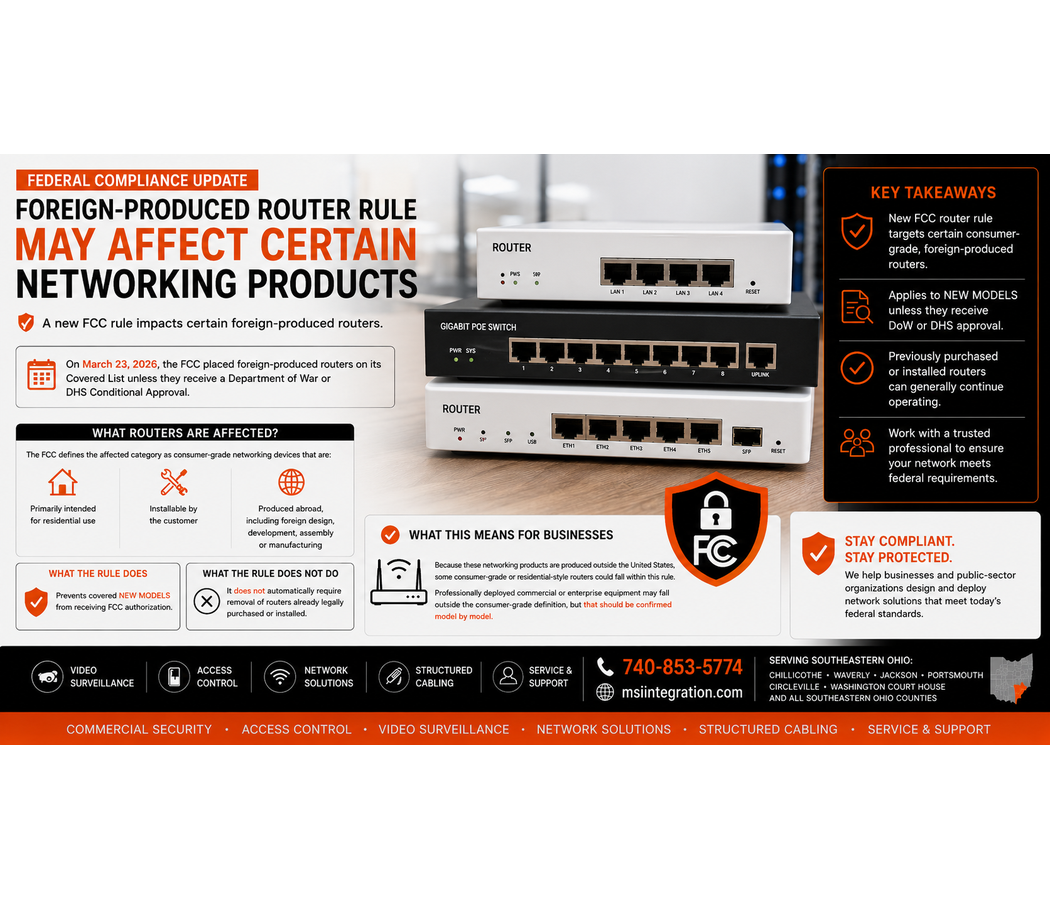
On March 23, 2026, the Federal Communications Commission announced the addition of routers produced in foreign countries to its Covered List, unless a router or class of routers receives a Conditional Approval from the Department of War or Department of Homeland Security.
However, there is an important distinction.
This rule should not automatically be interpreted as applying to every network switch, wireless bridge, commercial router, or other networking device manufactured outside the United States.
The FCC’s definition focuses on certain consumer-grade networking devices primarily intended for residential use and capable of being installed by the customer.
For commercial customers, that distinction matters.
At Midwest Security & Integration (MSI), we install commercial Wi-Fi, point-to-point wireless bridges, structured cabling, fiber, network infrastructure, security cameras, and access control throughout Southeastern Ohio.
As federal technology rules continue to change, businesses should understand how those changes may affect future equipment choices.
What Changed With the FCC Router Rule in 2026?
On March 23, 2026, the FCC added a new category to its Covered List involving:
Routers produced in a foreign country, except routers granted an applicable Conditional Approval.
The change is especially important for new equipment models that require FCC equipment authorization.
However, businesses should not interpret the rule as meaning every foreign-produced networking device already installed in the United States suddenly has to be removed.
Those are two very different issues.
What Does the FCC Mean by a Router?
This is one of the most important parts of understanding the rule.
When most people hear the word router, they may think of almost any device that helps move network traffic.
However, the definition connected to this FCC action is more specific.
It focuses on consumer-grade networking devices primarily intended for residential use that can be installed by the customer.
Therefore, headlines such as:
“All foreign-made networking equipment is banned.”
would be too broad.
The actual rule requires a more careful look at the equipment.
Does This Affect Commercial Networking Equipment?
This is where businesses need to be careful.
Networking manufacturers often produce many different types of equipment.
A manufacturer might offer:
- Residential routers
- Small-office equipment
- Commercial routers
- Enterprise networking equipment
- Network switches
- Outdoor wireless equipment
- Point-to-point wireless devices
- Industrial networking equipment
- ISP equipment
- Other specialized network hardware
Therefore, simply knowing that a networking product was produced outside the United States does not necessarily answer every regulatory question.
The specific product, intended use, classification, production, authorization status, and applicable rules can matter.
Why Did the Federal Government Take Action?
The federal action involves national-security and cybersecurity concerns related to certain foreign-produced consumer networking equipment.
Modern routers can play an important role in network security because they handle traffic moving between devices and networks.
A compromised networking device could potentially create serious cybersecurity risks.
For businesses, this is another reminder that network equipment should not be selected solely because it is inexpensive or easy to purchase.
Security, updates, support, intended use, and applicable requirements should also be considered.
What Does “Produced in a Foreign Country” Mean?
Determining where networking equipment is produced can be more complicated than simply reading where the final product was assembled.
As discussed in the federal determination, production can involve major stages such as:
- Manufacturing
- Assembly
- Design
- Development
Therefore, the country printed on a box may not always tell the entire story.
This is another reason businesses should avoid making assumptions about regulatory status based solely on a brand name or final assembly location.
Does My Business Have to Remove Its Existing Routers?
The March 2026 FCC action should not be described as a blanket order requiring every business to immediately remove previously purchased foreign-produced routers.
The equipment-authorization restrictions are particularly important for covered equipment seeking new FCC authorization.
Therefore, businesses should not panic and start removing working network infrastructure simply because they read a headline online.
Instead, businesses should determine:
- What equipment they currently have
- What each device actually does
- Whether it fits the applicable definition
- Whether the equipment already has authorization
- Whether new models are being purchased
- Whether government or contractual requirements apply
- Whether the project has additional compliance requirements
Those questions provide a much better starting point.
What Is a Conditional Approval?
The federal process provides a way for certain foreign-produced routers or classes of routers to receive a Conditional Approval.
According to the FCC guidance discussed in the original rule, the approval process involves review by the appropriate federal agency.
Manufacturers seeking approval may need to provide information about areas such as ownership, manufacturing, supply chains, software, firmware, components, and design.
Therefore, the regulatory status of a particular product or product class can potentially change.
That is another reason MSI does not want to make broad claims about individual manufacturers.
Are Commercial Wireless Bridges Considered Consumer Routers?
Not automatically.
This distinction can be important for commercial customers.
Businesses sometimes need professional wireless equipment to connect:
- A main building to a detached warehouse
- Two commercial buildings
- A parking lot to a main facility
- Remote security cameras
- Equipment yards
- Temporary work sites
- Construction locations
- Areas where trenching is difficult
- Other distant network locations
A professionally deployed point-to-point wireless device is not automatically the same thing as a consumer-grade residential router.
Therefore, businesses should avoid assuming that every foreign-produced wireless networking device automatically falls into the same regulatory category.
What About Commercial Network Switches?
The same caution applies when discussing network switches.
A commercial Ethernet or PoE switch should not automatically be called a consumer-grade residential router simply because it connects network devices.
Network equipment can serve very different purposes.
For example, a PoE switch may provide network connectivity and power to:
- IP security cameras
- Wireless access points
- Access control equipment
- VoIP phones
- Other compatible network devices
The product’s actual function and applicable regulatory classification matter.
Why This Matters for Commercial Security Cameras
Modern commercial security cameras often rely heavily on network infrastructure.
An IP surveillance system may include:
- IP cameras
- Ethernet cabling
- PoE switches
- Routers
- Fiber
- Wireless bridges
- Network switches
- NVRs or servers
- Internet connectivity
- Cloud services
Therefore, security camera performance depends on more than the cameras themselves.
A high-quality security camera can still experience problems if the network behind it is poorly designed.
That is why Midwest Security & Integration (MSI) approaches commercial surveillance as a complete system.
We don’t simply mount cameras.
We also consider the infrastructure connecting them.
Government Projects May Require Additional Review
Government and public-sector customers should pay particular attention to equipment requirements.
A private retail store may have different requirements than a:
- County facility
- Municipal building
- Government office
- Public-safety facility
- Public park
- Utility
- Critical-infrastructure location
- Other publicly funded project
In addition to FCC requirements, a project may have federal procurement rules, contract requirements, cybersecurity standards, funding requirements, or customer-specific equipment requirements.
Therefore, compliance-sensitive equipment should be reviewed before it is purchased and installed.
Should Businesses Stop Buying Foreign-Produced Networking Equipment?
The March 2026 FCC action should not be reduced to a simple statement that every business should stop purchasing all networking equipment produced outside the United States.
The rule is more specific than that.
Instead, businesses should evaluate equipment based on factors such as:
What is the device?
What is it designed to do?
Is it primarily a consumer residential product?
Is it professionally installed commercial equipment?
Where and how was it produced?
Does it require FCC authorization?
Does it have the required authorization?
Is there an applicable Conditional Approval?
Are government or contractual requirements involved?
This approach avoids treating every networking product as if it falls into the same category.
Why Equipment Selection Matters for Businesses
The lowest-priced networking device is not always the best long-term choice.
Businesses should consider:
- Cybersecurity
- Reliability
- Manufacturer support
- Firmware updates
- Network capacity
- Commercial suitability
- Environmental requirements
- Future expansion
- Equipment authorization
- Project-specific compliance
For some commercial projects, the network may support security cameras, access control, Wi-Fi, phones, computers, cloud applications, and other important systems.
Therefore, network infrastructure deserves careful planning.
Commercial Network Installation in Chillicothe and Ross County
Midwest Security & Integration (MSI) provides professional commercial network installation throughout Chillicothe and Ross County, Ohio.
Our services include commercial Wi-Fi, structured cabling, fiber, wireless bridges, security camera networking, access control infrastructure, and other commercial network solutions.
Commercial Wi-Fi in Waverly and Pike County
MSI also serves businesses throughout Waverly and Pike County, Ohio.
Whether your business needs connectivity for security cameras, warehouses, detached buildings, offices, parking areas, or other commercial locations, MSI can design the infrastructure around the property.
Business Network Installation in Jackson, Ohio
Businesses throughout Jackson and Jackson County, Ohio can contact Midwest Security & Integration for commercial networking and low-voltage infrastructure.
We provide structured cabling, commercial Wi-Fi, professional wireless connectivity, security cameras, and access control infrastructure.
Commercial Networking in Portsmouth and Scioto County
MSI provides commercial networking throughout Portsmouth and Scioto County, Ohio.
For large commercial properties, remote buildings, industrial sites, parking areas, and other challenging locations, we can evaluate wired, fiber, and professional wireless options.
Commercial Wi-Fi in Circleville and Washington Court House
Midwest Security & Integration also serves businesses throughout Circleville and Washington Court House, Ohio.
Our services include commercial networking, Wi-Fi, structured cabling, fiber, security cameras, access control, and professional wireless connectivity.
Commercial Networking Throughout Southeastern Ohio
Midwest Security & Integration (MSI) provides commercial network infrastructure throughout Southeastern Ohio.
Our service area includes:
- Ross County — Chillicothe
- Pike County — Waverly
- Jackson County — Jackson
- Scioto County — Portsmouth
- Athens County — Athens
- Gallia County — Gallipolis
- Hocking County — Logan
- Lawrence County — Ironton
- Meigs County — Pomeroy
- Monroe County — Woodsfield
- Morgan County — McConnelsville
- Noble County — Caldwell
- Perry County — New Lexington
- Vinton County — McArthur
- Washington County
We also serve Circleville, Washington Court House, and surrounding Southern and Southeastern Ohio communities.
What Types of Organizations Does MSI Serve?
Midwest Security & Integration works with commercial and public-sector properties throughout Southeastern Ohio, including:
- Retail stores
- Grocery stores
- Gas stations
- Convenience stores
- Restaurants
- Car dealerships
- Warehouses
- Manufacturing facilities
- Industrial properties
- Commercial offices
- Government facilities
- Healthcare facilities
- Parks
- Storage facilities
- Construction sites
- Road construction projects
- Temporary work sites
- Equipment yards
- Utilities
- Multi-location businesses
Because every property is different, MSI designs the network around the customer’s actual needs.
More Than Commercial Wi-Fi
Midwest Security & Integration (MSI) provides complete commercial security and low-voltage infrastructure, including:
- Commercial Wi-Fi installation
- Point-to-point wireless bridges
- Structured cabling installation
- Fiber connectivity
- Network infrastructure
- Commercial security camera installation
- NVR systems
- Cloud video surveillance
- VSaaS
- Commercial access control
- PTZ cameras
- License plate cameras
This allows MSI to consider how the network, cameras, access control, Wi-Fi, and cabling work together.
What Should Ohio Businesses Do About the 2026 FCC Router Rule?
The most important thing is to avoid broad assumptions.
The FCC’s March 2026 action involves foreign-produced routers, while the incorporated definition focuses on certain consumer-grade networking devices primarily intended for residential use and installable by the customer.
Therefore, businesses should evaluate equipment based on the specific product and application, not simply the manufacturer’s name or country associated with the brand.
This is particularly important for professionally deployed commercial, enterprise, ISP, outdoor wireless, and network infrastructure.
Federal requirements can also change. Therefore, businesses involved in government, public-sector, federally funded, or other compliance-sensitive projects should confirm the current rules that apply to the specific project and equipment before purchasing.
Midwest Security & Integration (MSI) will continue paying attention to federal developments as we design commercial networking, security camera, access control, Wi-Fi, fiber, and structured cabling systems throughout Southeastern Ohio.
For the official federal information behind this change, businesses can review the FCC’s March 23, 2026 Public Notice.
Check us out here: Midwest Security & Integration (MSI)
Call MSI: 740-853-5774