When Should a Business Replace or Upgrade Its Security Camera System?
Having cameras doesn’t necessarily mean you have useful evidence.
Many businesses already have security cameras. The cameras may have been installed five, eight, or even ten years ago. They still show pictures on a monitor, so everyone assumes the system is doing its job.
Then something happens.
A vehicle enters the parking lot, but the image is too blurry to provide useful details. Someone walks through an entrance, but the video doesn’t show enough detail. An incident happens at night, but the recording is dark and unclear.
At that point, the business discovers an important difference:
Having video and having useful video are not the same thing.
At Midwest Security & Integration (MSI), we help businesses throughout Southeastern Ohio evaluate, upgrade, and replace older commercial security camera systems.
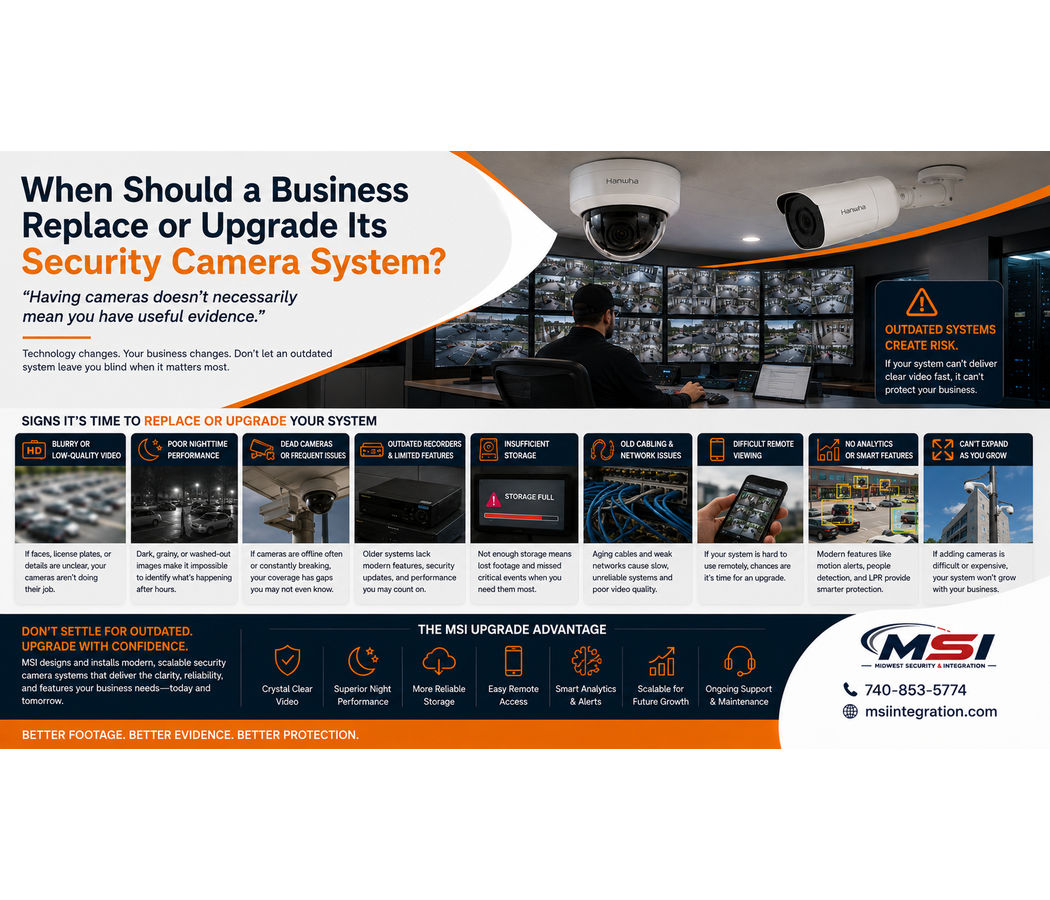
Here are some of the biggest signs that it may be time to upgrade yours.
1. Your Security Camera Footage Is Blurry
This is one of the clearest signs of an outdated or poorly designed system.
You can see that something happened, but you cannot see enough detail to understand exactly what happened.
For example, you may see a person enter the building. However, the recorded image may provide very little useful detail.
Likewise, you may see a vehicle in your parking lot but struggle to identify important details about it.
Older cameras often have much lower resolution than modern commercial cameras. In addition, poor lenses, bad placement, and older recording equipment can reduce image quality.
If you constantly have to zoom into blurry recordings, it may be time to evaluate the system.
2. Your Nighttime Video Is Poor
A camera can look great at noon and perform poorly at midnight.
Unfortunately, nighttime is when many businesses need dependable surveillance the most.
Parking lots, loading docks, gas stations, equipment yards, employee entrances, construction sites, and building perimeters can become much harder to monitor after dark.
Older cameras may struggle with:
- Low-light conditions
- Vehicle headlights
- Bright exterior lights
- Dark parking lots
- Reflections
- Changing weather
- Long-distance coverage
Modern commercial cameras can provide much better low-light performance.
However, the camera itself is only part of the solution. Lighting, mounting position, lens choice, distance, and camera settings also matter.
Therefore, an upgrade should include proper system design instead of simply replacing one old camera with one new camera.
3. Cameras Keep Going Offline
Do you have cameras that work sometimes and disappear at other times?
Maybe one camera has been dead for months.
Another may lose connection every few days.
Eventually, employees become used to seeing blank squares on the monitor.
That should not become normal.
A dead camera creates a gap in your coverage. Unfortunately, you may not realize how important that camera was until an incident occurs in that exact area.
The problem may involve the camera itself. However, it could also involve power, cabling, network switches, connectors, or other infrastructure.
At Midwest Security & Integration (MSI), we look beyond the camera to find the cause of the problem.
4. Your Recorder Is Outdated
The cameras are only one part of a surveillance system.
Your NVR, server, or recording platform also matters.
Older recorders may limit the resolution of newer cameras. They may also have limited storage, outdated software, slow playback, or poor remote-access options.
In addition, an older recorder may not support modern AI cameras or newer video technology.
Sometimes replacing a few cameras makes sense.
In other cases, the recording platform has become the biggest limitation.
A professional system evaluation can help determine whether part of the system can stay or whether a larger upgrade makes more sense.
5. You Don’t Have Enough Video Storage
How far back can you review your security footage?
Seven days?
Fourteen days?
Thirty days?
Many businesses do not know until they need a recording.
For example, you may discover an inventory problem several weeks after it happened. If the recorder only stores ten days of video, the footage you need may already be gone.
Adding more cameras or increasing camera resolution can also reduce retention if storage capacity stays the same.
For that reason, video storage should match your actual retention goals.
Many businesses choose goals such as 30, 60, or 90 days, depending on their needs.
However, there is no single retention period that works for every business.
MSI can calculate storage based on camera count, resolution, recording settings, and desired retention.
6. Your Existing Cabling Is Causing Problems
Older cabling can become another weak point.
Commercial IP cameras rely on the network infrastructure behind them.
Damaged cable, poor terminations, outdated infrastructure, bad connectors, and other issues can cause unreliable camera connections.
Simply replacing the camera may not fix the real problem.
That is why MSI evaluates the infrastructure supporting the system.
We provide professional structured cabling installation and network infrastructure in addition to commercial security cameras.
When needed, we can help upgrade the foundation behind the cameras.
7. Remote Viewing Is Difficult or Unreliable
Business owners and managers increasingly expect to access their cameras remotely.
If viewing your cameras from a phone or computer is slow, unreliable, or difficult to use, your current platform may be showing its age.
Modern commercial surveillance systems can provide much better remote-access options.
Depending on the platform, authorized users may be able to view live cameras, review recorded video, manage multiple locations, and search events remotely.
Cloud-based video surveillance and VSaaS (Video Surveillance as a Service) can provide additional options for businesses that want easier remote management.
However, traditional NVR systems can also provide remote access.
The right platform depends on the business.
8. Your System Has No Modern Video Analytics
Older security cameras mainly did one thing:
They recorded video.
Modern commercial cameras can do much more.
Depending on the camera and software, AI video analytics can help distinguish between people, vehicles, and other objects.
This can make recorded video easier to search and review.
For example, instead of manually searching through hours of footage, compatible analytics may help an authorized user narrow down events involving people or vehicles.
At MSI, we work with professional commercial surveillance technology, including Hanwha Vision, and can help businesses determine where AI features provide real value.
Not every camera needs advanced analytics. However, businesses using older systems may be surprised by what modern commercial video surveillance can do.
9. You Have Major Blind Spots
Your business may have changed since the original camera system was installed.
Maybe you added another entrance.
Perhaps the parking lot expanded.
You may have changed the layout of your store or warehouse.
New shelving, walls, equipment, inventory racks, buildings, and outdoor structures can create blind spots that did not exist before.
Therefore, an older camera layout may no longer match the property.
A system upgrade provides an opportunity to look at the entire facility again.
Instead of automatically putting new cameras where the old ones were, MSI can evaluate whether those locations still make sense.
10. Your Current System Cannot Expand
Businesses grow.
Your security system should be able to grow with you.
Unfortunately, some older systems have little or no room for expansion.
The recorder may have no open camera channels. The network switch may be full. Storage may already be at its limit.
As a result, adding one new camera can turn into a much larger problem.
Future expansion should be part of the system design.
At Midwest Security & Integration (MSI), we consider what the business needs today and what it may need tomorrow.
That can make future upgrades much easier.
11. Your Parking Lot Cameras Don’t Provide Enough Detail
Parking lots are especially difficult to cover.
An older camera may show that vehicles are present without providing enough detail to make the video useful.
Distance, lighting, lens selection, camera height, resolution, and viewing angle all matter.
If vehicle identification is important, the property may need cameras designed around specific areas.
For example, a business may use wide-angle cameras for general parking lot coverage while using another camera at the entrance or exit for more detailed vehicle views.
If license plate capture matters, a dedicated license plate camera or LPR solution may also be appropriate.
Should You Replace the Entire Security Camera System?
Not always.
An upgrade does not automatically mean everything needs to be removed.
Some existing infrastructure may still work well.
For example, certain network equipment, cabling, camera locations, or other components may still be useful.
In other situations, the existing system may be too outdated to provide a good foundation for modern equipment.
The right answer depends on the property.
That is why MSI starts by looking at what you already have.
We can then determine what may be worth keeping, what needs improvement, and what should be replaced.
Don’t Replace Old Cameras Without Fixing the Original Problems
Replacing an old camera with a newer camera does not automatically create a better security system.
If the original camera was installed in the wrong location, putting a new camera in the same place may create the same problem.
Likewise, a new camera cannot fix bad network cabling or poor system design.
A proper upgrade should ask:
What are we trying to see?
Where are our current blind spots?
What does the property look like at night?
How much video do we need to keep?
Do we need better remote access?
Would AI analytics help us?
Do we need license plate capture?
Will we add more cameras later?
Those questions help turn an equipment replacement into a real system upgrade.
Modern Commercial Security Is More Than Cameras
A security camera upgrade may also be a good time to evaluate the rest of your technology infrastructure.
Midwest Security & Integration (MSI) provides commercial solutions including:
- Commercial security camera installation
- Security camera system upgrades
- Hanwha Vision security cameras
- AI video analytics
- PTZ cameras
- License plate cameras
- NVR video recording
- Cloud video surveillance
- VSaaS
- Access control installation
- Commercial Wi-Fi
- Point-to-point wireless networking
- Structured cabling installation
- Network infrastructure cabling
This allows us to look at the entire system instead of simply replacing cameras one at a time.
What Types of Businesses Can Upgrade Their Security Cameras?
Nearly any commercial property with an older surveillance system may benefit from an evaluation.
Midwest Security & Integration (MSI) works with retail stores, grocery stores, gas stations, convenience stores, restaurants, car dealerships, warehouses, manufacturing plants, industrial facilities, schools, government buildings, parks, healthcare facilities, offices, apartment properties, storage facilities, construction sites, road construction projects, temporary work sites, utilities, and many other commercial environments.
Different businesses have different priorities.
A retail store may need better coverage around registers and entrances.
Meanwhile, a warehouse may need improved loading dock and inventory coverage.
A gas station may need better nighttime parking lot video.
An industrial facility may need cameras across several buildings or large outdoor areas.
That is why every upgrade should start with the needs of the property.
Security Camera System Upgrades in Southeastern Ohio
If you are searching for commercial security camera upgrades, security camera replacement, business security camera installation, or commercial video surveillance in Southeastern Ohio, Midwest Security & Integration can help.
MSI proudly serves businesses and organizations throughout Chillicothe, Waverly, Jackson, Portsmouth, Circleville, Washington Court House, Athens, Gallipolis, Logan, Ironton, McArthur, Pomeroy, New Lexington, Caldwell, Woodsfield, McConnelsville, Marietta, and surrounding Southeastern Ohio communities.
Our service area also includes Ross County, Pike County, Jackson County, Scioto County, Athens County, Gallia County, Hocking County, Lawrence County, Meigs County, Monroe County, Morgan County, Noble County, Perry County, Vinton County, Washington County, and surrounding areas.
Having Cameras Doesn’t Mean You Have Useful Evidence
Your security cameras should provide more than boxes on a monitor.
When something happens, you want video that can actually help you understand the event.
If your current system has blurry footage, poor nighttime images, dead cameras, limited storage, outdated recording equipment, difficult remote viewing, old cabling, major blind spots, or no room for expansion, it may be time for an upgrade.
Midwest Security & Integration (MSI) can evaluate your existing commercial security camera system and help determine what should stay, what should change, and how the system can improve.
You may not need to replace everything.
You need a system designed to provide useful video when it matters.
Whether you need commercial security camera upgrades, access control, commercial Wi-Fi, structured cabling, or network infrastructure, MSI provides professional commercial installation throughout Southeastern Ohio.
Check us out here: https://msiintegration.com/
Call Midwest Security & Integration (MSI): 740-853-5774