Security Cameras vs. Access Control: Why Businesses Often Need Both
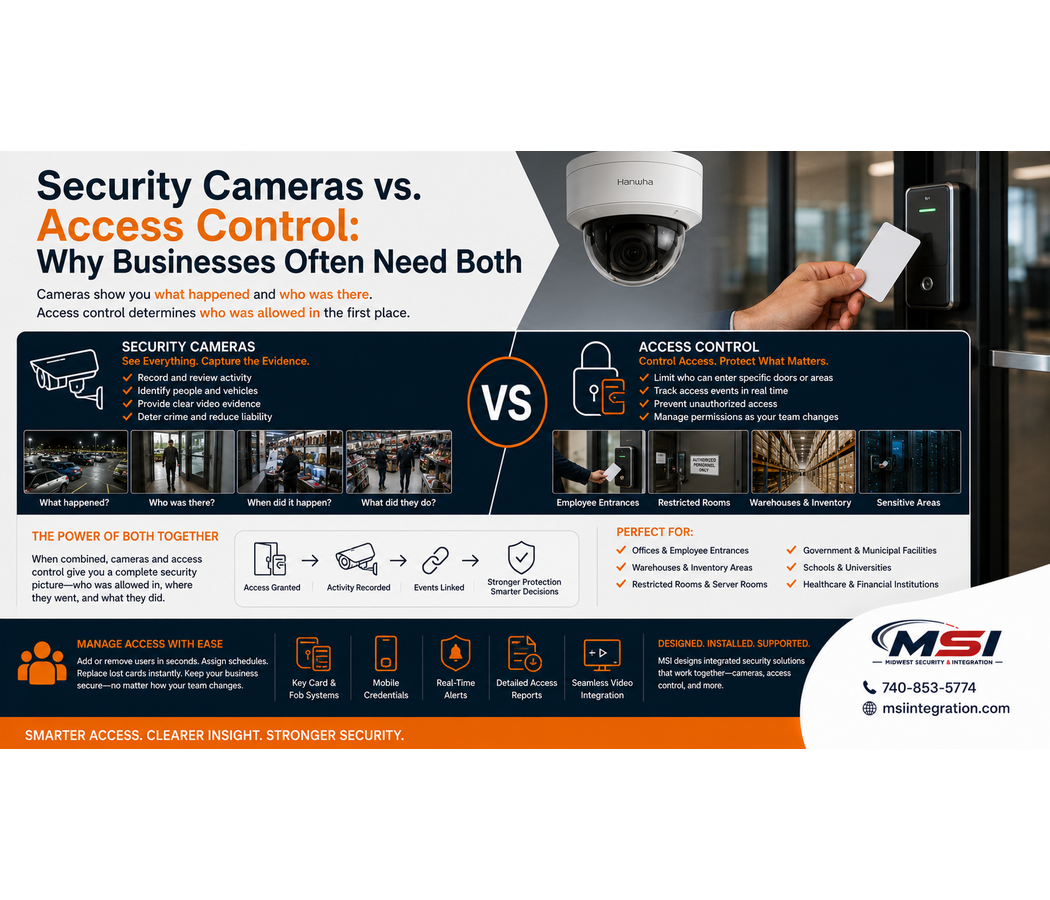
Security cameras and access control solve two different security problems.
A security camera can help answer:
What happened, and who was there?
An access control system helps answer:
Who should be allowed through this door in the first place?
For many businesses, the strongest solution is not choosing one or the other. Instead, security cameras and access control can work together as part of a complete commercial security system.
At Midwest Security & Integration (MSI), we install commercial security cameras and access control systems throughout Southeastern Ohio. We design these systems around the way each business operates.
What Do Commercial Security Cameras Do?
Security cameras provide visual information.
They can help businesses monitor entrances, parking lots, warehouses, registers, inventory areas, loading docks, employee entrances, and other important locations.
If an incident occurs, recorded video can help management understand what happened.
For example, a camera may show:
- Who entered an area
- When someone arrived
- What happened near a doorway
- Vehicle activity
- Employee or customer activity
- Movement around inventory
- Events in a parking lot
However, cameras generally do not control whether someone can open a door.
That is where access control comes in.
What Is a Commercial Access Control System?
A commercial access control system manages who can enter specific doors or areas.
Instead of giving every employee a traditional metal key, a business can use credentials such as key cards, key fobs, or other supported access methods.
The system then determines whether that credential has permission to unlock the door.
This gives businesses more control over access to their property.
For example, an employee may have permission to enter the main employee entrance but not a server room or another restricted area.
Access permissions can be designed around the needs of the organization.
Why Are Traditional Keys a Problem for Businesses?
Traditional keys are simple, but they can create problems.
Employees lose keys.
Keys get copied.
Former employees may forget to return them.
In addition, businesses may not know exactly how many copies exist.
When an important key goes missing, the company may need to replace locks or rekey doors.
Access control can provide another option.
If an employee loses a card or fob, an authorized administrator can typically disable that credential in the system.
A new credential can then be issued without replacing the physical lock simply because one credential was lost.
Access Control Can Help With Employee Turnover
Employee turnover is another reason businesses consider electronic door access.
Imagine an organization with dozens or hundreds of employees.
Over time, employees leave and new employees start.
Managing traditional keys can become difficult.
With a properly designed access control system, businesses can manage credentials electronically.
When an employee leaves, authorized management can remove or disable that employee’s access.
Likewise, a new employee can receive permissions based on the areas they need to enter.
This can make access management much easier for growing organizations.
Employee Entrances Are a Great Place for Access Control
Employee entrances are one of the most common locations for commercial access control.
Instead of leaving a rear employee door unlocked during business hours, authorized employees can use their credentials to enter.
This can help businesses keep certain doors secured while still allowing employees to move through them.
A security camera can also cover the same entrance.
As a result, the business gains two types of information.
The access control system can record the credential event, while the camera can provide video of the doorway.
Security Cameras and Access Control Work Well Together
This is where combining the two systems can become valuable.
Imagine an access control system records that an employee credential opened a door at 10:42 p.m.
The business may want to know more.
Who actually walked through the door?
Was the employee alone?
Did someone follow behind them?
What happened after the door opened?
Access control provides information about the credential event.
Meanwhile, video surveillance provides visual information.
When compatible systems and software support integration, authorized users may be able to review access events alongside related video.
This can provide much more context than either system alone.
Protect Restricted Rooms
Not every employee needs access to every room.
Businesses often have areas that should remain restricted.
These may include:
- Server rooms
- Network closets
- Inventory rooms
- Management offices
- Cash-handling areas
- Storage rooms
- Equipment rooms
- Maintenance areas
- Records rooms
- Utility rooms
Access control can help businesses decide which employees have permission to enter those areas.
Security cameras can then provide additional visibility around important entrances.
Together, they create multiple layers of security.
Access Control for Warehouses
Warehouses can have many access points.
Employees may use one entrance while delivery drivers use another. Loading docks may have separate doors, and high-value inventory may sit in restricted areas.
Because of this, warehouses can benefit from combining access control and video surveillance.
For example, a warehouse may use access control at employee entrances, management offices, inventory areas, and other restricted doors.
At the same time, cameras can cover loading docks, aisles, exterior areas, parking lots, and entrances.
This creates a more complete commercial security system.
Access Control for Offices
Office buildings may also benefit from electronic door access.
Not every visitor should have access to employee areas.
Likewise, certain departments may need more restricted access than others.
Access control can help separate public areas from employee-only areas.
Businesses can also create permissions based on job roles, departments, or other needs.
Meanwhile, security cameras can provide additional coverage around entrances, hallways, parking areas, and other important locations.
Access Control for Government Facilities
Government and public-sector facilities often have unique security requirements.
Different employees may need access to different areas. In addition, some rooms may contain records, equipment, technology, or other sensitive assets.
A properly designed commercial access control system can help manage those permissions.
Security cameras can add another layer by providing video coverage around entrances, restricted areas, parking lots, and other locations.
Midwest Security & Integration (MSI) works with commercial and government organizations throughout Southeastern Ohio to design systems around their individual requirements.
Protect Inventory Areas
Inventory can represent a major investment.
Retail stores, warehouses, manufacturing facilities, healthcare operations, and other businesses may have areas where access should remain limited.
Access control can restrict entry to authorized employees.
Meanwhile, cameras can provide video coverage of the doorway and surrounding area.
This combination can help management better understand both who had permission to enter and what happened around the area.
Create Different Access Levels
One advantage of electronic access control is the ability to create different permissions.
Not every employee needs the same level of access.
For example, a business may decide:
General employees can enter the main employee entrance.
Warehouse employees can also access shipping and receiving.
Managers can enter additional offices or inventory areas.
IT staff can access network and server rooms.
The exact setup depends on the organization.
This can provide much more control than giving everyone the same key.
Time-Based Access Can Add More Control
Depending on the system, businesses may also create access schedules.
For example, an employee may have permission to use a particular entrance during normal work hours.
Another employee may need access during overnight shifts.
Management may have broader access.
These permissions can help businesses manage how and when credentials work.
Again, the exact features depend on the access control platform and configuration.
What Happens When an Employee Loses a Key Card?
Lost credentials are still possible.
The difference is how the business responds.
If someone loses a traditional key, the business may not know who finds it or whether someone copied it.
With electronic access control, an authorized administrator can typically disable a lost credential.
A replacement can then be issued.
As a result, the company can manage the lost credential without automatically replacing every employee’s key or rekeying the entire door.
Access Logs Can Provide Useful Information
Commercial access control systems can also create event records.
Depending on the system, those records may show information such as when a credential was used and which controlled door received the request.
This can help authorized management review access activity.
However, an access log alone does not always tell the complete story.
A credential may identify which card was used. Video can provide additional context about what actually happened at the door.
That is another reason cameras and access control work well together.
Do You Need Access Control on Every Door?
Usually, no.
Just as every wall does not need a security camera, every door does not necessarily need electronic access control.
A professional system design should identify the doors that matter most.
These may include:
- Main employee entrances
- Rear entrances
- Management offices
- Inventory rooms
- Server rooms
- Network closets
- Restricted warehouse areas
- Equipment rooms
- Government offices
- Controlled interior areas
The right number of controlled doors depends on the business.
At MSI, we evaluate how people move through the property before designing the system.
Cameras Cannot Replace Access Control
Security cameras can provide valuable evidence.
However, they do not replace the need to control access.
A camera may record an unauthorized person entering a restricted room.
Access control is designed to help manage whether that person should have been able to open the controlled door in the first place.
Therefore, businesses should think about both sides of security:
Visibility and control.
Cameras provide visibility.
Access control provides control over selected entry points.
Access Control Cannot Replace Cameras Either
The opposite is also true.
An access control system may show that a credential opened a door.
However, it may not visually show who actually walked through it.
For example, someone could potentially follow an authorized employee through a door.
Video surveillance provides additional visual context.
For many commercial properties, using both technologies creates a stronger overall security strategy.
Your Network and Cabling Matter
Modern security cameras and access control systems rely on infrastructure.
Depending on the project, that may include network cabling, access control wiring, PoE switches, network equipment, equipment racks, fiber, wireless links, and other components.
Midwest Security & Integration (MSI) provides professional structured cabling and network infrastructure installation in addition to security cameras and access control.
That allows us to design the infrastructure behind the system instead of treating each device as a separate project.
More Than a Camera Installer
Commercial security involves more than mounting equipment.
A complete system may include:
- Commercial security cameras
- Access control
- Key card and credential systems
- Door controllers
- NVR video recording
- Cloud video surveillance
- VSaaS
- AI video analytics
- Commercial Wi-Fi
- Point-to-point wireless networking
- Structured cabling
- Network infrastructure
At Midwest Security & Integration (MSI), we approach these projects as a commercial security integrator.
Our goal is to determine how the different technologies can work together for the customer.
What Types of Businesses Can Benefit From Access Control?
Commercial access control can benefit many types of organizations.
MSI works with retail stores, grocery stores, gas stations, warehouses, manufacturing facilities, industrial properties, offices, schools, government facilities, healthcare facilities, apartment properties, storage facilities, utilities, construction operations, and many other commercial and public-sector environments.
A warehouse may use access control for employee entrances and inventory areas.
Meanwhile, an office may use it to separate public and employee areas.
A government facility may require several levels of controlled access.
Every property is different. Therefore, the system should match how the organization operates.
Commercial Access Control Installation in Southeastern Ohio
If you are searching for commercial access control in Ohio, business door access systems, key card systems in Ohio, or security cameras and access control in Southeastern Ohio, Midwest Security & Integration can help.
MSI proudly serves businesses and organizations throughout Chillicothe, Waverly, Jackson, Portsmouth, Circleville, Washington Court House, Athens, Gallipolis, Logan, Ironton, McArthur, Pomeroy, New Lexington, Caldwell, Woodsfield, McConnelsville, Marietta, and surrounding Southeastern Ohio communities.
Our service area also includes Ross County, Pike County, Jackson County, Scioto County, Athens County, Gallia County, Hocking County, Lawrence County, Meigs County, Monroe County, Morgan County, Noble County, Perry County, Vinton County, Washington County, and surrounding areas of Southeastern Ohio.
Security Cameras or Access Control? Many Businesses Need Both
Security cameras and access control are not competing technologies.
They solve different problems.
Security cameras help show what happened and who was there.
Access control helps manage who is allowed through a controlled door.
When used together, they can provide businesses with both visual information and better control over important entry points.
Midwest Security & Integration (MSI) can evaluate your property and design a commercial security solution around your doors, cameras, employees, restricted areas, network infrastructure, and future needs.
Whether you need commercial security cameras, access control, key card systems, commercial Wi-Fi, structured cabling, or network infrastructure, MSI provides professional commercial installation throughout Southeastern Ohio.
Check us out here: https://msiintegration.com/
Call Midwest Security & Integration (MSI): 740-853-5774