How Far Can a Security Camera Actually See?
If you are researching commercial security cameras in Southeastern Ohio, one of the most common questions is:
How far can a security camera actually see?
The answer depends on what you mean by “see.”
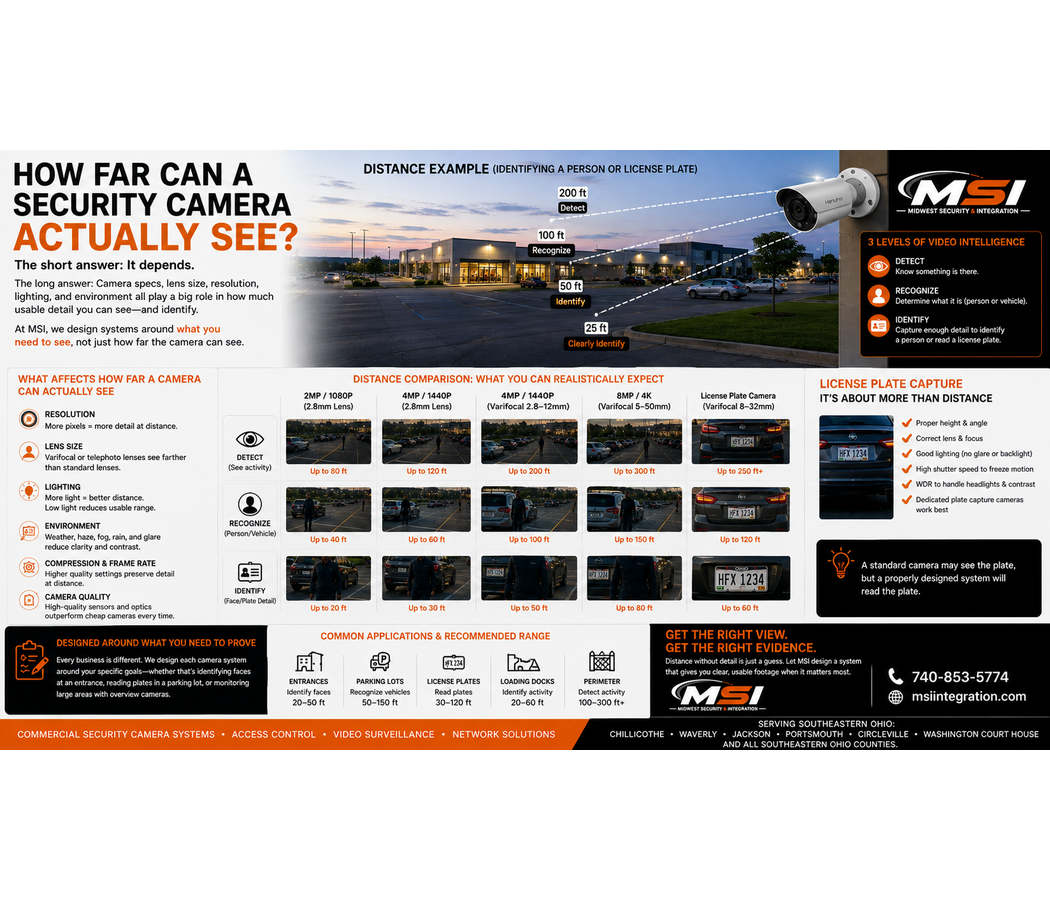
A camera may detect that a person or vehicle is present hundreds of feet away. However, that does not mean the camera can capture enough detail to identify a face, read a license plate, or show exactly what happened.
That difference is extremely important.
At Midwest Security & Integration (MSI), we design and install commercial security camera systems throughout Southeastern Ohio. When we evaluate camera distance, we do not ask only how far the camera can technically view.
We ask:
What do you need to identify at that distance?
How Far Can a Typical Security Camera See?
There is no single distance that applies to every camera.
A typical fixed commercial security camera may provide useful coverage across a room, storefront, entrance, parking area, or exterior property.
However, the usable distance depends on several factors:
- Camera resolution
- Lens size
- Field of view
- Camera height
- Lighting
- Sensor quality
- Image compression
- Target size
- Daytime or nighttime conditions
- Camera settings
A camera may clearly show a person at 100 feet.
However, the face may still be too small to identify.
That is why distance should always be connected to the purpose of the camera.
Seeing a Person Is Not the Same as Identifying a Face
This is one of the most important concepts in commercial video surveillance.
A camera may show:
“There is a person walking across the parking lot.”
That is detection.
A better camera angle or tighter lens may show:
“I can see the person’s clothing, build, and other details.”
That is better recognition.
However, if the goal is to identify a face, the person must usually occupy enough of the image for facial detail to be useful.
Therefore, a camera that “sees” 200 feet does not automatically provide useful identification at 200 feet.
This is why MSI designs cameras around specific goals instead of simply using the widest view possible.
Wide-Angle Cameras Cover More Area but Less Detail
Wide-angle cameras are useful for large areas.
For example, a wide-angle camera may cover:
- Retail sales floors
- Warehouses
- Parking lots
- Lobbies
- Loading areas
- Large rooms
The advantage is broad coverage.
The disadvantage is that people and vehicles farther away appear smaller in the image.
This can reduce useful detail.
For example, a camera may show an entire parking lot, but a person at the far end may only occupy a small number of pixels.
That makes identification much harder.
Varifocal and Zoom Lenses Can Improve Long-Distance Detail
A varifocal lens allows the installer to adjust the field of view.
This can help focus the camera on a specific area.
For example, instead of showing an entire parking lot, the camera can be adjusted toward a vehicle entrance.
The image becomes tighter.
As a result, vehicles and people in that area appear larger in the video.
This can improve useful detail.
However, the tradeoff is reduced overall coverage.
That is why camera design often involves balancing width and detail.
Why Megapixels Alone Do Not Determine Distance
A common mistake is assuming that a higher-resolution camera automatically sees farther.
Resolution helps.
However, it is only one part of the equation.
A high-megapixel camera with a very wide lens may still provide poor detail at long distances.
Likewise, a lower-resolution camera with a tighter lens may provide better detail in a specific target area.
Lens choice, sensor quality, lighting, shutter speed, placement, and compression all matter.
Therefore:
More megapixels do not automatically mean more usable distance.
Daytime Distance Is Different From Nighttime Distance
A camera may perform very well during the day and struggle after dark.
That is because nighttime creates additional challenges.
At night, there is less light available.
As a result, the camera may use slower shutter speeds or other exposure adjustments.
This can create motion blur.
In addition, headlights, infrared reflection, shadows, and poor exterior lighting can reduce useful detail.
Therefore, a camera that provides good facial detail at 100 feet during the day may not provide the same result at night.
That is why MSI considers both daytime and nighttime performance during system design.
Nighttime Lighting Matters
Outdoor lighting can significantly affect camera performance.
A well-lit parking lot can provide better nighttime image quality than a dark one.
However, lighting needs to be positioned correctly.
Poorly placed lights can create glare, bright spots, or deep shadows.
Vehicle headlights can also create difficult conditions.
A good security camera system should account for the actual lighting conditions at the property.
Parking Lots Are One of the Hardest Areas to Cover
Parking lots create several challenges at once.
They are large.
Vehicles move.
People may be far from the building.
Lighting changes.
Headlights can point toward the camera.
Weather can affect visibility.
As a result, one camera may not be enough.
A wide-angle camera may provide general coverage, while another camera may focus on entrances, exits, or high-value areas.
For larger properties, PTZ cameras, varifocal cameras, multi-sensor cameras, or dedicated vehicle cameras may also make sense.
When Does a PTZ Camera Make Sense?
A PTZ camera can pan, tilt, and zoom.
This can make it useful for large commercial areas.
Examples include:
- Large parking lots
- Industrial sites
- Campuses
- Parks
- Warehouses
- Manufacturing facilities
- Equipment yards
- Construction sites
A PTZ camera can zoom in on distant activity.
However, there is an important limitation.
A PTZ camera can only look in one direction at a time.
Therefore, it should not always replace fixed cameras.
A professional system may use fixed cameras for constant coverage and PTZ cameras for additional long-distance viewing.
When Does a Dedicated Camera Make More Sense?
Sometimes the best solution is not zooming farther.
It is adding a dedicated camera closer to the target.
For example, instead of asking one building-mounted camera to identify people 200 feet away, MSI may recommend another camera closer to the entrance, gate, or parking area.
This can provide better detail and more reliable evidence.
Dedicated cameras can also be useful for:
- License plates
- Employee entrances
- Loading docks
- Gates
- Cash registers
- Vehicle entrances
- High-value inventory
Each camera should have a clear purpose.
How Far Can a Camera See a License Plate?
License plate capture is different from general surveillance.
A camera may see a vehicle from a long distance.
However, reading the plate requires much more detail.
Distance, vehicle speed, angle, lighting, shutter speed, and lens choice all matter.
That is why businesses should not assume that a standard parking lot camera can capture readable plates at long distances.
If license plate identification matters, MSI can design a dedicated LPR or plate-capture solution.
Camera Height Affects Distance and Detail
Mounting height also changes what a camera can capture.
A camera mounted high may provide a large overview.
However, people and vehicles may appear smaller.
In addition, steep downward angles can reduce facial detail.
For identification, a lower and more controlled angle may provide better results.
That does not mean low mounting is always better.
The correct height depends on the camera’s purpose.
Long-Distance Coverage May Require Better Infrastructure
Sometimes a camera needs to be installed far from the main building.
For example, the best location may be:
- A parking lot pole
- Detached building
- Equipment yard
- Remote gate
- Construction area
- Storage building
In those situations, network connectivity becomes part of the design.
MSI may use:
- Structured cabling
- Fiber
- Point-to-point wireless bridges
- Outdoor network switches
- Remote PoE equipment
This is another reason commercial security systems require more than camera selection.
The network behind the camera matters.
Commercial Security Cameras in Chillicothe and Ross County
Midwest Security & Integration (MSI) installs commercial security cameras throughout Chillicothe and Ross County, Ohio.
Businesses in the Chillicothe area may need camera coverage for parking lots, entrances, warehouses, retail stores, government properties, industrial sites, or outdoor areas.
MSI can evaluate the property and determine the right camera type, lens, distance, and placement.
Security Camera Installation in Waverly and Pike County
MSI also serves Waverly and Pike County, Ohio.
For businesses with large parking lots, detached buildings, warehouses, gas stations, or industrial properties, we can design long-distance camera coverage around the real site conditions.
Commercial Security Cameras in Jackson, Ohio
Businesses throughout Jackson and Jackson County, Ohio can also contact MSI for commercial surveillance.
We provide system design for entrances, parking lots, loading docks, warehouses, employee areas, and other commercial locations.
Security Camera Installation in Portsmouth and Scioto County
MSI provides commercial security camera installation throughout Portsmouth and Scioto County, Ohio.
For large outdoor properties, MSI can evaluate options such as PTZ cameras, varifocal lenses, dedicated vehicle cameras, and remote network infrastructure.
Security Cameras in Circleville and Washington Court House
Midwest Security & Integration also serves businesses in Circleville and Washington Court House, Ohio.
Our commercial services include:
- Security camera installation
- Access control
- Commercial Wi-Fi
- Structured cabling
- Network infrastructure
- Wireless bridges
- Parking lot surveillance
Serving Businesses Throughout Southeastern Ohio
MSI proudly provides commercial security cameras in Southeastern Ohio.
Our service area includes:
- Ross County — Chillicothe
- Pike County — Waverly
- Jackson County — Jackson
- Scioto County — Portsmouth
- Athens County — Athens
- Gallia County — Gallipolis
- Hocking County — Logan
- Lawrence County — Ironton
- Meigs County — Pomeroy
- Monroe County — Woodsfield
- Morgan County — McConnelsville
- Noble County — Caldwell
- Perry County — New Lexington
- Vinton County — McArthur
- Washington County
We also serve Circleville, Washington Court House, and surrounding Southern and Southeastern Ohio communities.
What Types of Businesses Does MSI Serve?
Midwest Security & Integration (MSI) works with:
- Retail stores
- Grocery stores
- Gas stations
- Convenience stores
- Restaurants
- Car dealerships
- Warehouses
- Manufacturing facilities
- Industrial properties
- Government facilities
- Schools
- Parks
- Healthcare facilities
- Offices
- Apartment properties
- Storage facilities
- Construction sites
- Road construction projects
- Temporary work sites
- Equipment yards
- Utilities
Every property has different distance and coverage requirements.
That is why MSI designs systems around the site instead of using the same camera everywhere.
More Than Security Cameras
Midwest Security & Integration provides complete commercial technology solutions throughout Southeastern Ohio.
Our services include:
- Commercial security camera installation
- PTZ cameras
- Varifocal cameras
- License plate cameras
- Hanwha Vision cameras
- AI video analytics
- NVR systems
- Cloud video surveillance
- VSaaS
- Access control
- Commercial Wi-Fi
- Point-to-point wireless bridges
- Structured cabling
- Network infrastructure
This allows MSI to design both the cameras and the infrastructure supporting them.
So, How Far Can a Security Camera Actually See?
A security camera may be able to detect activity from a long distance.
However, the more important question is:
How far can it provide the detail you need?
There is a major difference between:
Seeing a person
and
Identifying a face
There is also a difference between:
Seeing a vehicle
and
Reading a license plate
The usable distance depends on lens choice, resolution, lighting, camera height, nighttime conditions, target size, and system design.
If your business needs long-distance coverage, do not choose cameras based only on megapixels or advertised range.
Midwest Security & Integration (MSI) can evaluate your property and design commercial security camera coverage around the actual distances and details your business needs.
Whether you need commercial security cameras, PTZ cameras, license plate cameras, access control, commercial Wi-Fi, structured cabling, or network infrastructure, MSI provides professional installation throughout Southeastern Ohio.
Check us out here: https://msiintegration.com/
Call Midwest Security & Integration (MSI): 740-853-5774