How Many Megapixels Do I Really Need for My Business Security Cameras?
If you are comparing commercial security cameras in Southeastern Ohio, you may be wondering whether your business needs 2MP, 4MP, 5MP, 8MP, or full 4K cameras.
The short answer is:
It depends on what you need the camera to see.
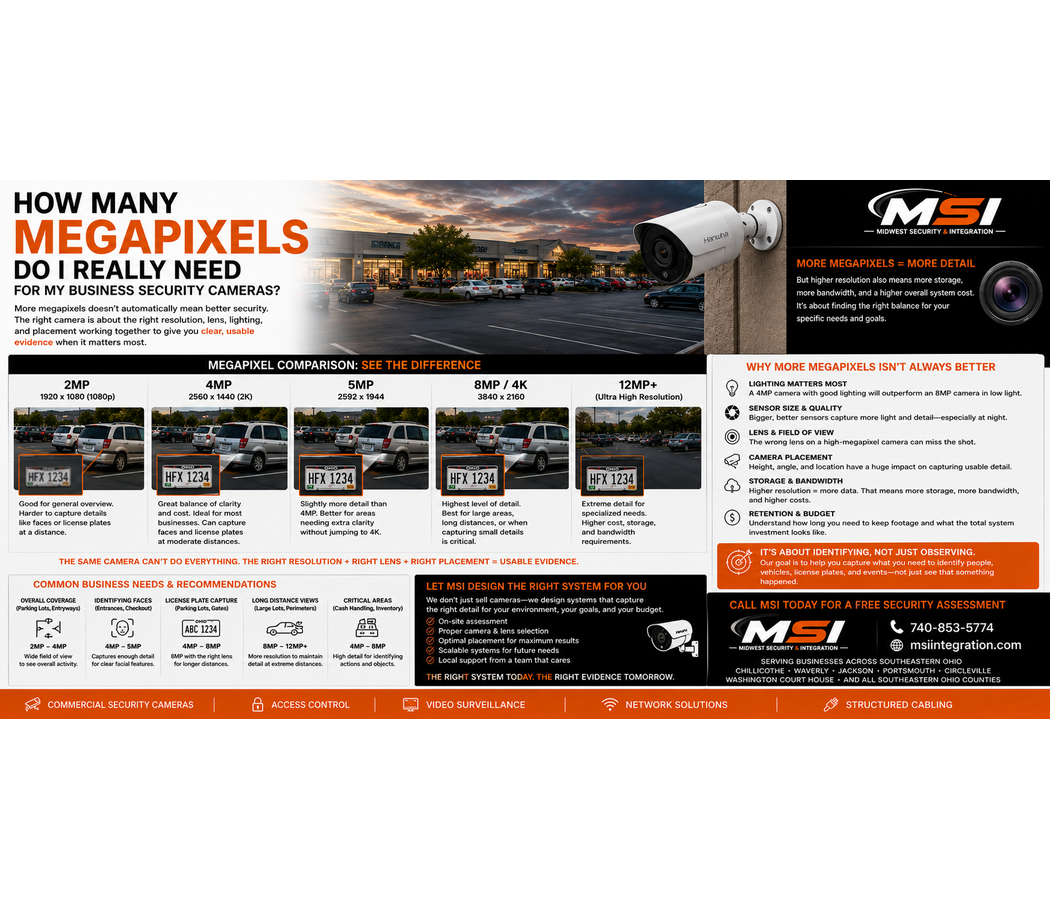
More megapixels can provide more image detail. However, more megapixels do not automatically mean a better security camera system.
A properly selected 4MP camera can sometimes provide more useful video than an 8MP camera if the lighting, sensor, lens, placement, and viewing distance are better suited to the location.
At Midwest Security & Integration (MSI), we design and install commercial security camera systems throughout Southeastern Ohio. Instead of choosing cameras based only on megapixel count, we look at the entire application.
What Does Megapixel Mean on a Security Camera?
A megapixel is approximately one million pixels.
Pixels are the tiny points that make up a digital image.
In general, a camera with more pixels can capture more image information.
Common security camera resolutions may include:
- 2MP
- 4MP
- 5MP
- 6MP
- 8MP
- 4K
An 8MP or 4K camera can provide significantly more resolution than a 2MP camera.
However, resolution is only one part of image quality.
More Megapixels Do Not Automatically Mean Better Video
This is one of the most important things business owners should understand.
A high-resolution camera can still produce poor video.
For example, an 8MP camera may struggle if:
- The area is too dark
- The lens is wrong
- The camera is mounted too high
- The target is too far away
- The sensor is small
- The shutter settings are poor
- Headlights or glare affect the image
- The camera is trying to cover too much area
Meanwhile, a properly selected 4MP camera may provide better usable detail in the same location.
That is why MSI does not choose cameras by megapixels alone.
When Is a 2MP Security Camera Enough?
A 2MP camera can still work well in certain commercial applications.
For example, it may provide useful coverage in:
- Small offices
- Hallways
- Utility rooms
- Certain indoor areas
- Small storage rooms
- Low-risk overview locations
If the viewing distance is short and the goal is general awareness, a 2MP camera may still meet the need.
However, businesses that need more detail may benefit from higher resolution.
When Does a 4MP Camera Make Sense?
A 4MP camera can offer a good balance between detail, storage, bandwidth, and low-light performance.
For many commercial applications, 4MP can provide excellent image quality.
It may work well for:
- Entrances
- Retail areas
- Offices
- Warehouses
- Loading docks
- Employee entrances
- Small parking areas
- Interior commercial spaces
A properly placed 4MP camera can provide very useful detail.
In some cases, it can even outperform a higher-resolution camera at night if the sensor and lens are better suited to the environment.
What About 5MP Security Cameras?
5MP cameras provide additional resolution over 4MP.
They can be useful in locations where more detail is needed without jumping all the way to 8MP or 4K.
For example, a 5MP camera may make sense in:
- Larger retail areas
- Warehouses
- Parking areas
- Entrances
- Inventory spaces
- Commercial outdoor locations
Again, the best choice depends on distance, lighting, and lens selection.
When Does 8MP or 4K Make Sense?
8MP or 4K cameras can provide excellent detail.
They can be useful where the business needs a wider view while still maintaining strong image resolution.
Examples may include:
- Large retail spaces
- Large parking lots
- Warehouses
- Manufacturing floors
- Building exteriors
- High-value areas
- Wide commercial entrances
However, 4K cameras also create more data.
That means storage, bandwidth, and network infrastructure need to support them.
Higher resolution should be selected because the application needs it—not simply because 4K sounds better.
Why a 4MP Camera Can Sometimes Beat an 8MP Camera
This may sound surprising.
However, there are situations where a 4MP camera can provide more useful video than an 8MP camera.
One reason is sensor size.
If two cameras use similar physical sensor sizes but one has twice as many pixels packed into that same space, each pixel may be smaller.
Smaller pixels can collect less light.
That can affect nighttime performance.
A well-designed lower-resolution camera with a strong sensor may therefore perform better in low-light conditions.
Sensor design varies by manufacturer and model, so the resolution number alone does not tell the whole story.
Sensor Size Matters
The image sensor is one of the most important parts of a camera.
It collects light and converts that light into the image you see.
A larger or higher-quality sensor can often perform better in difficult lighting conditions.
Therefore, businesses should not compare cameras based only on megapixels.
A high-resolution camera with a poor sensor may produce worse nighttime video than a lower-resolution camera with a better sensor.
This is especially important for outdoor commercial surveillance.
Nighttime Performance Is About More Than Resolution
Nighttime is where many security camera systems show their weaknesses.
A camera may look amazing at noon but struggle after dark.
Nighttime image quality can depend on:
- Sensor quality
- Lens quality
- Available light
- Infrared performance
- Shutter speed
- Camera placement
- Distance
- Headlights
- Reflections
- Resolution
A higher-resolution camera may need more light to create a clean image.
If the area is dark, the camera may increase exposure or use slower shutter speeds.
That can create motion blur.
As a result, an 8MP camera may produce a detailed image of a blurry person.
That is not useful evidence.
Seeing a Person Is Different From Identifying a Face
Megapixels can help with detail.
However, the camera still needs to be placed correctly.
A person standing 10 feet from a 4MP camera may provide more usable facial detail than someone standing 100 feet from an 8MP camera.
Distance matters.
Field of view matters.
Camera height matters.
Lens selection matters.
That is why MSI starts with the question:
What do you need to identify?
Then we select the camera.
Lens Selection Can Matter More Than Megapixels
The lens determines how wide or narrow the camera view is.
A wide-angle lens can cover more area.
However, people and vehicles farther away may appear smaller.
A tighter lens can provide more detail in a smaller target area.
For example, an 8MP camera with a very wide lens may show an entire parking lot.
However, a 4MP varifocal camera focused on the entrance may provide better detail of people walking through the door.
This is why lens selection is such an important part of commercial camera design.
Camera Placement Matters Too
Even the best camera can perform poorly if it is installed in the wrong location.
Common placement problems include:
- Mounting too high
- Looking directly into bright lights
- Trying to cover too much area
- Poor viewing angles
- Long target distances
- Obstructions
- Bad nighttime lighting
A camera may technically show the area while still failing to provide useful evidence.
MSI evaluates placement before choosing the final camera.
High Resolution Uses More Storage
More resolution creates more data.
That means higher-megapixel cameras generally require more storage when other settings remain similar.
For example, an 8MP camera may require more storage than a 4MP camera.
When dozens of cameras are involved, that difference can become significant.
Businesses should consider:
- Camera count
- Resolution
- Frame rate
- Recording method
- Retention period
- Compression
- Storage capacity
If your business wants 30, 60, or 90 days of recorded video, the storage system should be sized around the final camera design.
Higher Resolution Can Use More Bandwidth
Network bandwidth also matters.
Modern IP cameras send video across the network.
More high-resolution cameras can create more network traffic.
That means the switches, cabling, recorder, and network infrastructure should support the system.
At Midwest Security & Integration (MSI), we provide structured cabling and network infrastructure in addition to commercial security cameras.
This allows us to design the full system—not just the cameras.
Do I Need 4K Cameras Everywhere?
Usually, no.
Not every location needs the highest possible resolution.
For example, a small utility room may not need an 8MP camera.
A hallway may work perfectly well with 4MP.
Meanwhile, a large parking lot or warehouse may benefit from higher resolution.
The best system often uses different camera types for different locations.
That can improve performance while controlling storage and cost.
Security Cameras Should Be Selected by Purpose
A professional commercial camera system should answer:
What does this camera need to accomplish?
One camera may need to show a wide overview.
Another may need facial detail.
Another may need to cover a cash register.
Another may need to monitor a loading dock.
A different camera may need to capture license plates.
Each job may require a different resolution, lens, and camera type.
This approach works much better than simply installing 8MP cameras everywhere.
What About License Plate Cameras?
License plate capture is a specialized task.
More megapixels alone do not guarantee readable plates.
Vehicle speed, angle, distance, shutter speed, lighting, and lens selection all matter.
A dedicated license plate camera may need a tighter view and different settings than a normal parking lot camera.
If license plate capture matters, MSI can design that camera around the vehicle path.
What About PTZ Cameras?
PTZ cameras can pan, tilt, and zoom.
They can be useful for large parking lots, industrial properties, parks, campuses, and long-distance coverage.
A PTZ camera with optical zoom can provide detailed views of distant activity.
However, it only looks in one direction at a time.
Therefore, fixed cameras are often used for constant coverage while PTZ cameras provide additional flexibility.
Commercial Security Cameras in Chillicothe and Ross County
Midwest Security & Integration (MSI) installs commercial security camera systems throughout Chillicothe and Ross County, Ohio.
For businesses in Chillicothe, we can help determine whether 2MP, 4MP, 5MP, 8MP, or other camera options make sense based on the property.
We work with retail stores, gas stations, warehouses, industrial facilities, offices, government properties, and other commercial locations.
Security Camera Installation in Waverly and Pike County
MSI also serves Waverly and Pike County, Ohio.
Businesses in the Waverly area can contact MSI for commercial security camera installation, access control, structured cabling, commercial Wi-Fi, and network infrastructure.
Commercial Security Cameras in Jackson, Ohio
Businesses throughout Jackson and Jackson County, Ohio can also turn to Midwest Security & Integration for professional commercial surveillance.
We design systems around the actual camera requirements—not just megapixel numbers.
Security Camera Installation in Portsmouth and Scioto County
MSI provides commercial security camera installation throughout Portsmouth and Scioto County, Ohio.
For large parking lots, warehouses, industrial properties, and outdoor areas, we can evaluate resolution, lens choice, nighttime conditions, and long-distance coverage.
Commercial Security Cameras in Circleville and Washington Court House
Midwest Security & Integration also serves businesses in Circleville and Washington Court House, Ohio.
Our commercial services include:
- Security camera installation
- Access control
- Commercial Wi-Fi
- Structured cabling
- Network infrastructure
- Point-to-point wireless bridges
- Parking lot surveillance
Commercial Security Cameras Throughout Southeastern Ohio
MSI proudly provides commercial security cameras in Southeastern Ohio.
Our service area includes:
- Ross County — Chillicothe
- Pike County — Waverly
- Jackson County — Jackson
- Scioto County — Portsmouth
- Athens County — Athens
- Gallia County — Gallipolis
- Hocking County — Logan
- Lawrence County — Ironton
- Meigs County — Pomeroy
- Monroe County — Woodsfield
- Morgan County — McConnelsville
- Noble County — Caldwell
- Perry County — New Lexington
- Vinton County — McArthur
- Washington County
We also serve Circleville, Washington Court House, and surrounding Southern and Southeastern Ohio communities.
What Types of Businesses Does MSI Serve?
Midwest Security & Integration (MSI) works with:
- Retail stores
- Grocery stores
- Gas stations
- Convenience stores
- Restaurants
- Car dealerships
- Warehouses
- Manufacturing facilities
- Industrial properties
- Government facilities
- Schools
- Parks
- Healthcare facilities
- Offices
- Apartment properties
- Storage facilities
- Construction sites
- Road construction projects
- Temporary work sites
- Equipment yards
- Utilities
Each property has different image-quality requirements.
That is why we do not install the same camera everywhere.
More Than Commercial Security Cameras
Midwest Security & Integration provides complete commercial technology solutions throughout Southeastern Ohio.
Our services include:
- Commercial security camera installation
- Hanwha Vision cameras
- AI video analytics
- PTZ cameras
- License plate cameras
- NVR recording systems
- Cloud video surveillance
- VSaaS
- Access control
- Commercial Wi-Fi
- Point-to-point wireless bridges
- Structured cabling
- Network infrastructure
This allows us to design both the surveillance system and the technology behind it.
So, How Many Megapixels Does Your Business Really Need?
There is no single answer.
Some areas may work perfectly with 2MP.
Others may benefit from 4MP or 5MP.
Certain applications may justify 8MP or 4K.
The key is not to choose the biggest number.
The key is to choose the right camera for the job.
More megapixels do not automatically mean a better security camera system.
Sensor quality, lens selection, nighttime performance, distance, placement, storage, and network design all matter.
Midwest Security & Integration (MSI) can evaluate your property and design a commercial surveillance system around the image detail your business actually needs.
Whether you need commercial security cameras, PTZ cameras, license plate cameras, access control, commercial Wi-Fi, structured cabling, or network infrastructure, MSI provides professional commercial installation throughout Southeastern Ohio.
Check us out here: https://msiintegration.com/
Call Midwest Security & Integration (MSI): 740-853-5774