How Much Does an Access Control System Cost for a Business?
If you’re researching the cost of commercial access control in Southeastern Ohio, you’ve probably discovered that it’s difficult to find one simple price.
There’s a reason for that.
Commercial access control is not priced by the card reader alone.
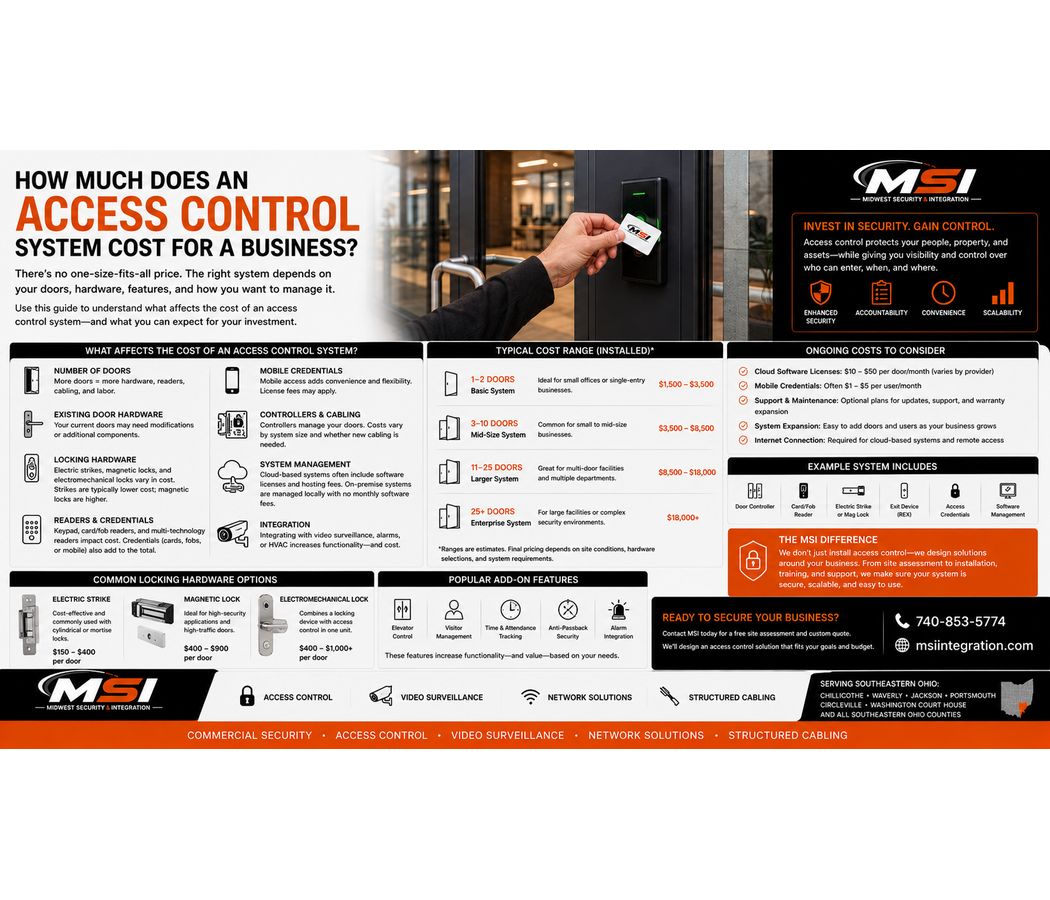
The number of doors, existing locks, door condition, electric locking hardware, readers, controllers, credentials, cabling, network infrastructure, software, backup power, and installation requirements can all affect the final cost.
A simple one-door office installation can be very different from securing 20 doors throughout a warehouse, manufacturing facility, school, or government building.
At Midwest Security & Integration (MSI), we install commercial access control systems throughout Southeastern Ohio, including Chillicothe, Waverly, Jackson, Portsmouth, Circleville, Washington Court House, and surrounding communities.
Rather than guessing at a price, we evaluate the doors, determine what the business needs, and design the system around the property.
What Is a Commercial Access Control System?
Access control replaces or supplements traditional keys with electronically managed credentials.
Instead of giving every employee a physical key, a business may use:
- Key cards
- Key fobs
- Mobile credentials
- PIN codes
- Other electronic credentials
When an employee presents an authorized credential, the system checks whether that person has permission to enter.
If access is allowed, the system electronically releases the appropriate locking hardware.
Modern access-control platforms can support readers, controllers, cards, fobs, and mobile credentials. For example, HID offers reader technologies supporting several credential types, including cards, fobs, and mobile devices.
How Much Does Commercial Access Control Cost?
There isn’t one honest number that applies to every business.
The final commercial access control cost depends heavily on the property.
For example, two businesses may each want access control on four doors.
One building already has compatible commercial door hardware and accessible pathways for new cabling.
The other has older doors that require hardware modifications, long cable runs, new power supplies, and additional network infrastructure.
Both projects have four doors.
They can still be very different installations.
That is why MSI prefers evaluating the property before providing an accurate quote.
Number of Doors Is One of the Biggest Cost Factors
The first question is usually:
How many doors need access control?
A business may only need one employee entrance.
Another property may need controlled access at:
- Main entrances
- Employee entrances
- Offices
- Server rooms
- Inventory rooms
- Warehouses
- Maintenance areas
- Loading areas
- Restricted government areas
- IT rooms
- Equipment rooms
As the number of controlled doors increases, the project may require additional readers, locking hardware, controllers, power, cabling, and installation labor.
However, cost does not always increase at exactly the same amount per door.
Controller architecture itself can affect scalability and cost. HID notes that single-door controllers and traditional multi-door panel architectures can have different economics depending on the size of the installation.
Your Existing Door Hardware Matters
This is a major factor that customers sometimes overlook.
Access control is not simply a reader mounted beside a door.
The door itself matters.
Before designing the system, an installer may need to evaluate:
- Door type
- Existing lock
- Door frame
- Panic hardware
- Fire-rating requirements
- Existing power
- Door closer
- Request-to-exit requirements
- Door position monitoring
- Current condition of the door
A door that already has suitable commercial hardware may be easier to integrate than a door requiring extensive modifications.
Electric Strike vs. Magnetic Lock
The type of electronic locking hardware can also affect the project.
Two common technologies are electric strikes and electromagnetic locks, although they are not the only options.
Electric Strikes
An electric strike works with compatible mechanical locking hardware to electronically control entry.
Electric strikes can often integrate with existing commercial door hardware, depending on the application. ASSA ABLOY describes electric strikes as the connection between mechanical locks and electronic access-control systems, with options designed for many types of commercial doors.
Magnetic Locks
An electromagnetic lock, often called a maglock, uses an electromagnet and armature plate to secure the door.
Maglocks have different power, mounting, egress, life-safety, and door-hardware considerations.
The right solution depends on the specific opening.
The cheapest locking device is not automatically the correct locking device.
Door operation, security requirements, applicable codes, and safe egress all need to be considered.
Card and Fob Readers Affect Access Control Cost
The reader is the device employees interact with at the door.
Depending on the system, users may present:
- Proximity cards
- Smart cards
- Key fobs
- Mobile credentials
- Other supported credentials
Reader technology can vary significantly.
Some readers support older credential technologies, while modern multi-technology readers can support several credential types and make future upgrades easier. HID, for example, offers readers supporting multiple card technologies as well as mobile credentials.
The correct reader depends on the security level, existing credentials, budget, and future plans.
What Are Mobile Credentials?
Some modern access control platforms can allow an employee’s smartphone or compatible device to function as a credential.
Instead of carrying a traditional card or fob, an authorized employee may use a mobile credential to access the building.
This can provide convenience, especially for organizations that frequently add or remove employees.
However, mobile credential capabilities, licensing, compatibility, and recurring costs vary by platform.
Therefore, businesses should understand the complete cost before choosing a mobile-access solution.
Access Control Controllers Affect the Price
Behind the reader is another important component:
The controller.
The controller helps make access decisions and communicates with other parts of the system.
Depending on the architecture, one controller may support a single door or multiple doors.
Larger properties may require several controllers or panels.
The controller design affects:
- Number of supported doors
- Expansion capability
- Reader compatibility
- Network requirements
- Offline operation
- Integration
- Future upgrades
HID specifically identifies the number of doors, existing infrastructure, future expansion, protocols, and integration requirements as factors organizations should consider when selecting access-control controllers.
Cabling Is a Major Part of Commercial Access Control
Access control requires infrastructure.
Depending on the system, cabling may connect:
- Readers
- Controllers
- Door position switches
- Request-to-exit devices
- Electric locking hardware
- Power supplies
- Network equipment
Cable distance and installation difficulty matter.
Running cable through an open commercial ceiling may be very different from routing it through finished walls, concrete areas, or multiple floors.
This is one reason Midwest Security & Integration provides structured and infrastructure cabling in addition to access control.
We can install the system and the infrastructure supporting it.
Network Infrastructure May Be Required
Modern access control increasingly relies on network connectivity.
Controllers or management systems may communicate across the business network.
Therefore, the project may also involve:
- Ethernet cabling
- Network switches
- IP addressing
- Internet connectivity
- Network segmentation
- Remote management
- Cloud connectivity
A poorly designed network can create problems for an otherwise good access-control system.
At MSI, we already work with commercial networking, Wi-Fi, structured cabling, and security cameras, allowing us to consider the entire infrastructure.
Backup Power Can Affect System Design
Commercial access control also needs a plan for power interruptions.
Depending on the system and door requirements, backup power may be part of the design.
That can include battery-backed power supplies or UPS equipment for certain network and control components.
The correct solution depends on the system, locking hardware, required operation, and applicable life-safety requirements.
Cloud vs. Locally Managed Access Control
Businesses may also choose between locally managed and cloud-connected access-control platforms.
Locally Managed Access Control
A traditional system may keep much of its management infrastructure on the customer’s premises.
This can provide local control and may reduce certain recurring cloud costs.
Cloud Access Control
A cloud-connected platform can provide convenient remote management.
Authorized users may be able to manage employees, credentials, doors, schedules, and locations from a web-based platform.
Cloud systems may involve recurring software or service fees.
The right choice depends on how the business wants to manage its system.
Does Access Control Require a Monthly Fee?
Not every system does.
Some locally managed access-control systems may operate without a recurring cloud subscription.
Other platforms use recurring fees for services such as:
- Cloud management
- Mobile credentials
- Software licensing
- Remote administration
- Managed services
- Support
Therefore, businesses should ask exactly what is included.
A lower upfront price does not necessarily mean a lower long-term cost.
Likewise, a monthly subscription is not automatically a bad value if it includes services the business actually needs.
Access Control and Security Cameras Can Work Together
This is where access control becomes especially powerful.
Security cameras answer:
What happened?
Access control answers:
Who was authorized to use the door?
When systems support integration, access events and video can complement each other.
Imagine an employee credential opens a restricted warehouse door at 10:42 p.m.
The access-control system records the event.
The camera system can provide video from that area.
Instead of searching through hours of footage without context, authorized personnel may have more information to investigate what occurred.
The exact integration capabilities depend on the selected platforms.
Lost Keys Can Become Expensive
Traditional keys create another problem.
What happens when an employee loses a key?
Or leaves the company without returning it?
Depending on the property, the business may need to consider rekeying locks or accepting the risk that an uncontrolled key still exists.
Electronic credentials can make this easier.
If an employee leaves, an authorized administrator can typically disable that credential.
The company does not necessarily have to change the physical lock every time someone leaves.
Access Control Can Make Employee Changes Easier
Employee changes can create problems when a business relies only on traditional keys.
For example, a new employee may need access to several areas of the building. Instead of giving that person several physical keys, the business can issue one approved card, fob, or other supported credential.
If the employee changes positions, an authorized manager can update their access. As a result, the employee can gain access to new areas while losing access to locations they no longer need.
When an employee leaves the company, the business can disable that credential. Therefore, the former employee can no longer use it to enter controlled doors.
If someone loses a card or fob, the business can also disable it and issue a replacement.
This gives businesses more control over building access. In addition, it can reduce some of the problems that come with lost or unreturned physical keys.
Access Control Can Limit When Employees Enter
Businesses may also create access schedules.
For example, an employee may have permission to enter during normal business hours but not overnight.
Managers may have broader access.
Maintenance personnel may have access only to specific areas.
Different employees can have different permissions.
This can provide much more control than handing everyone the same physical key.
How Much Does Access Control Cost for Multiple Locations?
Multi-location businesses have additional considerations.
Imagine a company operating facilities in:
Chillicothe, Waverly, Jackson, and Portsmouth.
The business may want centralized management across all four locations.
A cloud-connected platform may simplify that process.
However, the final cost can depend on:
- Total doors
- Total users
- Number of locations
- Credentials
- Cloud licensing
- Internet connectivity
- Door hardware
- Controllers
- Installation requirements
This is why multi-site projects should be designed as complete systems.
Commercial Access Control in Chillicothe and Ross County, Ohio
Midwest Security & Integration (MSI) provides professional commercial access control installation in Chillicothe and Ross County, Ohio.
We work with businesses that want better control over employee entrances, offices, warehouses, inventory areas, restricted rooms, and other commercial doors.
If you’re searching for business access control in Chillicothe, key card systems in Ross County, or commercial door access systems in Southeastern Ohio, MSI can evaluate your property and provide a customized solution.
Access Control Installation in Waverly and Pike County
MSI also provides commercial access control in Waverly and Pike County, Ohio.
Businesses in the Waverly area can contact MSI for card readers, fob systems, controlled doors, security cameras, structured cabling, Wi-Fi, and network infrastructure.
Commercial Access Control in Jackson, Ohio
Businesses throughout Jackson and Jackson County, Ohio can turn to Midwest Security & Integration for professional access-control installation.
Whether you need one controlled employee entrance or multiple doors throughout a commercial property, MSI can design the system around your needs.
Access Control Systems in Portsmouth and Scioto County
MSI provides commercial access-control solutions throughout Portsmouth and Scioto County, Ohio.
We can design systems for offices, warehouses, industrial facilities, retail locations, government properties, healthcare environments, and other commercial applications.
Access Control in Circleville and Washington Court House
Midwest Security & Integration also serves businesses in Circleville and Washington Court House, Ohio.
Our commercial services include access control, security cameras, structured cabling, commercial Wi-Fi, point-to-point wireless networking, and network infrastructure.
Commercial Access Control Throughout Southeastern Ohio
Midwest Security & Integration (MSI) proudly provides commercial access control and security integration throughout Southeastern Ohio.
Our service area includes:
- Ross County — Chillicothe
- Pike County — Waverly
- Jackson County — Jackson
- Scioto County — Portsmouth
- Athens County — Athens
- Gallia County — Gallipolis
- Hocking County — Logan
- Lawrence County — Ironton
- Meigs County — Pomeroy
- Monroe County — Woodsfield
- Morgan County — McConnelsville
- Noble County — Caldwell
- Perry County — New Lexington
- Vinton County — McArthur
- Washington County
MSI also serves Circleville, Washington Court House, and surrounding Southern and Southeastern Ohio communities.
What Types of Businesses Need Access Control?
Midwest Security & Integration provides commercial security solutions for:
- Retail stores
- Grocery stores
- Gas stations
- Convenience stores
- Restaurants
- Car dealerships
- Warehouses
- Manufacturing facilities
- Industrial properties
- Government facilities
- Schools
- Parks and public facilities
- Healthcare facilities
- Commercial offices
- Apartment properties
- Storage facilities
- Construction sites
- Equipment yards
- Utilities
- Multi-location businesses
Access control can be particularly valuable anywhere a business needs to manage who can enter, which doors they can use, and when they are allowed access.
More Than Commercial Access Control
MSI provides complete commercial security and technology solutions throughout Southeastern Ohio.
Our services include:
- Commercial access control installation
- Card and fob systems
- Mobile credential solutions
- Commercial security camera installation
- Hanwha Vision security cameras
- NVR systems
- Cloud video surveillance
- VSaaS
- License plate cameras
- PTZ cameras
- Commercial Wi-Fi
- Point-to-point wireless bridges
- Structured cabling installation
- Network infrastructure
This allows MSI to design the door security, video surveillance, cabling, and network as a complete solution.
So, How Much Does an Access Control System Cost for a Business?
There isn’t one universal price.
The cost of commercial access control in Southeastern Ohio depends on the number of doors, existing hardware, locking hardware, readers, credentials, controllers, cabling, network requirements, software, backup power, installation difficulty, and ongoing services.
A one-door office system and a 30-door manufacturing facility should not be priced the same way.
More importantly, the cheapest system is not necessarily the best value.
A properly designed access-control system should meet today’s requirements while allowing the business to grow.
Midwest Security & Integration (MSI) can evaluate your doors and provide a professional access-control design based on your property, security needs, and budget.
If you’re looking for commercial access control in Chillicothe, Waverly, Jackson, Portsmouth, Circleville, Washington Court House, or anywhere throughout Southeastern Ohio, contact MSI for a free, no-obligation quote.
Check us out here: Midwest Security & Integration — msiintegration.com
Call Midwest Security & Integration (MSI): 740-853-5774