New FCC Power Inverter Rule in 2026: What Ohio Businesses Need to Know
Businesses, government agencies, security integrators, solar installers, and organizations using connected power equipment should be aware of an important FCC power inverter rule that took effect in 2026.
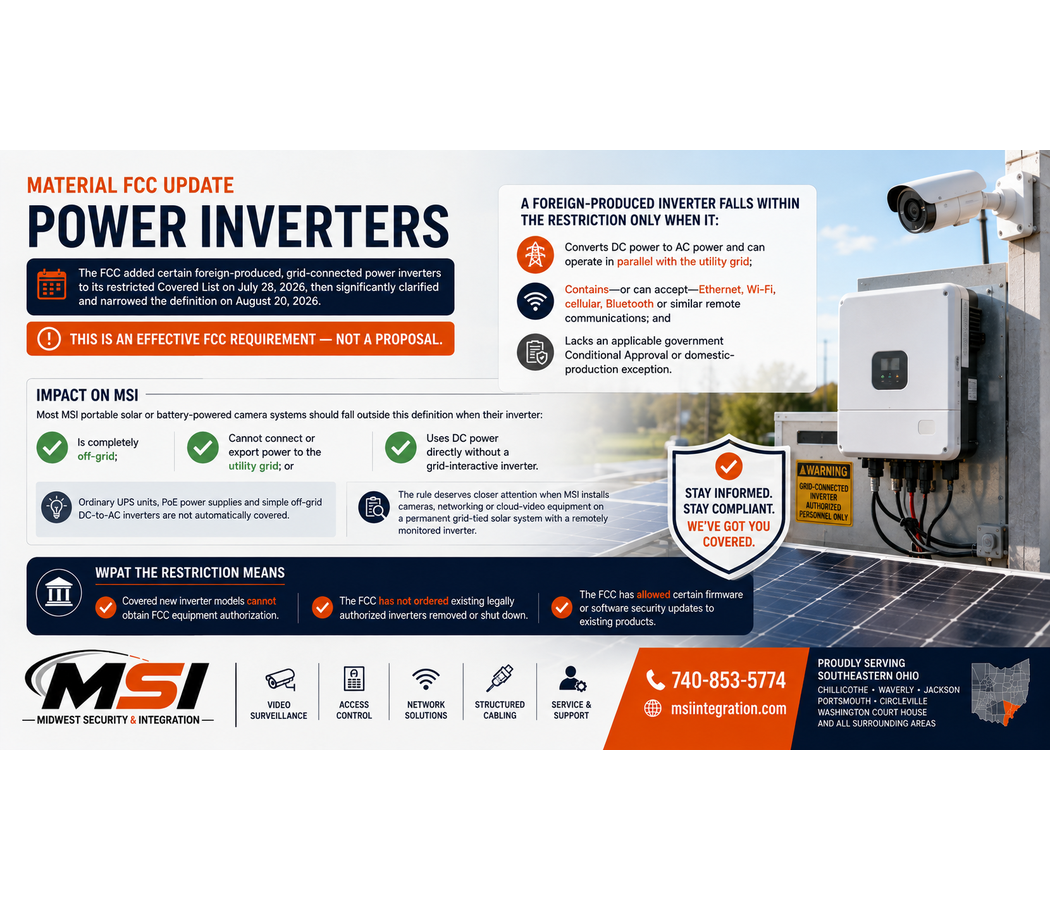
On July 28, 2026, the Federal Communications Commission (FCC) added certain foreign-produced power inverters to its Covered List. Then, on August 20, 2026, the FCC significantly clarified and narrowed what types of power inverters fall within that category.
This is important because the rule does not mean that every inverter manufactured outside the United States is prohibited.
The current definition focuses on certain grid-connected, or utility-interactive, power inverters that also contain—or are designed to accept—remote communications capabilities.
For businesses throughout Southeastern Ohio, understanding that distinction is especially important when selecting equipment for solar installations, network infrastructure, security camera systems, remote sites, and other technology projects.
At Midwest Security & Integration (MSI), we install commercial security cameras, access control, commercial Wi-Fi, structured cabling, fiber, networking, cloud video systems, and portable or remotely powered surveillance solutions throughout Southeastern Ohio.
Here is what businesses need to understand about the new FCC inverter requirements.
What Did the FCC Change in July 2026?
On July 28, 2026, the FCC’s Public Safety and Homeland Security Bureau added foreign-produced power inverters to the FCC Covered List.
The action followed a national-security determination concerning potential cybersecurity and supply-chain risks associated with certain connected power inverters.
However, the initial announcement created an important question:
Exactly what counts as a power inverter for purposes of this restriction?
The federal government provided a much more specific answer in August.
The FCC Clarified the Power Inverter Rule on August 20, 2026
On August 20, 2026, the FCC announced a modification of the power-inverter entry on the Covered List.
The revised definition significantly helps distinguish the equipment of concern from ordinary power equipment.
Under the updated definition, the covered category focuses on a power inverter that meets both of these basic characteristics:
1. It Is Utility-Interactive
The device changes DC power into AC power, including certain bidirectional devices, and is intended to operate in parallel with an electric utility to supply loads and sometimes deliver power to the utility.
In simpler terms:
It is designed to interact with the electrical grid.
2. It Has Connected or Remote-Communication Capabilities
The inverter must also contain—or be designed, equipped, or configured to accept—a component capable of remote communication, control, sensing, data collection, or monitoring through connections such as:
- Ethernet
- Wi-Fi
- Cellular
- Bluetooth
- Other similar wired or wireless connections
That second requirement is extremely important.
The FCC’s concern is not simply that an inverter converts electricity.
The current definition focuses on grid-interactive inverters with connected capabilities.
Does This Mean Every Foreign-Made Inverter Is Covered?
No.
That would be an overly broad interpretation of the current FCC definition.
A device does not automatically fall within this particular power-inverter definition simply because it:
Converts DC electricity into AC electricity.
The August 20 clarification specifically focuses on utility-interactive equipment meeting the definition incorporated into the FCC’s Covered List.
The government specifically determined that power inverters incapable of connecting to the utility grid—referred to as non-utility-interactive inverters—generally do not present the same risk to the public utility grid addressed by this action.
That distinction is particularly important for businesses using portable solar systems, batteries, temporary power systems, and remote security equipment.
What About Off-Grid Solar Security Camera Systems?
This is particularly relevant to Midwest Security & Integration (MSI) because certain commercial surveillance applications can require independent power.
For example, a customer may need cameras at:
- Construction sites
- Illegal-dumping locations
- Remote parking lots
- Equipment yards
- Vacant commercial properties
- Parks
- Utility sites
- Temporary work areas
- Road-construction projects
- Remote entrances
- Areas without convenient electrical service
Some of these systems may use solar panels and batteries to operate independently from the electrical grid.
A completely off-grid system is fundamentally different from a permanent grid-interactive solar installation.
If an inverter cannot connect to or operate in parallel with the utility grid, it generally falls outside the utility-interactive inverter definition addressed by the August 20 FCC clarification.
What If the Security Camera System Uses DC Power Directly?
Some remote security systems may not need a traditional DC-to-AC inverter at all.
For example, a properly designed system may use:
Solar panel → charge controller → battery → DC-powered equipment
The exact design depends on the cameras, network equipment, battery system, power requirements, site conditions, and other factors.
If the system does not use a utility-interactive DC-to-AC inverter, the FCC’s specific Covered List category for connected utility-interactive power inverters may not apply to that equipment.
This is one reason businesses should evaluate the actual equipment and application rather than assuming every solar-powered device is affected.
What About Ordinary Off-Grid DC-to-AC Inverters?
An ordinary inverter designed solely to provide AC power from a battery or other DC source—and incapable of operating in parallel with the utility grid—is different from the utility-interactive equipment described in the FCC’s revised definition.
Therefore, businesses should not automatically assume that every portable DC-to-AC inverter is now Covered List equipment.
The key question is whether the inverter meets the specific FCC definition.
What About UPS Battery Backup Systems?
Businesses also should not automatically assume that an ordinary uninterruptible power supply, or UPS, falls within this FCC power-inverter restriction.
UPS systems are commonly used to provide temporary backup power for equipment such as:
- Network switches
- NVRs
- Servers
- Computers
- Access control equipment
- Security systems
- Internet equipment
The FCC’s August definition centers on utility-interactive inverters intended to operate in parallel with the electrical utility.
Therefore, an ordinary UPS should not automatically be classified as a covered power inverter simply because it contains batteries and power-conversion electronics.
The actual equipment and functionality still matter.
What About PoE Power Supplies?
The same principle applies to Power over Ethernet, or PoE, equipment.
PoE switches and injectors are commonly used to provide power to:
- IP security cameras
- Wireless access points
- Network devices
- Access control equipment
- Other compatible devices
These devices should not automatically be confused with the utility-interactive power inverters described in the FCC’s August 2026 definition.
A PoE power supply is performing a very different job from a grid-connected solar inverter.
When Should Ohio Businesses Pay Closer Attention?
The rule deserves closer attention when a project includes a permanent grid-connected energy system with remotely connected inverter technology.
For example, imagine a commercial property has:
- Solar panels
- A grid-tied electrical system
- A connected inverter
- Ethernet or Wi-Fi monitoring
- Remote cloud management
- Security cameras
- Network equipment
- Cloud video surveillance
In that situation, the inverter should receive additional attention because it may be much closer to the type of equipment addressed by the FCC’s current definition.
The exact product, production status, connectivity, applicable exceptions, and authorization status would need to be evaluated.
Why Is Remote Connectivity Important?
Modern power equipment can be much more sophisticated than a simple electrical converter.
Some equipment can potentially communicate through wired or wireless networks for purposes such as:
- Remote monitoring
- System management
- Diagnostics
- Data collection
- Performance monitoring
- Remote configuration
- Firmware management
- System control
The August 2026 federal determination specifically includes Ethernet as well as Wi-Fi, cellular, Bluetooth, and similar connections.
Therefore, wired connectivity can matter too.
A device does not necessarily fall outside the definition merely because it doesn’t have Wi-Fi.
Why Is the FCC Concerned About Connected Power Inverters?
The federal determination identifies concerns involving both supply-chain security and cybersecurity.
The concern is that connected equipment interacting with the electrical grid could potentially create risks beyond one individual building.
The government specifically distinguished non-utility-interactive equipment because its potential impacts are generally limited to the local system rather than the interconnected electrical grid.
This helps explain why the August clarification is so important.
The focus isn’t simply:
“Does this device convert DC to AC?”
The better questions are:
Can it interact with the electrical utility?
and
Can it communicate, monitor, collect data, or be controlled through a wired or wireless connection?
Are There Exceptions for Certain Power Inverters?
Yes.
The FCC’s August 20 update includes important exceptions when determining whether an inverter is considered “foreign-produced” for purposes of this Covered List category.
Certain equipment qualifying under applicable domestic-production standards can fall outside the foreign-produced definition.
In addition, the federal process allows manufacturers or other eligible entities to seek a Conditional Approval from the appropriate federal agency.
A Conditional Approval can exempt a particular inverter or class of inverters from the Covered List restriction.
Because these determinations can change, businesses involved in compliance-sensitive projects should verify the current status of the specific equipment before purchasing it.
What Does Being on the FCC Covered List Actually Mean?
This is another area where businesses need to avoid misunderstanding.
Being covered does not automatically mean the federal government has ordered every existing device removed from service.
One immediate consequence involves FCC equipment authorization.
Under the FCC’s existing rules, equipment that qualifies as covered equipment is prohibited from receiving FCC equipment authorization.
That is especially important for manufacturers introducing new equipment requiring authorization for the U.S. market.
Do Existing Inverters Have to Be Removed?
The FCC’s August 20 notice does not announce a blanket order requiring businesses to shut down and remove every previously authorized inverter that may now fall within the Covered List definition.
That distinction matters.
Businesses should not automatically begin removing existing equipment solely because they hear that foreign-produced power inverters were added to the Covered List.
Existing equipment and new equipment authorization are different regulatory questions.
Organizations with government, utility, procurement, contractual, cybersecurity, or other compliance requirements may have additional obligations, so those projects deserve individual review.
Can Existing Inverters Still Receive Security Updates?
The FCC has also addressed an important cybersecurity problem involving equipment that received FCC authorization before the Covered List addition.
On July 28, 2026, the FCC’s Office of Engineering and Technology issued a waiver concerning certain software and firmware updates intended to mitigate harm to U.S. consumers for covered power inverters that had received FCC authorization before the Covered List addition.
The August 20 FCC notice confirmed that this waiver applies under the revised inverter definitions.
That matters because preventing important security or maintenance updates to already-deployed equipment could create additional problems rather than reducing risk.
Why This Matters for Commercial Security Camera Installations
At first glance, a federal rule about power inverters may not seem related to security cameras.
However, commercial security systems increasingly depend on multiple technologies working together.
A modern surveillance installation could include:
- IP security cameras
- Cloud video surveillance
- Cellular connectivity
- Wi-Fi
- Ethernet
- PoE switches
- Batteries
- Solar panels
- Wireless bridges
- Network equipment
- Remote monitoring
- Power-conversion equipment
Therefore, an integrator needs to understand more than just cameras.
The power system, network, cabling, communications equipment, and surveillance equipment all work together.
Portable Solar Camera Systems Are Different From Grid-Tied Solar Systems
This distinction is worth emphasizing.
Imagine two surveillance projects.
Project One: Remote Illegal-Dumping Camera
A township wants a temporary camera installed at a remote dumping location.
The system uses:
Solar panels → batteries → cameras and communications equipment
It operates independently and cannot connect to the utility grid.
That type of installation is very different from the equipment targeted by the FCC’s utility-interactive inverter definition.
Project Two: Permanent Commercial Solar Facility
A commercial property has a permanent solar array connected to the electrical utility.
Its inverter converts DC solar power into AC, operates in parallel with the utility, and contains Ethernet or wireless remote-monitoring capabilities.
That project deserves significantly more attention under the FCC’s August 2026 definition.
The difference isn’t simply whether both systems use solar power.
The architecture of the power system matters.
Government and Public-Sector Projects Need Additional Attention
Government agencies, municipalities, townships, schools, public facilities, utilities, and other public-sector customers may have additional procurement or compliance requirements.
A project may need to consider:
- FCC requirements
- Federal procurement requirements
- Funding requirements
- Cybersecurity policies
- Contract requirements
- Customer-specific equipment standards
- Other applicable federal, state, or local requirements
Therefore, equipment selection for government and compliance-sensitive projects should be reviewed before equipment is purchased.
Commercial Security Camera Installation in Chillicothe and Ross County
Midwest Security & Integration (MSI) provides commercial security camera installation, networking, access control, structured cabling, and remote surveillance solutions throughout Chillicothe and Ross County, Ohio.
For remote properties without convenient electrical service, MSI can evaluate appropriate power and connectivity options based on the application.
Commercial Surveillance in Waverly and Pike County
Businesses, government agencies, and other organizations throughout Waverly and Pike County, Ohio can contact MSI for professional commercial surveillance solutions.
This includes permanent facilities as well as remote and temporary camera applications.
Security Cameras in Jackson, Ohio
MSI provides commercial security camera installation throughout Jackson and Jackson County, Ohio.
Our systems can incorporate cameras, networking, wireless connectivity, structured cabling, access control, cloud video, and other technologies depending on the property.
Commercial Security Cameras in Portsmouth and Scioto County
Businesses throughout Portsmouth and Scioto County, Ohio can contact Midwest Security & Integration for commercial video surveillance and low-voltage infrastructure.
We work with everything from traditional commercial buildings to large properties, parking areas, equipment yards, and remote locations.
Commercial Security Systems in Circleville and Washington Court House
Midwest Security & Integration also serves commercial customers throughout Circleville and Washington Court House, Ohio.
Our services include security cameras, commercial Wi-Fi, networking, structured cabling, fiber, access control, and cloud video surveillance.
Commercial Security and Networking Throughout Southeastern Ohio
Midwest Security & Integration (MSI) provides commercial security and low-voltage solutions throughout Southeastern Ohio.
Our service area includes Chillicothe and Ross County, Waverly and Pike County, Jackson and Jackson County, Portsmouth and Scioto County, Athens and Athens County, Gallipolis and Gallia County, Logan and Hocking County, Ironton and Lawrence County, Pomeroy and Meigs County, Woodsfield and Monroe County, McConnelsville and Morgan County, Caldwell and Noble County, New Lexington and Perry County, McArthur and Vinton County, Washington County, as well as Circleville, Washington Court House, and surrounding Southern and Southeastern Ohio communities.
What Types of Organizations Does MSI Serve?
Midwest Security & Integration works with commercial and public-sector customers including retail stores, grocery stores, gas stations, convenience stores, car dealerships, warehouses, manufacturing facilities, industrial properties, offices, healthcare facilities, government facilities, parks, schools, storage facilities, construction sites, road-construction projects, temporary work sites, equipment yards, utilities, and multi-location businesses.
Every property is different, so MSI designs the security and network infrastructure around the actual application.
More Than Security Cameras
Midwest Security & Integration (MSI) provides complete commercial security and low-voltage solutions throughout Southeastern Ohio, including:
- Commercial security camera installation
- Portable and remote surveillance systems
- Solar and battery-powered camera applications
- Cloud video surveillance
- VSaaS
- NVR systems
- License plate cameras
- PTZ cameras
- AI video analytics
- Commercial access control
- Commercial Wi-Fi
- Point-to-point wireless bridges
- Structured cabling
- Fiber
- Network infrastructure
This allows MSI to evaluate the complete system rather than looking at the camera alone.
What Should Ohio Businesses Know About the 2026 FCC Power Inverter Rule?
The biggest takeaway is simple:
Do not assume every foreign-produced inverter is prohibited.
The FCC’s August 20, 2026 clarification narrowed the applicable definition.
For purposes of this Covered List entry, the power inverter must generally be a utility-interactive device that changes DC power to AC power and contains—or is designed, equipped, or configured to accept—technology enabling remote communication, control, sensing, data collection, or monitoring through Ethernet, Wi-Fi, cellular, Bluetooth, or a similar wired or wireless connection.
There are also applicable Conditional Approval and domestic-production exceptions.
That means an off-grid inverter that cannot connect to the utility grid is not the same thing as a remotely connected grid-interactive solar inverter.
Likewise, ordinary PoE power supplies, DC-powered security equipment, battery systems, and UPS equipment should not automatically be lumped into the FCC’s utility-interactive power-inverter category simply because they involve power conversion.
For MSI customers, this means most truly off-grid portable solar and battery-powered surveillance applications should be analyzed differently from permanent grid-tied solar installations.
However, when a commercial security, networking, or cloud-video project interfaces with a permanent grid-tied solar system using a remotely connected inverter, the inverter’s regulatory status deserves closer review.
Federal requirements can change, and individual projects may have additional procurement or contractual requirements. Organizations should confirm the status of specific equipment when compliance is required.
Midwest Security & Integration (MSI) will continue monitoring federal technology requirements as we design commercial security, networking, and low-voltage systems throughout Southeastern Ohio.
Official FCC information: Review the FCC’s August 20, 2026 modification of the power-inverter Covered List entry and the current FCC Covered List for the most current federal information.
Check us out: Midwest Security & Integration — msiintegration.com
Call MSI: 740-853-5774
This article provides general educational information about federal equipment requirements. It is not legal, regulatory, electrical, tax, or procurement advice. Requirements can depend on the specific equipment, project, customer, funding source, and application.
Recommended Focus Keyphrase
FCC power inverter rule 2026
Additional SEO Keyphrases
FCC power inverter Covered List, foreign-produced power inverters, grid-connected inverter FCC rule, solar security cameras Ohio, solar powered security cameras Ohio, off-grid security cameras, remote security cameras Southeastern Ohio, commercial security cameras Southeastern Ohio, portable security camera systems Ohio
Short Meta Description
Learn how the 2026 FCC power inverter rule affects certain connected grid-tied inverters and what Ohio businesses using solar, battery and security systems should know.