

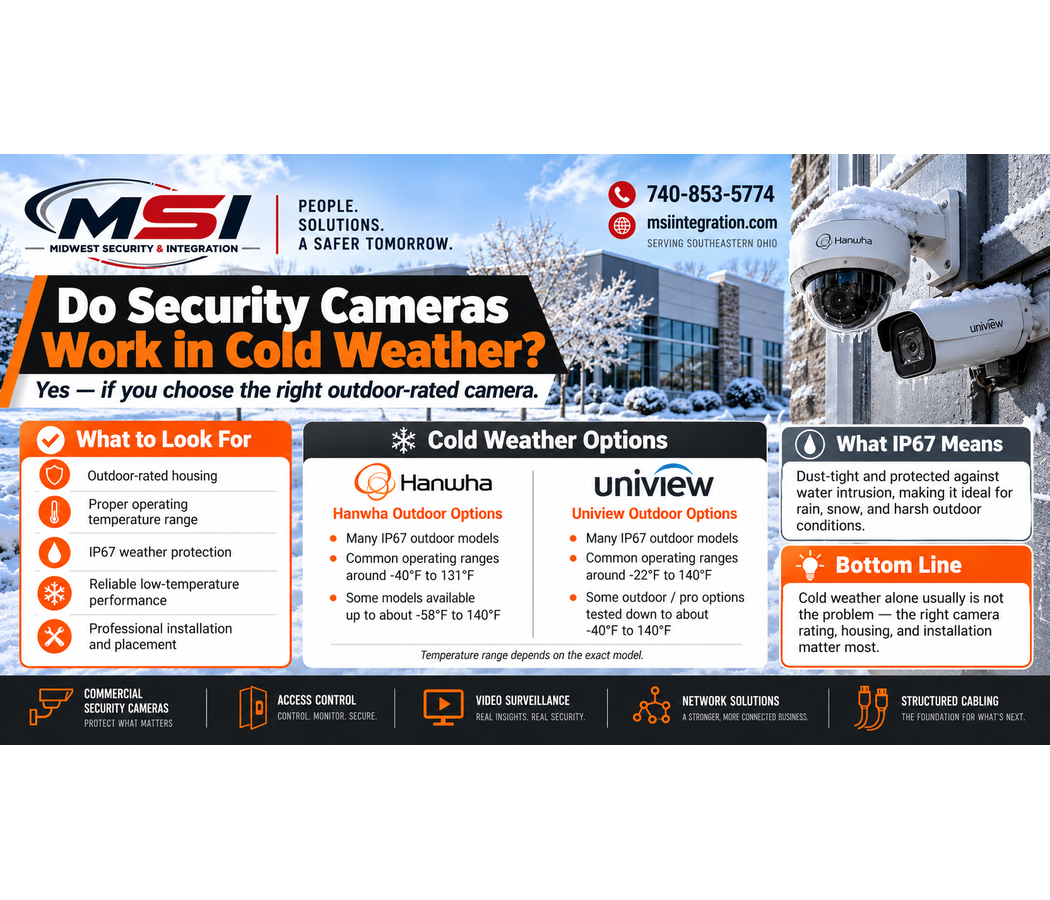
Do Security Cameras Work in Cold Weather? What Ohio Businesses Need to Know
If you own or manage a business in Chillicothe, Ross County, or anywhere in Southeastern Ohio, winter weather can raise an important question:
Will my security cameras still work when temperatures drop below freezing?
The answer is generally yes—if the cameras are designed for outdoor use and installed correctly.
Commercial outdoor security cameras are built to operate in conditions that would be difficult for ordinary electronics. However, not every camera has the same temperature rating, weather protection, housing, or low-temperature capabilities.
At Midwest Security & Integration (MSI), we install commercial security camera systems throughout Chillicothe and Southeastern Ohio, including outdoor camera options from Hanwha Vision and Uniview. When designing an exterior surveillance system, we consider much more than resolution. We also look at the environment where that camera will operate throughout the year.
Can Security Cameras Work Below Freezing?
Yes. Many commercial outdoor security cameras are specifically designed to operate below 32°F.
The important number isn’t simply whether the camera says “outdoor.”
Businesses should look at the manufacturer’s specified operating temperature range for the exact camera model.
Different models can have significantly different ratings.
For example, commercial outdoor cameras may be designed to operate at temperatures well below freezing. Certain specialized models can handle even more extreme temperatures.
That means a properly selected commercial camera can continue protecting a business during an Ohio winter.
What Temperature Is Too Cold for a Security Camera?
There isn’t one temperature that applies to every security camera.
Every model has its own operating-temperature specification.
For example, one outdoor camera might be rated for approximately -22°F, while another commercial model may be rated to approximately -40°F or lower.
This is why MSI doesn’t recommend choosing outdoor cameras based solely on megapixels.
Before installing an exterior camera, we consider:
- Manufacturer operating-temperature rating
- Weather resistance
- Camera housing
- Installation location
- Exposure to snow and rain
- Wind exposure
- Mounting surface
- Cable and connection protection
- Power requirements
The exact manufacturer’s specification for the selected model should always control.
Hanwha Security Cameras for Cold Weather
Hanwha Vision offers commercial outdoor surveillance cameras with weather-resistant housings and operating-temperature ranges designed for demanding outdoor environments.
Depending on the exact model, Hanwha outdoor cameras can provide features such as:
- IP67 weather protection
- Sub-freezing operating temperatures
- Commercial outdoor housings
- Infrared night vision
- Low-light imaging
- Vandal-resistant construction on applicable models
- AI video analytics on applicable models
Certain Hanwha models are designed for significantly lower temperatures than others.
That is why MSI selects cameras based on the actual installation environment instead of assuming every outdoor Hanwha camera has identical specifications.
Uniview Security Cameras for Cold Weather
Uniview also offers commercial outdoor security cameras designed for demanding weather conditions.
Depending on the specific Uniview model, outdoor camera specifications may include:
- IP67 weather resistance
- Below-freezing operating temperatures
- Infrared illumination
- Commercial outdoor housings
- Low-light capabilities
- Vandal-resistant options
- AI and smart analytics on applicable models
Again, the important part is checking the exact model.
A Uniview camera installed under a covered entrance may have different environmental demands than a camera mounted on a pole overlooking a large parking lot.
What Does IP67 Mean on a Security Camera?
You’ll frequently see IP67 listed on outdoor commercial security cameras.
But what does it actually mean?
The IP rating, or Ingress Protection rating, describes how well an enclosure protects against the intrusion of solids and water.
For an IP67-rated camera, the first number—6—indicates a dust-tight enclosure.
The second number—7—indicates protection against temporary water immersion under the conditions specified by the rating standard.
For a business owner, the simple takeaway is:
IP67 is a strong weather-resistance rating commonly found on outdoor commercial security cameras.
It can be appropriate for cameras exposed to conditions such as:
- Rain
- Snow
- Blowing dust
- Moisture
- Harsh outdoor environments
However, there is an important distinction.
IP67 does not tell you how cold the camera can operate.
Weather resistance and operating temperature are two separate specifications.
A camera can be IP67 and still have a temperature limitation.
That’s why MSI checks both.
Snow Isn’t Necessarily the Biggest Problem
Seeing a camera covered in snow can make a business owner understandably nervous.
But an appropriately rated outdoor camera is designed with outdoor exposure in mind.
There are other winter-related issues that can affect surveillance performance.
For example:
Snow or ice on the lens or dome can block the camera’s view.
Water droplets can reduce image clarity.
Snowflakes close to infrared illumination can appear extremely bright at night.
Ice buildup can obstruct a camera.
Poorly protected connections can allow moisture to create problems.
Damaged cabling can cause power or connectivity issues.
So when a security camera develops problems during cold weather, the temperature itself isn’t automatically the cause.
Why Does My Camera Look Bad When It’s Snowing at Night?
This is a common nighttime surveillance issue.
Many outdoor security cameras use infrared (IR) illumination to help produce images in darkness.
When snow falls directly in front of the camera, the infrared light can reflect off snowflakes close to the lens.
Because those snowflakes are much closer to the camera than the area you’re trying to monitor, they can appear as bright spots, streaks, or glowing objects.
The camera itself may be operating normally.
The problem is the interaction between the camera’s illumination and the weather immediately in front of it.
Similar effects can occur with:
- Heavy rain
- Fog
- Bugs
- Spider webs
- Dust
- Moisture near the lens
Camera positioning, lighting, IR configuration, and maintenance can all influence nighttime image quality.
Cold Weather Can Expose Installation Problems
Winter sometimes reveals problems that weren’t obvious during warmer weather.
For example, an outdoor camera may be rated perfectly for the temperature, but a poorly protected cable connection could still cause trouble.
Professional exterior camera installation should consider more than the camera housing.
MSI evaluates:
- Cable entry points
- Exterior-rated connections
- Junction boxes
- Mounting hardware
- Water exposure
- Cable pathways
- PoE/network connectivity
- Building penetrations
- Camera positioning
A high-quality outdoor camera is only one part of a reliable commercial surveillance system.
Parking Lot Cameras During an Ohio Winter
Parking lots are particularly challenging because cameras may be exposed to wind, snow, ice, rain, darkness, headlights, and large temperature changes.
A parking lot camera may also need to cover significantly longer distances than a camera installed at a building entrance.
MSI considers the purpose of each view.
For example, does the business need:
A general parking-lot overview?
Vehicle identification?
Coverage of an entrance or exit?
A dedicated view for license plates?
Coverage around employee vehicles?
The camera, lens, mounting location, and lighting should be selected around that objective.
Security Cameras at Gas Stations During Winter
Gas stations and convenience stores around Chillicothe and Southeastern Ohio can present particularly demanding exterior environments.
Cameras may be needed around:
- Fuel pumps
- Parking areas
- Store entrances
- Side and rear doors
- Dumpster areas
- Vehicle entrances and exits
These cameras can be exposed to weather around the clock.
Using properly rated commercial outdoor cameras is especially important when surveillance equipment has little protection from the elements.
Security Cameras for Warehouses and Industrial Properties
Warehouses, manufacturing facilities, equipment yards, and industrial properties can also present difficult winter environments.
Some facilities need cameras mounted high on exterior walls.
Others have detached buildings or large outdoor storage areas.
In those situations, MSI considers not only camera temperature and weather ratings but also the infrastructure required to support the cameras.
That can include:
- Structured cabling
- PoE
- Fiber
- Network switches
- Commercial wireless bridges
- Surge protection where appropriate
- Recording infrastructure
A commercial surveillance system is only as dependable as the infrastructure connecting everything together.
Don’t Forget About Your NVR and Network Equipment
The exterior camera may be designed for freezing temperatures, but that doesn’t mean every component of the surveillance system belongs outside.
Network video recorders, switches, monitors, and other equipment have their own environmental requirements.
Equipment should be installed in locations appropriate for its specifications.
MSI considers the entire system—from the exterior camera all the way back to the network and recording equipment.
What Happens to Security Cameras During a Power Outage?
Cold weather can also bring ice, wind, and power outages.
A standard PoE camera generally relies on its network equipment for power.
If power is lost to the PoE switch or NVR supplying that camera, the camera may stop operating unless appropriate backup power is available.
Businesses that need greater resiliency may want to discuss UPS battery backup and other power considerations as part of their system design.
A UPS doesn’t mean a security system can run indefinitely during an outage. Runtime depends on the equipment load, battery capacity, and system design.
Should You Clean Outdoor Security Cameras During Winter?
Yes, when necessary and when it can be done safely.
Outdoor cameras can accumulate:
- Snow
- Ice
- Dirt
- Road salt residue
- Water spots
- Spider webs
- Dust and debris
A dirty camera can dramatically reduce image quality, especially at night.
However, businesses should follow the manufacturer’s cleaning recommendations and avoid applying unknown chemicals or abrasive products to camera lenses, domes, or protective coatings.
For cameras mounted high above the ground, proper safety equipment should also be used.
How Can Businesses Prepare Security Cameras for Winter?
Before the colder months arrive, businesses should consider checking their exterior surveillance system.
Look at actual recorded video—not simply whether the camera says “online.”
Review nighttime footage.
Check exterior camera images for dirt, water spots, webs, or damaged housings.
Make sure cameras haven’t shifted from their intended positions.
Confirm footage is actually recording.
Check playback.
Test remote access.
If your system has been installed for several years, this is also a good opportunity to determine whether older cameras or infrastructure need attention.
Why Professional Security Camera Installation Matters in Ohio
Ohio businesses deal with changing conditions throughout the year.
A camera may experience summer heat, heavy rain, freezing temperatures, snow, ice, wind, and humidity—all at the same location.
That’s one reason commercial security camera installation in Ohio should involve more than simply choosing a camera from a catalog.
At Midwest Security & Integration, we evaluate:
- Operating temperature
- IP/weather rating
- Camera placement
- Mounting height
- Lighting
- Nighttime performance
- Viewing distance
- Network infrastructure
- Recording requirements
- Cabling
- Future expansion
The goal is to build a commercial surveillance system that fits the property and its environment.
Commercial Security Camera Installation in Chillicothe, Ohio
MSI provides commercial security camera installation in Chillicothe and Ross County, Ohio.
We work with businesses that need indoor and outdoor surveillance for parking lots, entrances, warehouses, retail spaces, equipment areas, and other commercial environments.
Our services extend beyond cameras to include access control, structured cabling, commercial networking, Wi-Fi, fiber, and cloud video surveillance.
Outdoor Security Cameras in Waverly, Jackson and Portsmouth
Midwest Security & Integration also installs commercial outdoor security cameras throughout Waverly, Jackson, Portsmouth, and surrounding Southeastern Ohio communities.
For exterior projects, we evaluate the environmental conditions as part of camera selection rather than assuming every outdoor camera is appropriate for every location.
Commercial Security Cameras in Circleville and Washington Court House
Businesses in Circleville and Washington Court House, Ohio, can also contact MSI for professional commercial security camera installation, access control, networking, and structured cabling.
Whether you need to monitor an entrance, parking lot, warehouse, dealership, or other commercial property, MSI can evaluate the correct system for the application.
Serving Businesses Throughout Southeastern Ohio
Midwest Security & Integration provides commercial security and low-voltage solutions throughout Southeastern Ohio, including Chillicothe, Waverly, Jackson, Portsmouth, Circleville, Washington Court House, Athens, Gallipolis, Logan, Ironton, Pomeroy, Woodsfield, McConnelsville, Caldwell, New Lexington, McArthur, and surrounding communities.
MSI works with:
- Retail stores
- Gas stations
- Grocery stores
- Offices
- Car dealerships
- Warehouses
- Manufacturing facilities
- Industrial properties
- Healthcare facilities
- Schools
- Storage facilities
- Construction sites
- Equipment yards
- Parks and public facilities
- Government organizations
- Multi-location businesses
Do Security Cameras Work in Cold Weather? The Bottom Line
Yes. Commercial security cameras can work very well in cold weather when the right equipment is selected and installed correctly.
The important things to look for are the camera’s actual operating-temperature specification, weather-resistant housing, IP rating, placement, cabling, and installation quality.
An IP67 rating can provide strong protection against dust and water, but remember:
IP67 does not automatically tell you the camera’s temperature rating.
That must be checked separately for the exact camera model.
MSI works with commercial outdoor camera options from Hanwha Vision and Uniview, allowing us to select equipment based on the needs of the property rather than using the same camera everywhere.
If you’re looking for outdoor commercial security cameras in Chillicothe, Ross County, or Southeastern Ohio, contact Midwest Security & Integration for a free, no-obligation quote.
Better security backed by real experience.
Website: msiintegration.com
Phone: 740-853-5774