Ohio’s New Public Construction Contract Law: What Businesses and Contractors Need to Know About SB 262
If your company works on public construction projects in Ohio, an important new contract requirement is now in effect.
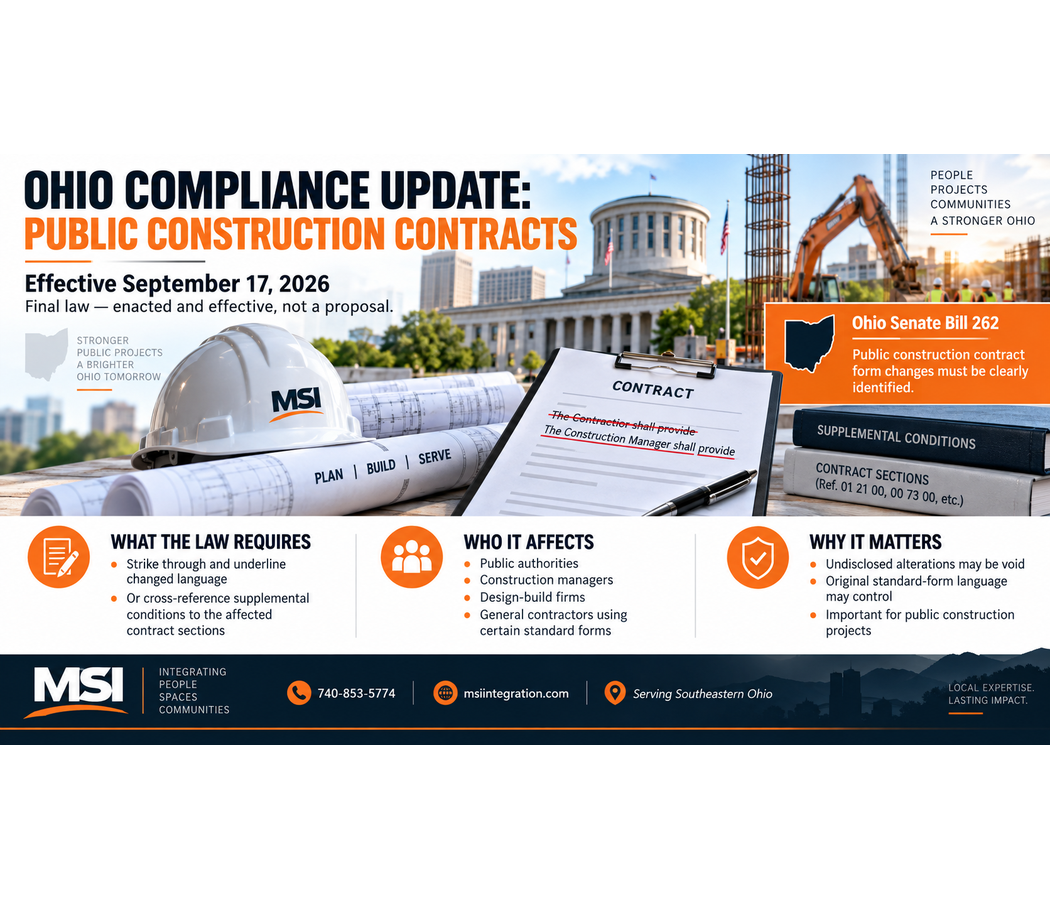
Effective September 17, 2026, Ohio Senate Bill 262 changed state law regarding certain industry-standard construction contracts and subcontracts used on public improvement projects.
The basic idea is straightforward:
If certain standard construction contract forms are changed, those changes now have to be clearly identified.
For contractors and subcontractors, that can make it easier to recognize when important language has been changed from the original standard form.
This matters to companies like Midwest Security & Integration (MSI) because commercial security cameras, access control, structured cabling, fiber, Wi-Fi, and network infrastructure can all become part of larger public construction and renovation projects.
MSI works with businesses, contractors, townships, municipalities, government agencies, public facilities, and other organizations throughout Southeastern Ohio.
What Is Ohio Senate Bill 262?
Ohio Senate Bill 262 was enacted during the 136th General Assembly and became effective on September 17, 2026.
The legislation amended several sections of Ohio law involving public construction contracts.
Its purpose is reflected directly in the legislation’s title: requiring a public authority or other party to a construction contract to note variations from an industry-standard form.
This is important because construction contracts can be long and complicated.
A contractor may recognize a familiar standard contract form, but that doesn’t necessarily mean every provision is identical to the original published version.
Individual terms may have been modified.
SB 262 creates requirements for identifying certain alterations rather than leaving those changes buried within otherwise familiar standard-form language.
What Does Ohio’s New Construction Contract Law Require?
When the covered parties use applicable industry-standard published construction-management, design-build, contract, or subcontract forms, alterations must be identified in one of the ways permitted by Ohio law.
That can include:
- Striking through and underlining changes to the original language;
- Cross-referencing conditions that supplement the standard form; or
- Including supplemental conditions that cross-reference the section or sections of the standard form being altered.
The exact application depends on the contract and statutory provision involved.
The important takeaway is that changes to covered standard forms are supposed to be identifiable.
What Happens If a Change Isn’t Properly Identified?
This is one of the most significant parts of SB 262.
Under the amended Ohio Revised Code provisions, failure to identify an alteration in the required manner results in that alteration being “void and without effect,” with the original language prevailing.
Here’s an easy hypothetical example.
Imagine an applicable standard construction subcontract originally gives a subcontractor a certain amount of time to complete a required contractual action.
Someone changes that provision before giving the contract to the subcontractor.
However, the modified language isn’t identified in one of the ways required by the new Ohio law.
If the statutory requirements apply to that particular contract and alteration, the undisclosed modification may be void and without effect, allowing the original standard-form language to prevail.
That is a significant reason contractors and subcontractors working on Ohio public projects should understand the new requirement.
Does This Apply to Every Construction Contract in Ohio?
No.
Businesses should not interpret SB 262 as a rule covering every private construction contract or every agreement signed in Ohio.
The amendments are contained within Ohio’s laws governing public improvements and specific public construction contracting arrangements.
They also address the use of certain industry-standard published contract and subcontract forms.
Therefore, whether SB 262 applies depends on factors such as:
- The type of project
- The public authority involved
- The project-delivery method
- The parties to the contract
- The type of contract or subcontract
- Whether an applicable industry-standard published form is being used
Businesses should review their particular contracts rather than assuming every agreement automatically receives the same protection.
Why Does This Matter to Security and Low-Voltage Contractors?
A public construction project involves much more than concrete, framing, plumbing, and electrical work.
Modern government and commercial facilities also depend heavily on technology infrastructure.
A new or renovated public building may require:
- Security cameras
- Access control
- Structured cabling
- Fiber
- Network infrastructure
- Commercial Wi-Fi
- Building-to-building network connections
- Cloud-connected security systems
- Other low-voltage technology
A security or low-voltage integrator may therefore work as a subcontractor underneath a general contractor, construction manager at risk, or design-build firm.
That means the contract MSI signs can be just as important as the equipment MSI installs.
Why Contract Details Matter on Security Projects
Consider a commercial security-camera installation.
The plans might initially appear straightforward:
Install cameras.
Install network cabling.
Connect everything.
Test the system.
But the actual contract may contain requirements involving:
- Project scheduling
- Payment
- Retainage
- Change orders
- Documentation
- Insurance
- Site access
- Submittals
- Closeout documentation
- Warranty obligations
- Delays
- Coordination with other trades
- Dispute procedures
- Notice requirements
Small contractual changes can sometimes create significant differences in responsibility.
That is why being able to identify modifications to applicable standard contract language can be valuable to contractors and subcontractors.
Public Security Projects Require More Than Just Installing Cameras
Government and public-sector security installations can involve additional planning that isn’t always present in a small private commercial project.
MSI may need to coordinate with:
General contractors
Construction managers
Electrical contractors
IT departments
Architects and engineers
Government representatives
Facility managers
Other trades
A camera might need network connectivity.
The network switch may need fiber.
Access control may need coordination with door hardware.
The doors may need coordination with other contractors.
Cloud-connected equipment may need approval from the customer’s IT department.
Everything has to work together.
This is one reason choosing an experienced commercial security integrator matters.
Why Businesses and Public Agencies Choose Midwest Security & Integration
At Midwest Security & Integration (MSI), we don’t approach commercial security as simply putting cameras on a wall.
We look at the complete system.
That starts with understanding what the customer actually needs the system to accomplish.
For a security camera, that might mean asking:
Do you need an overview of the parking lot—or do you need enough detail to identify vehicles?
Do you need to know that someone entered the building—or do you need a clear view of the person’s face?
Does the camera need to work primarily during the day, or is nighttime performance critical?
Does the customer need local recording, cloud video, or both?
How will the camera connect back to the network?
Those questions matter because simply having a camera doesn’t necessarily mean you have useful video.
Professional Commercial Security System Design
MSI focuses on commercial security system design and integration.
That means considering the entire environment, including:
- Camera placement
- Camera resolution
- Lens selection
- Mounting height
- Nighttime performance
- Lighting
- Network capacity
- PoE requirements
- Recording
- Video retention
- Structured cabling
- Fiber
- Wireless connectivity
- Access control
- Future expansion
The goal isn’t simply to install equipment.
The goal is to build a system that makes sense for the property.
Security Cameras, Access Control and Networking From One Integrator
Another advantage of working with MSI is that customers don’t necessarily need separate companies for every piece of their security infrastructure.
Midwest Security & Integration provides:
- Commercial security camera installation
- Access control
- Structured cabling
- Fiber
- Commercial Wi-Fi
- Point-to-point wireless bridges
- Network infrastructure
- NVR systems
- Cloud video surveillance
- VSaaS
- License plate cameras
- PTZ cameras
- AI video analytics
That can be particularly useful during construction projects.
For example, an IP security camera requires more than a camera.
It may require Ethernet cabling, PoE, network switches, fiber or wireless connectivity, recording infrastructure, and proper network configuration.
Having an integrator that understands how those pieces work together can simplify the project.
Planning for Future Expansion
Another part of professional system design is considering what happens after the current project is finished.
A customer may install 20 cameras today but add another building next year.
A township may later want additional cameras at a park.
A warehouse may expand.
A business may add another entrance requiring access control.
A government facility may eventually move toward cloud-managed technology.
Whenever practical, MSI considers future expansion when designing the original infrastructure.
Good planning today can make tomorrow’s upgrades easier.
Working Around the Customer’s Schedule
Commercial installations can also create operational challenges.
A retail store may not want technicians working over customers during peak hours.
A government office may have restricted working times.
A manufacturing facility may have production schedules.
A gas station or grocery store may operate long hours.
MSI works with customers to coordinate installation schedules around the property whenever practical.
For certain high-traffic businesses, that can include off-hours installation to reduce interference with normal operations.
Experience Beyond the Equipment
Technology is only one part of security.
MSI’s owners bring law-enforcement backgrounds to the company.
That experience contributes to the way we think about camera placement and usable evidence.
There is a major difference between:
“I can see that something happened.”
and
“I can see useful details about what happened.”
Professional surveillance design should focus on what the customer may actually need from the footage when an incident occurs.
Why Local Service Matters
When businesses and government organizations invest in security infrastructure, having a local company behind the system can matter.
Midwest Security & Integration is focused on serving Southeastern Ohio.
We’re not simply shipping equipment to a customer and expecting them to figure everything out.
We provide professional installation, system configuration, troubleshooting, upgrades, and ongoing support based on the services and agreements selected by the customer.
For public-sector organizations and businesses, that provides a local resource when the system needs attention.
Commercial Security Installation in Chillicothe and Ross County
Midwest Security & Integration (MSI) provides commercial security cameras, access control, networking, fiber, Wi-Fi, and structured cabling throughout Chillicothe and Ross County, Ohio.
We work with commercial customers as well as townships, government facilities, public properties, and other organizations.
Security Cameras and Access Control in Waverly and Pike County
MSI serves businesses and organizations throughout Waverly and Pike County, Ohio.
Whether the project involves an existing facility, renovation, new construction, detached building, parking area, or public property, MSI can evaluate the security and network requirements.
Commercial Security Systems in Jackson, Ohio
Businesses and public organizations throughout Jackson and Jackson County, Ohio can contact MSI for professional commercial security integration.
Our services include security cameras, access control, commercial networking, Wi-Fi, structured cabling, fiber, and cloud video surveillance.
Commercial Security Installation in Portsmouth and Scioto County
Midwest Security & Integration serves Portsmouth and Scioto County, Ohio, with commercial security and low-voltage solutions.
We work with offices, warehouses, industrial facilities, retail businesses, government properties, and other commercial environments.
Security and Low-Voltage Installation in Circleville and Washington Court House
MSI also provides commercial security and low-voltage services throughout Circleville and Washington Court House, Ohio.
Whether you’re planning new construction, renovating an existing building, or upgrading an older security system, MSI can help evaluate the infrastructure needed for the project.
Serving Businesses and Public Organizations Throughout Southeastern Ohio
Midwest Security & Integration provides commercial security and low-voltage services throughout Southeastern Ohio, including:
- Ross County — Chillicothe
- Pike County — Waverly
- Jackson County — Jackson
- Scioto County — Portsmouth
- Athens County — Athens
- Gallia County — Gallipolis
- Hocking County — Logan
- Lawrence County — Ironton
- Meigs County — Pomeroy
- Monroe County — Woodsfield
- Morgan County — McConnelsville
- Noble County — Caldwell
- Perry County — New Lexington
- Vinton County — McArthur
- Washington County
MSI also serves Circleville, Washington Court House, and surrounding Southern and Southeastern Ohio communities.
What Types of Organizations Does MSI Work With?
MSI works with a wide range of commercial and public-sector customers, including:
- Government facilities
- Townships and municipalities
- Parks and public facilities
- Schools
- Retail stores
- Grocery stores
- Gas stations
- Car dealerships
- Warehouses
- Manufacturing facilities
- Industrial properties
- Offices
- Healthcare facilities
- Storage facilities
- Construction sites
- Equipment yards
- Utilities
- Multi-location businesses
Every property has different security and technology requirements, which is why MSI designs systems around the actual application rather than trying to use the same solution everywhere.
What Should Ohio Contractors Know About SB 262?
The biggest takeaway from Ohio Senate Bill 262 is transparency.
Effective September 17, 2026, Ohio law requires alterations to certain applicable industry-standard public construction contract and subcontract forms to be identified in the manner required by the statute.
Depending on the applicable provision, that can involve striking through and underlining changes or properly cross-referencing supplemental conditions.
If a covered alteration isn’t identified as required, Ohio law provides that the alteration is void and without effect and the original standard-form language prevails.
However, this should not be interpreted to mean that every contract modification in Ohio is automatically invalid.
The law applies in specific public-construction and standard-form contracting situations.
Contractors and subcontractors should still carefully review every contract before signing it and seek qualified legal advice when a contract presents significant legal questions.
For official information, review the Ohio Legislature’s SB 262 materials and the applicable sections of the Ohio Revised Code.
For your commercial security, access control, networking, fiber, Wi-Fi, or structured cabling needs, contact Midwest Security & Integration.
Better security backed by real experience.
Check us out here: msiintegration.com
Call MSI: 740-853-5774
This article is provided for general educational information and is not legal advice. The application of Ohio construction law can depend on the project, contract, parties, project-delivery method, and other circumstances. Contractors and public entities should consult qualified legal counsel regarding specific contracts or disputes.