

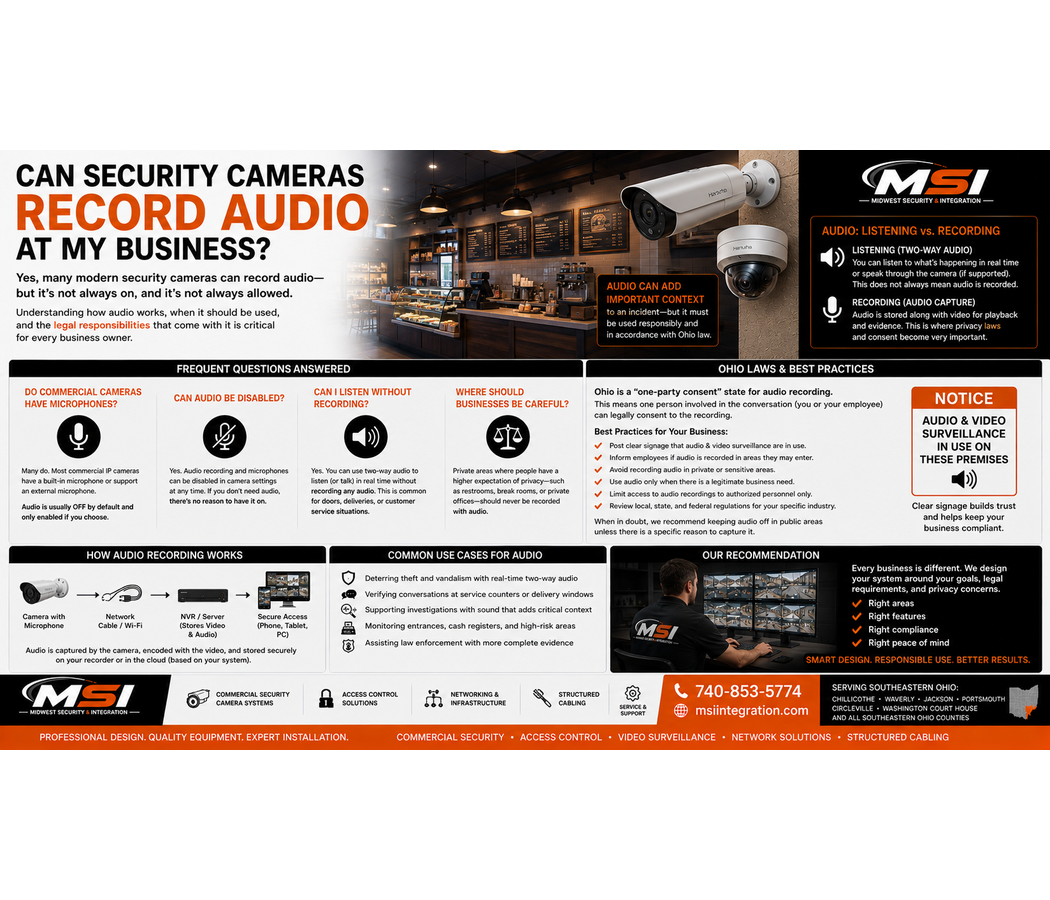
Can Security Cameras Record Audio at My Business?
If you are considering security cameras with audio in Ohio, it is important to understand that audio and video are not always treated the same way.
Yes, some commercial security cameras can capture audio. Certain cameras have built-in microphones, while others support external microphone inputs. For example, professional Hanwha Vision camera models are available with built-in or selectable microphone capabilities.
However, just because a security camera can record audio does not automatically mean a business should turn that feature on.
Audio recording can raise privacy and legal concerns that are different from ordinary video surveillance.
At Midwest Security & Integration (MSI), we design and install commercial security camera systems throughout Southeastern Ohio. When a customer asks about audio, we explain the technology and encourage the business to consider applicable laws, employee policies, customer privacy, and legal guidance before enabling audio recording.
Do Commercial Security Cameras Have Microphones?
Some do.
Commercial security cameras may have:
- Built-in microphones
- External microphone inputs
- Audio line inputs
- Two-way audio capability
- Audio event features
Other cameras may not support audio at all.
Therefore, businesses should check the exact camera model and system configuration.
Professional manufacturers such as Hanwha Vision offer commercial cameras with different audio capabilities depending on the model.
Can the Microphone Be Disabled?
Yes, on many commercial systems the audio feature can be disabled or left unused.
A business may install a camera that supports audio while choosing to record video only.
That can be an important option.
For example, the camera may provide excellent image quality, AI analytics, low-light performance, or another feature the business needs even though audio recording is not appropriate for that location.
At MSI, the goal is to configure the system around the customer’s actual requirements.
Listening to Audio and Recording Audio Are Different
Businesses should also understand the difference between hearing live audio and recording conversations.
A camera may support live audio so an authorized user can hear sound near the camera.
Another system may save that audio together with recorded video.
Both uses deserve careful consideration.
The fact that audio is not permanently stored does not automatically mean every type of listening is legally acceptable.
Therefore, businesses should review how the feature will be used before enabling it.
What Does Ohio Law Say About Recording Conversations?
Ohio law generally prohibits purposely intercepting wire, oral, or electronic communications, but it contains exceptions. One important exception applies when the person recording is a party to the communication or when one of the parties has given prior consent, provided the interception is not made for a criminal, tortious, or other injurious purpose.
This is why Ohio is often described as a one-party-consent state.
However, business surveillance creates an important distinction.
Imagine two employees or two customers having a conversation near a security camera.
If the business owner or person operating the camera is not a party to that conversation, simply saying “Ohio is a one-party-consent state” does not necessarily answer whether the surveillance microphone may lawfully record that conversation.
That is one reason businesses should be careful with always-on audio recording.
Businesses can review the current statute directly through the Ohio Revised Code Section 2933.52.
Privacy Expectations Matter
Ohio law defines an “oral communication” in part by whether the person speaking has an expectation that the communication is not being intercepted under circumstances that justify that expectation.
That makes location and circumstances important.
A conversation in a noisy public-facing area may present different issues from a conversation occurring in a private office or another location where people expect greater privacy.
Because each situation can be different, businesses should not assume that one audio policy works everywhere on the property.
Where Should Businesses Be Especially Careful?
Businesses should use extra caution anywhere employees, customers, patients, visitors, or other individuals may reasonably expect private conversations.
For example, audio around private offices, employee areas, healthcare environments, HR-related spaces, or other sensitive locations should receive careful legal review before recording is enabled.
There may also be additional laws, employment rules, contractual requirements, industry regulations, or privacy obligations that apply to a specific organization.
Therefore, MSI does not tell customers that audio recording is automatically lawful simply because the camera supports it.
What About Employee Conversations?
Employee areas require careful consideration.
A business may have legitimate security reasons for installing cameras around entrances, warehouses, cash-handling areas, loading docks, inventory rooms, or other locations.
However, recording employee conversations creates a separate issue.
Businesses should consider:
- Where audio is being captured
- Why audio is needed
- Whether employees have been informed
- Whether consent is required
- Company policies
- Employment laws
- Industry-specific requirements
- Whether the microphone is necessary at all
Before continuously recording employee conversations, businesses should consider obtaining legal advice that applies to their specific workplace.
What About Customer Conversations?
Customer conversations can create similar concerns.
Imagine a retail store with a microphone capable of capturing conversations throughout a checkout area.
The business should not simply assume that recording every conversation is acceptable because the camera is located on its property.
Audio-recording laws focus on communications and interception, not simply who owns the building.
Ohio’s interception statute includes serious penalties for violations, and Ohio law also provides potential civil remedies for unlawful interception.
That is why businesses should treat audio much more carefully than ordinary surveillance video.
Should Businesses Post Signs About Audio Recording?
Notice can be an important part of a business’s overall privacy and security approach.
However, putting up a sign does not automatically resolve every legal question.
Whether notice or consent is sufficient can depend on the situation and the law that applies.
Therefore, businesses planning to record conversations should speak with qualified legal counsel about the proper notice, consent, policies, and procedures for their specific operation.
MSI can configure the technology, but legal counsel should determine whether and how the business should use audio recording.
Why Would a Business Want Audio?
When legally appropriate, audio can provide additional context.
Video may show what people did.
Audio may provide information about what was said around an event.
Depending on the environment, that could provide additional context when management reviews an incident.
However, the value of that extra information needs to be weighed against privacy concerns and legal requirements.
For many properties, video alone may accomplish the security goal.
Security Cameras Do Not Need Audio to Be Effective
A commercial surveillance system can provide significant value without recording conversations.
Professional cameras can still provide:
- High-resolution video
- Low-light performance
- AI person and vehicle detection
- Parking lot surveillance
- PTZ coverage
- License plate capture
- Remote viewing
- Recorded playback
- Cloud or NVR storage
- Event searching
Therefore, businesses should not think of audio as a requirement for a good security camera system.
It is simply another feature that may or may not be appropriate.
Audio Can Also Increase Storage and Network Use
When a system records audio with video, the audio stream also becomes part of the recorded data.
Compared with modern high-resolution video, audio may represent a smaller part of the overall data load. However, it is still another part of the system that needs to be transmitted, stored, secured, and managed.
Businesses should also consider who can access the audio.
User permissions matter.
If only certain managers should hear recorded conversations, the surveillance platform should be configured accordingly when those controls are available.
Recorded Audio Should Be Protected
If a business lawfully records audio, those recordings may contain sensitive information.
Therefore, businesses should treat access to audio carefully.
That means considering:
- Strong passwords
- Individual user accounts
- User permissions
- Secure remote access
- Firmware updates
- Network security
- Video and audio retention
- Export permissions
This is another reason modern surveillance requires more than simply mounting cameras.
The network and security behind the cameras matter.
Commercial Security Cameras With Audio in Chillicothe and Ross County
Midwest Security & Integration (MSI) provides professional commercial security camera installation throughout Chillicothe and Ross County, Ohio.
We work with retail stores, grocery stores, gas stations, warehouses, manufacturing facilities, industrial properties, offices, government facilities, healthcare properties, and many other commercial organizations.
For customers considering security cameras with audio in Ohio, MSI can explain the technical capabilities of the equipment and configure cameras according to the customer’s approved requirements.
Commercial Security Camera Installation in Waverly and Pike County
MSI also serves businesses throughout Waverly and Pike County, Ohio.
Our commercial services include:
- Security camera installation
- Access control
- Commercial Wi-Fi
- Structured cabling
- Network infrastructure
- Cloud video surveillance
- NVR systems
- Wireless bridges
Businesses considering audio-capable cameras can choose equipment based on the location and intended use.
Security Cameras in Jackson, Ohio
Businesses throughout Jackson and Jackson County, Ohio can also contact Midwest Security & Integration for professional commercial surveillance.
Whether the goal involves entrances, parking lots, inventory areas, employee entrances, loading docks, or exterior property, MSI designs each camera around what that location needs to accomplish.
Security Camera Installation in Portsmouth and Scioto County
MSI provides commercial security camera installation throughout Portsmouth and Scioto County, Ohio.
We can design systems for retail, industrial, government, warehouse, transportation, outdoor, and other commercial environments.
When audio-capable cameras are requested, MSI can explain how those features work while the business determines whether recording audio is appropriate for its operation.
Commercial Security Systems in Circleville and Washington Court House
Midwest Security & Integration also serves businesses in Circleville and Washington Court House, Ohio.
Our commercial solutions include security cameras, access control, commercial Wi-Fi, structured cabling, network infrastructure, cloud video, and other integrated technologies.
Commercial Security Cameras Throughout Southeastern Ohio
MSI proudly provides commercial security camera installation throughout Southeastern Ohio.
Our service area includes:
- Ross County — Chillicothe
- Pike County — Waverly
- Jackson County — Jackson
- Scioto County — Portsmouth
- Athens County — Athens
- Gallia County — Gallipolis
- Hocking County — Logan
- Lawrence County — Ironton
- Meigs County — Pomeroy
- Monroe County — Woodsfield
- Morgan County — McConnelsville
- Noble County — Caldwell
- Perry County — New Lexington
- Vinton County — McArthur
- Washington County
We also serve Circleville, Washington Court House, and surrounding Southern and Southeastern Ohio communities.
What Types of Businesses Does MSI Serve?
Midwest Security & Integration (MSI) works with commercial and public-sector customers including:
- Retail stores
- Grocery stores
- Gas stations
- Convenience stores
- Restaurants
- Car dealerships
- Warehouses
- Manufacturing facilities
- Industrial properties
- Government facilities
- Schools
- Parks
- Healthcare facilities
- Offices
- Apartment properties
- Storage facilities
- Construction sites
- Road construction projects
- Temporary work sites
- Equipment yards
- Utilities
Every environment presents different security and privacy concerns.
Therefore, every system should be designed around the property.
More Than Security Cameras
MSI provides complete commercial security and infrastructure solutions throughout Southeastern Ohio.
Our services include:
- Commercial security camera installation
- Hanwha Vision cameras
- AI video analytics
- PTZ cameras
- License plate cameras
- NVR systems
- Cloud video surveillance
- VSaaS
- Commercial access control
- Key card systems
- Commercial Wi-Fi
- Point-to-point wireless bridges
- Structured cabling
- Network infrastructure
This allows us to design both the security equipment and the infrastructure behind it.
So, Can Security Cameras Record Audio at Your Business?
Technically, yes. Legally, the answer requires more care.
Some commercial security cameras include microphones or support external audio. However, Ohio law restricts interception of oral communications and contains consent-based exceptions that do not automatically make every business surveillance recording lawful.
Therefore, businesses should not enable audio simply because the camera has a microphone.
Start by asking:
Why do we need audio?
Where will it be captured?
Who will be recorded?
Who will have access?
Do we need consent or notice?
Would video alone accomplish the goal?
Then speak with qualified legal counsel if the system will capture employee, customer, visitor, or other conversations.
Midwest Security & Integration (MSI) can design and configure the commercial surveillance technology while helping customers understand the technical options available.
For commercial security camera installation, access control, commercial Wi-Fi, structured cabling, and network infrastructure throughout Southeastern Ohio, contact MSI.
Check us out here: Midwest Security & Integration
Call Midwest Security & Integration (MSI): 740-853-5774
This article provides general information about surveillance technology and is not legal advice. Laws and individual circumstances can vary. Businesses considering audio recording should consult qualified legal counsel regarding their specific use.