Cloud Security vs NVR Which Is Better
Businesses looking for a new security camera system are hearing more and more about cloud video surveillance, VSaaS, and remote video management.
At the same time, traditional on-premise NVR systems are still widely used and can be an excellent choice for many commercial properties.
So which is better?
The answer depends on your business.
At Midwest Security & Integration (MSI), we provide professional commercial video surveillance solutions throughout Southeastern Ohio, including traditional NVR-based systems and cloud-based options. Rather than pushing every customer toward one technology, we help determine which platform makes the most sense for the property, budget, network, and long-term goals.
What Is an On-Premise NVR Security Camera System?
An NVR, or Network Video Recorder, is a recording device located at your business.
Your IP security cameras send video across the local network to the NVR, where recordings are stored on hard drives.
This is one of the most common approaches to professional commercial video surveillance.
Depending on the system, authorized users may still be able to view live and recorded video remotely through a computer, phone, or other device.
The major difference is that the primary recording equipment and storage are typically located at the customer’s facility.
What Are Cloud Security Cameras?
Cloud-based video surveillance uses cloud technology to provide some or all of the system’s video management, storage, remote access, or administrative functions.
Depending on the platform, the system may still use equipment on-site while relying on cloud services for additional functionality.
This type of system is often associated with VSaaS — Video Surveillance as a Service.
With a VSaaS model, businesses may pay a recurring monthly fee for cloud services, software, equipment, maintenance, or other benefits depending on the agreement selected.
For some organizations, that recurring-service approach can make managing video surveillance significantly easier.
Advantage of an On-Premise NVR: Local Video Storage
One of the biggest advantages of a traditional NVR is local storage.
Recorded video is generally stored at the business instead of relying completely on cloud storage.
This can be attractive for organizations that prefer to keep their recordings locally or want greater control over their storage infrastructure.
Depending on the system design, an NVR can also continue recording locally even if the property’s internet connection temporarily goes down.
That can be an important consideration for businesses in areas where internet connectivity isn’t always reliable.
Advantage of an NVR: No Required Monthly Cloud Subscription
Many traditional NVR systems can operate without requiring an ongoing cloud subscription simply to record video locally.
For businesses that prefer purchasing their system upfront and owning the installed equipment, this can be appealing.
There may still be future expenses for maintenance, repairs, software licensing, hard-drive replacement, or service depending on the system.
However, the customer isn’t necessarily committed to a recurring cloud-service payment.
Advantage of an NVR: Large Local Storage Capacity
Businesses with many cameras or long video-retention requirements can generate a significant amount of data.
A properly designed commercial NVR can support large-capacity hard drives and substantial amounts of local video storage.
This may make traditional NVR systems attractive for larger facilities with significant recording requirements.
Examples could include:
- Warehouses
- Manufacturing plants
- Schools
- Government facilities
- Large retail locations
- Industrial sites
- Multi-camera commercial properties
Storage still needs to be properly calculated based on resolution, camera count, frame rate, compression, and desired retention period.
Disadvantage of an On-Premise NVR: You Have Equipment to Maintain
An NVR is physical equipment.
That means hard drives, network switches, recording appliances, and other components can eventually require maintenance or replacement.
If a business purchases a traditional system, it is important to consider who will support that equipment over the long term.
At Midwest Security & Integration (MSI), we provide professional service and support for the commercial systems we install based on the selected agreement and service arrangement.
Advantage of Cloud Security Cameras: Easier Remote Access
One of the biggest reasons businesses consider cloud video surveillance is convenience.
Depending on the platform and configuration, authorized users may be able to access cameras and recorded video from multiple locations through a centralized cloud-based interface.
This can be especially useful for:
Multi-location businesses
Property managers
Retail organizations
Gas stations and convenience stores
Construction companies
Government organizations
Businesses where owners or managers travel frequently
Instead of managing completely separate systems at every property, cloud-based technology may provide a more centralized experience.
Advantage of VSaaS: Predictable Monthly Service
Some businesses prefer predictable monthly operating expenses instead of making a larger upfront technology investment.
A VSaaS solution may allow businesses to pay a recurring monthly fee for the selected service.
Depending on the agreement, that may include cloud services, software, system management, equipment service, or other benefits.
At Midwest Security & Integration (MSI), certain managed or recurring-service solutions can provide customers with ongoing professional support rather than leaving them to manage all of the equipment themselves.
For the right business, that can mean:
Less equipment-management stress.
More predictable budgeting.
Professional support when covered equipment needs attention.
Specific coverage and service levels depend on the agreement selected.
Advantage of Cloud Video: Easier Multi-Site Management
Cloud technology can be particularly attractive for organizations operating multiple properties.
Imagine a company with locations in Chillicothe, Jackson, Portsmouth, and Waverly.
Instead of treating each property as a completely separate surveillance environment, compatible cloud platforms may allow authorized management to access multiple sites through one interface.
That can simplify administration and make it easier to manage commercial surveillance across a growing organization.
Disadvantage of Cloud Security Cameras: Monthly Costs
Cloud services generally involve recurring fees.
Those fees may be based on:
- Number of cameras
- Cloud storage
- Retention period
- Software features
- Analytics
- Equipment
- Service level
- Other platform capabilities
Over time, recurring subscriptions should be considered when comparing the total cost of a cloud solution with a traditional NVR.
The lowest upfront cost is not always the lowest long-term cost, and the opposite can also be true.
The best approach is to compare the total value and service model rather than looking at one number.
Disadvantage of Cloud Video: Internet Connectivity Matters
Cloud-based services depend heavily on reliable internet connectivity.
The exact effect of an internet outage depends on how the system is designed.
Some platforms may maintain local recording or buffering capabilities, while others may depend more heavily on a continuous connection.
Before choosing a cloud surveillance platform, businesses should understand what happens if their internet service is interrupted.
Reliable commercial networking, Wi-Fi, and structured cabling infrastructure can therefore become an important part of a cloud video deployment.
MSI can evaluate the network infrastructure supporting the surveillance system as part of the project.
What About Cybersecurity?
Both cloud-based and local surveillance systems should be configured with security in mind.
Strong passwords, proper account management, software and firmware updates, secure remote-access practices, network segmentation when appropriate, and professional configuration can all matter.
Cloud platforms may provide centralized security and software management, while traditional NVR systems provide businesses with greater local control over certain parts of their infrastructure.
Neither approach should simply be installed and forgotten.
Which Option Is Better for a Small Business?
For some small businesses, a traditional NVR can be an excellent choice.
A retail shop, restaurant, office, or other commercial property may want a straightforward professionally installed camera system with local recording and remote access.
Other small businesses may prefer a monthly service model because they don’t want to manage equipment or worry about future service.
For these customers, VSaaS may be more attractive.
There is no universal right answer.
Which Option Is Better for Multiple Locations?
Cloud-based video surveillance can become particularly valuable as the number of locations grows.
Businesses with several retail stores, gas stations, offices, properties, or other locations may benefit from centralized cloud administration and easier remote access.
That does not automatically mean an NVR cannot work for multiple sites.
It simply means cloud technology may simplify certain management tasks.
Can You Combine Cloud and Local Recording?
In some cases, yes.
Modern commercial surveillance systems can sometimes use a hybrid approach, combining on-site equipment with cloud-connected features.
This can provide businesses with some benefits of local recording while also offering remote management, cloud access, or other hosted capabilities.
The available options depend on the manufacturer and platform selected.
MSI can help determine whether a traditional, cloud-based, or hybrid configuration best fits the application.
Where Hanwha Vision Can Fit In
Midwest Security & Integration (MSI) works with professional commercial surveillance technology, including solutions from Hanwha Vision.
Hanwha offers commercial cameras, recording platforms, video management technology, analytics, and cloud-connected solutions that can support a wide range of commercial environments.
The right system may include fixed cameras, PTZ cameras, multi-sensor cameras, AI-enabled cameras, local recording, cloud capabilities, or a combination of technologies.
Our goal is to match the technology to the business instead of forcing the business into a specific platform.
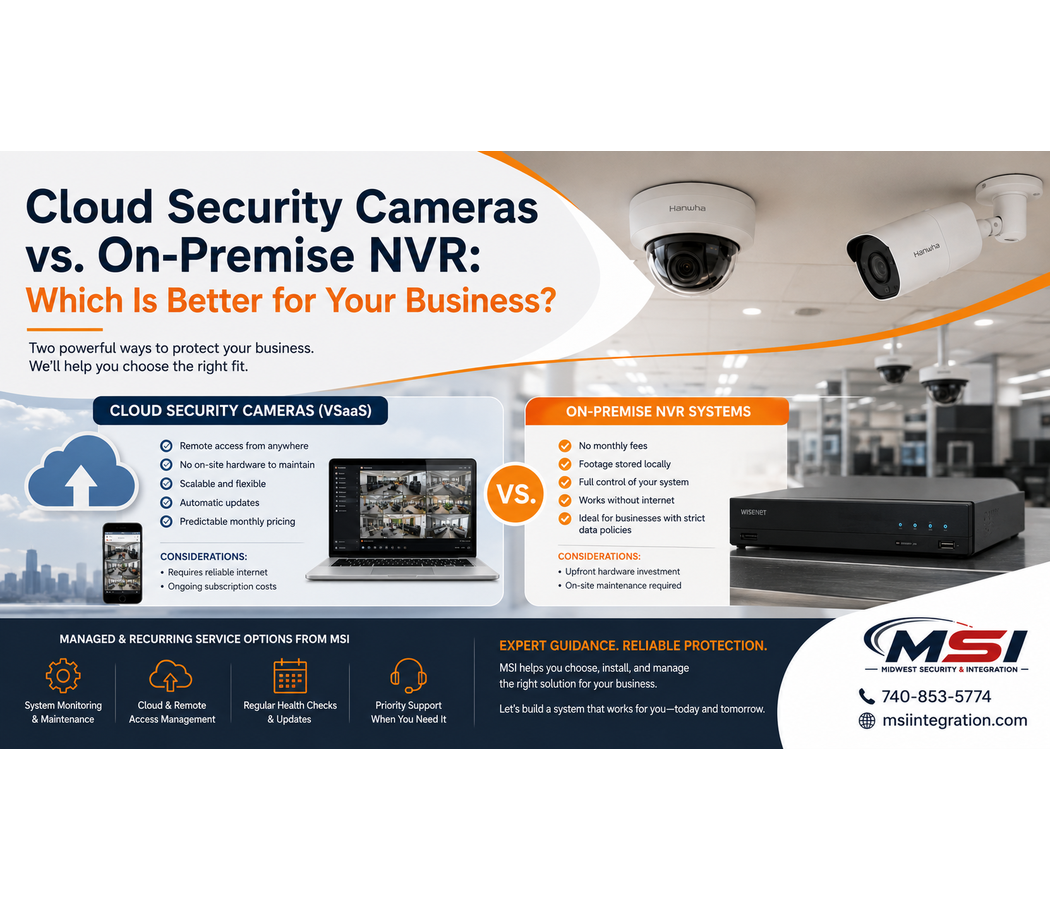
Cloud vs. NVR: A Simple Comparison
A traditional on-premise NVR may be a better fit if you value:
Local video storage
Greater control over on-site equipment
Reduced reliance on recurring cloud subscriptions
Large local storage capacity
Recording that can continue locally during certain internet outages
A cloud or VSaaS solution may be a better fit if you value:
Simplified remote access
Centralized management
Multi-location administration
Predictable monthly service
Ongoing professional equipment support under qualifying service agreements
Reduced responsibility for managing the system yourself
Neither option is automatically better.
The right answer depends on your organization.
More Than Just Video Surveillance
The performance of either type of security camera system depends on the infrastructure supporting it.
Midwest Security & Integration (MSI) provides commercial services including:
- Commercial security camera installation
- Cloud video surveillance
- VSaaS solutions
- NVR-based video surveillance
- Hanwha Vision security cameras
- AI video analytics
- Access control installation
- Commercial Wi-Fi installation
- Point-to-point wireless networking
- Structured cabling installation
- Network infrastructure cabling
- Commercial network installation
That allows us to help businesses with both the surveillance system and the technology infrastructure behind it.
What Types of Businesses Can Use Cloud or NVR Surveillance?
MSI provides solutions for a wide range of commercial and public-sector environments, including retail stores, grocery stores, gas stations, convenience stores, restaurants, warehouses, manufacturing facilities, industrial properties, schools, government buildings, parks, offices, healthcare facilities, apartment properties, car dealerships, storage facilities, construction companies, temporary work sites, road construction projects, utilities, and many other commercial facilities.
Each type of property can have different requirements.
That’s why the system should be designed around how the organization actually operates.
Commercial Video Surveillance in Southeastern Ohio
If you’re searching for cloud security cameras for business, VSaaS, cloud vs. NVR security cameras, or professional commercial video surveillance in Southeastern Ohio, Midwest Security & Integration can help.
MSI proudly serves businesses and organizations throughout Southeastern Ohio, including Chillicothe, Waverly, Jackson, Portsmouth, Circleville, Washington Court House, Athens, Gallipolis, Logan, Ironton, McArthur, Pomeroy, New Lexington, Caldwell, Woodsfield, McConnelsville, Marietta, and surrounding communities.
Our service area includes Ross County, Pike County, Jackson County, Scioto County, Athens County, Gallia County, Hocking County, Lawrence County, Meigs County, Monroe County, Morgan County, Noble County, Perry County, Vinton County, Washington County, and surrounding areas of Southeastern Ohio.
So, Which Is Better: Cloud Security Cameras or an NVR?
It depends on what matters most to your business.
If you want local storage, more direct control over your recording equipment, and potentially fewer recurring cloud fees, a traditional NVR may be the right choice.
If you want easier remote access, centralized management, predictable monthly service, and ongoing support through a qualifying managed-service agreement, VSaaS or cloud-based video surveillance may be a better fit.
And in some cases, a hybrid solution may offer the best balance.
Midwest Security & Integration (MSI) can evaluate your property, network infrastructure, number of locations, storage requirements, budget, and long-term goals to help determine the right commercial surveillance solution.
Whether you need cloud security cameras, an on-premise NVR, access control, commercial Wi-Fi, structured cabling, or network infrastructure, MSI serves businesses and organizations throughout Southeastern Ohio.
Check us out here: https://msiintegration.com/
Call Midwest Security & Integration (MSI): 740-853-5774