how-much-does-a-security-cameras-cost-in-ohio
If you’re considering security cameras for your business, one of your first questions is probably:
How much does a commercial security camera system actually cost?
The answer depends heavily on the property.
A small retail store requiring a handful of cameras is completely different from a large warehouse, manufacturing facility, school, government building, grocery store, or multi-building commercial property requiring dozens of cameras.
At Midwest Security & Integration (MSI), we provide professional commercial security camera installation throughout Southeastern Ohio. Rather than selling businesses a one-size-fits-all camera package, we design systems around the facility, security objectives, infrastructure, and budget.
Here’s what Ohio business owners should understand when budgeting for a commercial video surveillance system.
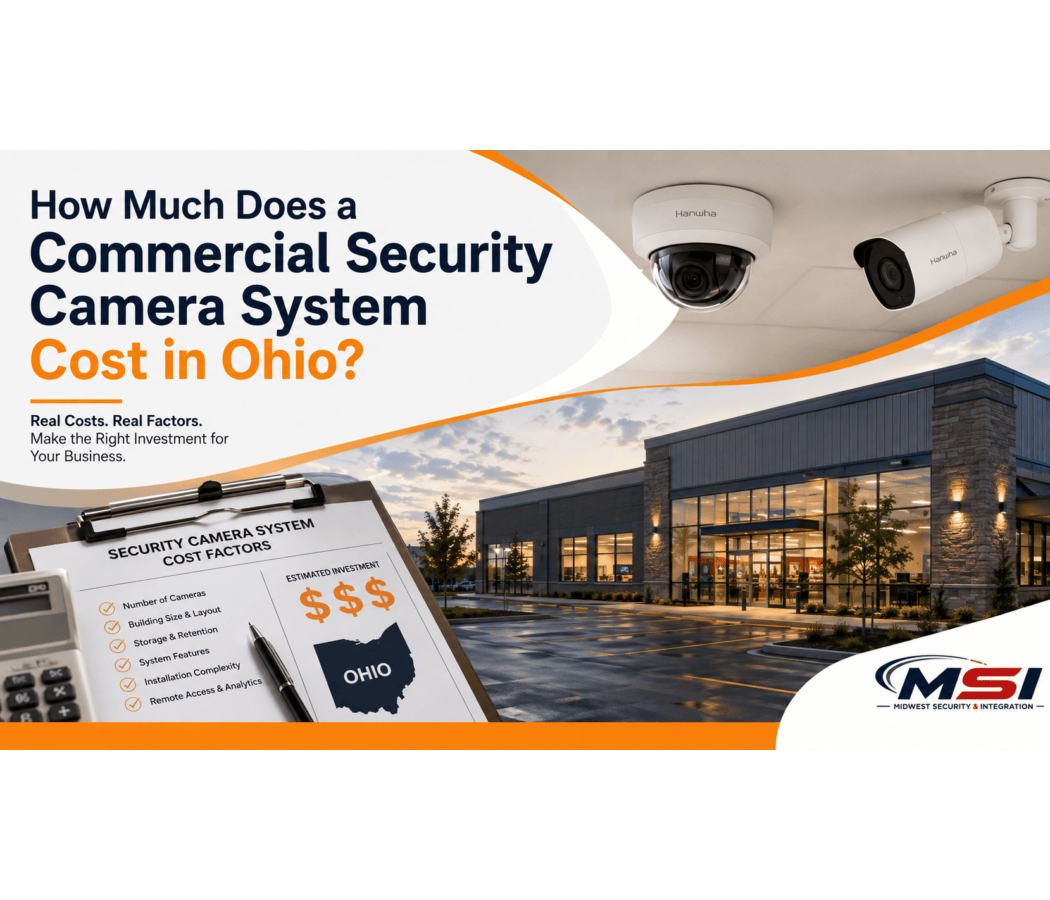
What Does a Commercial Security Camera System Cost?
There isn’t one accurate price that applies to every business.
A professional commercial security camera project can range from a relatively small installation to a substantial investment depending on the number and type of cameras, recording requirements, network infrastructure, cabling, building layout, installation difficulty, and technology being used.
For example, consider the difference between:
A small retail business needing cameras around its entrance, register, sales floor, and parking area.
versus:
A large industrial facility requiring dozens of cameras, multiple network switches, long cable runs, fiber connections between buildings, large amounts of video storage, access control, wireless infrastructure, and advanced video analytics.
Both are commercial security camera systems, but the scope of work is completely different.
That’s why a professional site evaluation and system design are so important.
1. How Many Security Cameras Do You Need?
Camera count is one of the biggest factors affecting the cost of a commercial surveillance system.
However, more cameras aren’t automatically better.
A properly designed system should identify what you actually need to see.
That may include:
- Entrances and exits
- Parking lots
- Cash registers
- Sales floors
- Loading docks
- Warehouses
- Building perimeters
- Inventory areas
- Employee entrances
- Equipment yards
- Fuel pumps
- Hallways
- Restricted areas
- Construction equipment
- Temporary work sites
Strategic placement can sometimes allow one properly selected camera to accomplish a job that several poorly positioned cameras cannot.
Midwest Security & Integration (MSI) evaluates the property and recommends cameras based on the coverage and image detail required.
2. The Type of Camera Makes a Difference
Not every commercial security camera costs the same.
Different environments require different equipment.
A standard fixed camera covering an indoor hallway has very different requirements from a camera expected to identify activity across a large parking lot at night.
Commercial systems may utilize technologies such as:
Fixed cameras for consistent coverage of important areas.
Varifocal cameras where the viewing angle needs to be adjusted for a particular target.
PTZ cameras that provide pan, tilt, and optical zoom capabilities for large areas.
Multi-sensor cameras that can provide multiple viewing angles from a single installation location.
AI-enabled cameras that can provide intelligent object classification and advanced video analytics.
License plate recognition cameras designed for applications where capturing vehicle license plates is an important objective.
MSI works with professional commercial surveillance manufacturers, including Hanwha Vision, to select equipment based on the application rather than simply choosing the cheapest camera available.
3. Your Building Size and Layout Affect Installation Cost
The camera itself is only part of a professional installation.
The physical building can have a major impact on project cost.
Consider two businesses that both need 12 cameras.
One operates in a relatively small single-story building with accessible ceilings.
The other operates in a large industrial facility with 25-foot ceilings, multiple buildings, difficult cable pathways, outdoor equipment, and cameras located hundreds of feet from the network equipment.
Those installations are not going to cost the same.
Installation complexity can involve:
- Ceiling height
- Building construction
- Cable distances
- Conduit requirements
- Exterior penetrations
- Lift requirements
- Multiple buildings
- Underground pathways
- Network equipment locations
- Existing infrastructure
- Outdoor camera mounting
- Difficult-to-access areas
This is one reason online camera-package pricing rarely tells you the actual cost of a professionally installed commercial system.
4. Structured Cabling and Network Infrastructure
Modern commercial IP security cameras depend on a reliable network.
That means structured cabling and network infrastructure are an important part of many installations.
A project may require new Ethernet cabling, PoE network switches, equipment racks, patch panels, network configuration, fiber connections, wireless bridges, or other infrastructure.
At Midwest Security & Integration (MSI), we provide professional structured cabling installation and commercial network infrastructure installation in addition to video surveillance.
This allows us to look at the complete infrastructure supporting the security system rather than treating the cameras as separate devices.
5. How Much Video Storage Do You Need?
Another major consideration is video retention.
How long does your business want to keep recorded video?
Several days?
Several weeks?
Longer?
Storage requirements depend on factors including:
- Number of cameras
- Camera resolution
- Frame rate
- Recording configuration
- Video compression
- Amount of activity
- Desired retention period
A business with four cameras and modest retention requirements needs significantly less storage than a facility operating 50 high-resolution cameras.
Recording requirements should be calculated when designing the system instead of guessing how much storage will be enough.
6. AI Video Analytics Can Affect Cost
Modern commercial security cameras are becoming much more intelligent.
Depending on the equipment and software selected, AI video analytics may provide capabilities such as distinguishing people from vehicles and helping authorized users search recorded video more efficiently.
Advanced analytics can be extremely valuable for certain businesses, but the required cameras, software, licensing, and configuration can affect the overall project cost.
The important question isn’t:
“Does this camera have AI?”
It’s:
“Which analytics will actually benefit my business?”
MSI can help determine where advanced analytics make sense and where a traditional camera may accomplish the job perfectly well.
7. Local Recording vs. Cloud-Based Video Surveillance
Businesses also have different options for how their surveillance system is managed.
A traditional commercial system may use an on-site NVR or video management appliance to store recorded video locally.
Other businesses may prefer cloud-based video surveillance or VSaaS (Video Surveillance as a Service).
With qualifying VSaaS solutions, businesses can use a recurring monthly service model rather than approaching video surveillance solely as a traditional upfront equipment purchase.
Cloud features, storage, equipment coverage, remote access, service levels, and monthly costs vary depending on the solution and agreement selected.
MSI can help businesses compare traditional video surveillance and cloud-based options to determine which approach makes sense.
8. Don’t Choose a Security System Based Only on Price
Price matters.
But with commercial surveillance, the cheapest proposal isn’t necessarily the least expensive solution over the long term.
A lower-priced system isn’t much of a bargain if cameras repeatedly fail, important areas aren’t covered, nighttime video is unusable, recordings don’t contain enough detail, storage wasn’t calculated correctly, or nobody is available when the system needs service.
When comparing commercial security camera proposals, look beyond the final number.
Ask:
What equipment am I getting?
How are the cameras being positioned?
What image quality should I expect?
How long will my recordings be retained?
What happens when I need technical support?
Who services the equipment?
Is the network infrastructure being installed professionally?
Can the system expand as my business grows?
A commercial surveillance system should be designed as infrastructure for your business—not simply a collection of cameras.
Security Cameras Are Only One Part of Commercial Security
Depending on your facility, it may make sense to integrate additional technologies into the project.
Midwest Security & Integration (MSI) provides commercial technology solutions including:
- Commercial security camera installation
- Hanwha Vision security cameras
- AI video surveillance
- PTZ security cameras
- Cloud video surveillance and VSaaS
- Access control installation
- Door access control systems
- Commercial Wi-Fi installation
- Point-to-point wireless networking
- Structured cabling installation
- Network infrastructure cabling
- Commercial network installation
Having one commercial integration company capable of working with the cameras, network, cabling, wireless infrastructure, and access control can simplify both installation and future expansion.
What Types of Businesses Does MSI Work With?
Commercial surveillance requirements are different for every industry.
Midwest Security & Integration (MSI) provides solutions for businesses and organizations including retail stores, grocery stores, gas stations, convenience stores, restaurants, car dealerships, warehouses, manufacturing facilities, industrial plants, schools, government facilities, parks, offices, healthcare facilities, apartment properties, storage facilities, construction companies, road construction projects, temporary work sites, utilities, and other commercial and public-sector environments.
Whether you’re protecting one small commercial property or multiple facilities, the system should be designed around your actual risks and operational requirements.
Commercial Security Camera Installation in Southeastern Ohio
If you’re searching Google for commercial security camera installation cost in Ohio, business security camera cost, commercial security cameras in Southeastern Ohio, or a commercial security camera installer near you, Midwest Security & Integration can help.
MSI proudly serves Southeastern Ohio, including Chillicothe, Waverly, Jackson, Portsmouth, Circleville, Washington Court House, Athens, Gallipolis, Logan, Ironton, McArthur, Pomeroy, New Lexington, Caldwell, Woodsfield, McConnelsville, Marietta, and surrounding communities.
Our service area includes Ross County, Pike County, Jackson County, Scioto County, Athens County, Gallia County, Hocking County, Lawrence County, Meigs County, Monroe County, Morgan County, Noble County, Perry County, Vinton County, Washington County, and surrounding areas of Southeastern Ohio.
So, How Much Will Your Security Camera System Cost?
The best way to answer that question is to evaluate your property and determine what you’re actually trying to accomplish.
How many cameras do you need? What areas need coverage? How much video storage is required? Is cabling already available? Do you need new network infrastructure? Would AI analytics benefit your operation? Do you prefer traditional local recording or a cloud-based solution?
Those answers determine the real cost of your project.
Instead of buying equipment first and figuring everything else out later, Midwest Security & Integration (MSI) can help design a professional commercial security system around your facility and budget.
Request a Commercial Security Camera Quote
If you’re considering commercial security camera installation, access control, commercial Wi-Fi, or structured cabling in Southeastern Ohio, contact Midwest Security & Integration.
Let MSI evaluate your property, discuss your goals, and build a solution around what your business actually needs.
Check us out here: https://msiintegration.com/
Call Midwest Security & Integration (MSI): 740-853-5774