

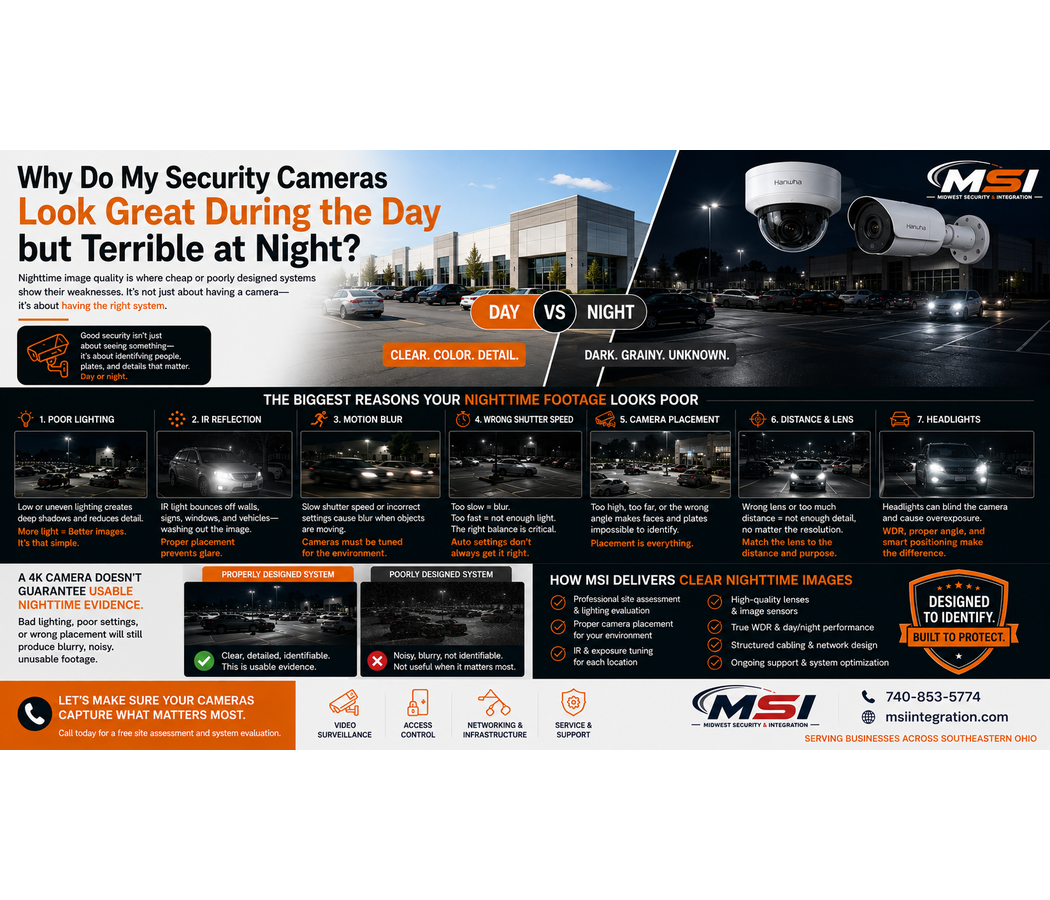
why do security camera look terrible at night
Your security cameras look sharp during the day.
You can see people, vehicles, entrances, and activity clearly.
Then the sun goes down.
Suddenly, faces become blurry. Vehicles lose detail. Headlights wash out the image. Moving people turn into a blur, and the expensive “4K” camera you bought does not seem nearly as impressive.
Nighttime is where a security camera system often proves how good—or how poorly designed—it really is.
At Midwest Security & Integration (MSI), we design and install professional commercial security camera systems throughout Southeastern Ohio. One of the most important parts of our system design is determining how cameras need to perform when lighting conditions are at their worst.
For many businesses, that means after dark.
Why Do Security Cameras Struggle at Night?
Cameras need light to create an image.
During the day, there is usually plenty of available light. As a result, cameras can capture sharper images with better detail.
At night, the situation changes.
The camera has much less light available. Therefore, it must work harder to produce a usable image.
Several factors can affect the result:
- Available lighting
- Camera sensor quality
- Shutter speed
- Infrared illumination
- Camera placement
- Lens selection
- Distance
- Vehicle headlights
- Reflections
- Movement
- Camera settings
This is why nighttime performance involves much more than simply choosing a camera with a high resolution.
A 4K Camera Does Not Guarantee Great Night Video
This is one of the biggest misunderstandings in commercial video surveillance.
More megapixels do not automatically mean better nighttime evidence.
A 4K camera can provide excellent detail under the right conditions. However, resolution is only one part of image quality.
Think about it this way.
A camera can record a high-resolution image of a blurry person.
You now have a lot of pixels, but the person is still blurry.
Sensor performance, available light, lens quality, shutter speed, exposure, placement, and distance can all affect the amount of usable detail in the recording.
Therefore, businesses should not choose cameras based only on the number printed on the box.
Seeing Someone Is Different From Identifying Someone
This distinction is extremely important.
A security camera may clearly show that a person walked across your parking lot.
However, can you actually identify useful details about that person?
That is a different goal.
The same applies to vehicles.
A camera may show a car entering the property. However, it may not provide enough detail to identify important characteristics or capture a readable license plate.
When MSI designs a system, we consider what each camera needs to accomplish.
A general overview camera has a different job than a camera designed to capture useful detail at an entrance.
Low Exterior Lighting Creates Challenges
Many commercial properties have areas with limited lighting.
Parking lots, loading docks, equipment yards, rear entrances, construction sites, storage areas, and building perimeters may become extremely dark at night.
A camera may compensate by increasing exposure or making other adjustments to brighten the image.
That can help with stationary objects.
However, movement can become more difficult.
This is where businesses may see a strange problem:
The parking lot looks bright enough, but the moving person is blurry.
The camera produced a bright image, but that does not necessarily mean it captured useful evidence.
Motion Blur Can Destroy Important Detail
Motion blur is one of the biggest nighttime security camera problems.
Imagine someone walking quickly across a dark parking lot.
The camera needs enough light to create an image. In low-light conditions, it may use a slower shutter speed to collect more light.
However, the person continues moving while the camera captures that image.
The result can be a brighter picture with a blurry person.
This creates an important tradeoff between brightness and motion detail.
A professionally designed system should consider the type of movement expected in each area.
Why Shutter Speed Matters
Shutter speed affects how long the camera gathers light for each image.
A slower shutter can gather more light. Therefore, the scene may appear brighter.
However, moving objects may become blurry.
A faster shutter can help freeze motion and capture sharper moving objects.
The downside is that the camera receives less light.
Therefore, the image may become darker unless enough light is available.
This is one reason professional camera setup matters.
Simply leaving every camera on default settings may not provide the best results for every location.
What Is Infrared Night Vision?
Many security cameras use infrared, or IR, illumination to help see in dark conditions.
Infrared light is generally invisible to the human eye. However, compatible security cameras can use it to create an image when visible light is limited.
This is why many nighttime security recordings appear black and white.
IR can be very useful.
However, it also has limitations.
Distance, camera placement, reflective objects, walls, ceilings, and other surfaces can affect how well infrared illumination works.
IR Reflection Can Ruin an Image
Have you ever seen a nighttime security camera image where part of the picture is extremely bright while everything else is dark?
Infrared reflection may be part of the problem.
For example, IR light can reflect from:
- Walls
- Soffits
- Signs
- Building surfaces
- Spider webs
- Dirt on the camera
- Nearby objects
- Certain reflective materials
The camera may then adjust exposure based on that bright reflection.
As a result, the area you actually want to see may become darker.
Proper camera placement can help reduce these problems.
Spider Webs Can Become a Bigger Problem Than You Think
Outdoor cameras attract insects.
In turn, spiders sometimes build webs around cameras.
During the day, a small web may barely affect the image.
At night, the camera’s infrared light can illuminate the web directly in front of the lens.
Suddenly, a tiny strand can appear extremely bright.
The same issue can happen with insects, dust, water, or debris close to the camera.
Regular maintenance can help keep outdoor camera images clear.
Vehicle Headlights Are Difficult for Cameras
Parking lots and driveways create another challenge: headlights.
A camera may be looking at a dark entrance when a vehicle approaches with bright headlights pointed directly toward it.
Now the camera must deal with extremely bright headlights and a dark background at the same time.
That is a difficult scene.
Professional cameras can use technologies and settings designed to handle challenging lighting conditions. However, placement still matters.
In some situations, changing the camera angle can make a major difference.
License Plates Are Even More Difficult at Night
License plates create their own set of challenges.
They are small, reflective, and attached to moving vehicles.
At night, headlights and infrared illumination can make a plate appear extremely bright.
Meanwhile, motion can make the characters blurry.
This is why a normal parking lot camera should not automatically be expected to capture readable license plates.
If plate capture matters, a business may need a dedicated license plate camera or LPR solution designed around a specific vehicle entrance or exit.
Camera Placement Can Make or Break Nighttime Video
You can buy an excellent camera and still get poor results if it is installed in the wrong place.
Mounting height matters.
Viewing angle matters.
Distance matters.
Nearby lights matter.
The direction vehicles travel matters.
Even the color and location of nearby walls can affect nighttime performance.
For example, mounting a camera extremely high may provide a large overview. However, the people and vehicles you want to identify may become very small in the image.
Therefore, MSI does not simply ask:
“Where can we mount a camera?”
We ask:
“What does this camera need to see?”
Distance Becomes Even More Important at Night
A camera may provide a beautiful wide view of a parking lot.
However, a person 150 feet away may only occupy a small part of that image.
At night, the problem can become even more noticeable.
Less light and greater distance can make useful identification difficult.
In some situations, adding another camera closer to an important area may provide better results than trying to make one camera cover everything.
Proper lens selection can also help.
More Cameras Can Sometimes Be Better Than One Giant Overview
Businesses often want one camera to cover as much property as possible.
That sounds efficient.
However, extremely wide coverage can reduce the amount of detail available for individual targets.
For example, one camera may provide an overview of an entire parking lot.
Another camera may focus on the employee entrance.
A third camera may cover the vehicle entrance.
Each camera now has a specific job.
This type of design can provide more useful video than asking one camera to accomplish every goal.
Good Exterior Lighting Can Improve Security Camera Performance
Sometimes the best improvement is not another camera.
It is better lighting.
Proper exterior lighting can help cameras maintain better image quality and capture moving subjects more clearly.
It can also improve visibility around entrances, sidewalks, parking areas, loading docks, and other parts of the property.
However, more light is not automatically better.
Poorly positioned lights can create glare, harsh shadows, and uneven exposure.
Therefore, lighting and camera placement should work together.
Color Night Vision vs. Infrared
Modern commercial cameras may offer different approaches to nighttime imaging.
Some cameras can produce useful color images in low-light environments when enough ambient light is available.
Others may switch to infrared-assisted black-and-white video as conditions become darker.
The best choice depends on the location.
A well-lit entrance may have different requirements than a dark equipment yard.
Likewise, a parking lot with strong exterior lighting may require a different approach than a remote construction site.
AI Cannot Fix a Bad Image
Modern AI security cameras can provide valuable tools.
Depending on the system, AI may help distinguish people from vehicles and make recorded video easier to search.
However, AI does not eliminate the need for good image quality.
If the camera cannot capture enough useful visual information, software cannot magically recreate details that were never recorded.
Therefore, good camera selection and placement still come first.
At Midwest Security & Integration (MSI), we work with professional commercial surveillance technology, including Hanwha Vision, to design systems around real-world conditions.
Test Your Cameras at Night—Not Just During the Day
One of the best things a business owner can do is review the system after dark.
Do not simply look at the monitor and ask whether you can see the parking lot.
Look deeper.
Can you see a moving person’s face clearly enough for your needs?
Can you see vehicles?
How does the camera react to headlights?
Are entrances properly exposed?
Are there bright reflections?
Do moving objects become blurry?
Are distant areas actually useful?
You may discover that a system that looks excellent at 2:00 p.m. performs very differently at 2:00 a.m.
Your Old Cameras May Be Ready for an Upgrade
Poor nighttime performance can also be a sign of an aging security camera system.
Older cameras may lack the sensor performance, processing, analytics, and low-light capabilities available in newer commercial equipment.
However, replacing cameras should not become a simple one-for-one swap.
If the old camera was installed in a poor location, installing a new camera in exactly the same place may repeat the problem.
An upgrade provides an opportunity to reconsider the complete system.
Commercial Nighttime Security Camera Installation
At Midwest Security & Integration (MSI), we design commercial surveillance systems around the property instead of simply mounting cameras wherever installation is easiest.
Depending on the project, a system may include:
- Commercial security cameras
- Low-light cameras
- Hanwha Vision cameras
- AI video analytics
- PTZ cameras
- License plate cameras
- NVR video recording
- Cloud video surveillance
- VSaaS
- Access control
- Commercial Wi-Fi
- Point-to-point wireless networking
- Structured cabling
- Network infrastructure
Our goal is to build a complete system that works together.
What Types of Businesses Need Good Nighttime Video?
Nighttime performance matters for almost every commercial property. However, it becomes especially important for businesses that operate late or have valuable outdoor areas.
Midwest Security & Integration (MSI) works with retail stores, grocery stores, gas stations, convenience stores, restaurants, car dealerships, warehouses, manufacturing plants, industrial facilities, schools, government buildings, parks, healthcare facilities, offices, apartment properties, storage facilities, construction sites, road construction projects, temporary work sites, utilities, equipment yards, and other commercial properties.
A gas station may need clear video around fuel pumps and parking areas.
Meanwhile, a warehouse may need nighttime coverage of loading docks and employee entrances.
A car dealership may need long-distance coverage across rows of vehicles.
A construction site may need cameras around equipment and materials.
Each location requires a different approach.
Commercial Security Camera Installation in Southeastern Ohio
If you are searching for commercial security cameras with good night vision, outdoor security camera installation, low-light security cameras, or commercial video surveillance in Southeastern Ohio, Midwest Security & Integration can help.
MSI proudly serves businesses and organizations throughout Chillicothe, Waverly, Jackson, Portsmouth, Circleville, Washington Court House, Athens, Gallipolis, Logan, Ironton, McArthur, Pomeroy, New Lexington, Caldwell, Woodsfield, McConnelsville, Marietta, and surrounding Southeastern Ohio communities.
Our service area also includes Ross County, Pike County, Jackson County, Scioto County, Athens County, Gallia County, Hocking County, Lawrence County, Meigs County, Monroe County, Morgan County, Noble County, Perry County, Vinton County, Washington County, and surrounding areas of Southeastern Ohio.
Don’t Judge a Security Camera Only by Its Daytime Image
A security camera system needs to perform when your business needs it most.
That includes nighttime.
If your cameras look great during the day but produce blurry people, washed-out headlights, dark parking lots, bright IR reflections, or poor detail after dark, the problem may not simply be camera resolution.
Lighting, shutter speed, camera placement, distance, lenses, infrared performance, and system design all play a role.
Most importantly:
A “4K” label does not guarantee useful evidence.
At Midwest Security & Integration (MSI), we can evaluate your existing system or design a new commercial surveillance system around the real conditions at your property—day and night.
Whether you need commercial security camera installation, low-light cameras, license plate cameras, access control, commercial Wi-Fi, structured cabling, or network infrastructure, MSI provides professional commercial installation throughout Southeastern Ohio.
Check us out here: msiintegration.com
Call Midwest Security & Integration (MSI): 740-853-5774