Security Camera Footage After a Theft: Will Your System Actually Give Police Useful Evidence?
After a theft, one of the first things a business owner may do is pull up the security camera footage.
Then comes the real question:
Can you actually identify the person, vehicle, or license plate involved?
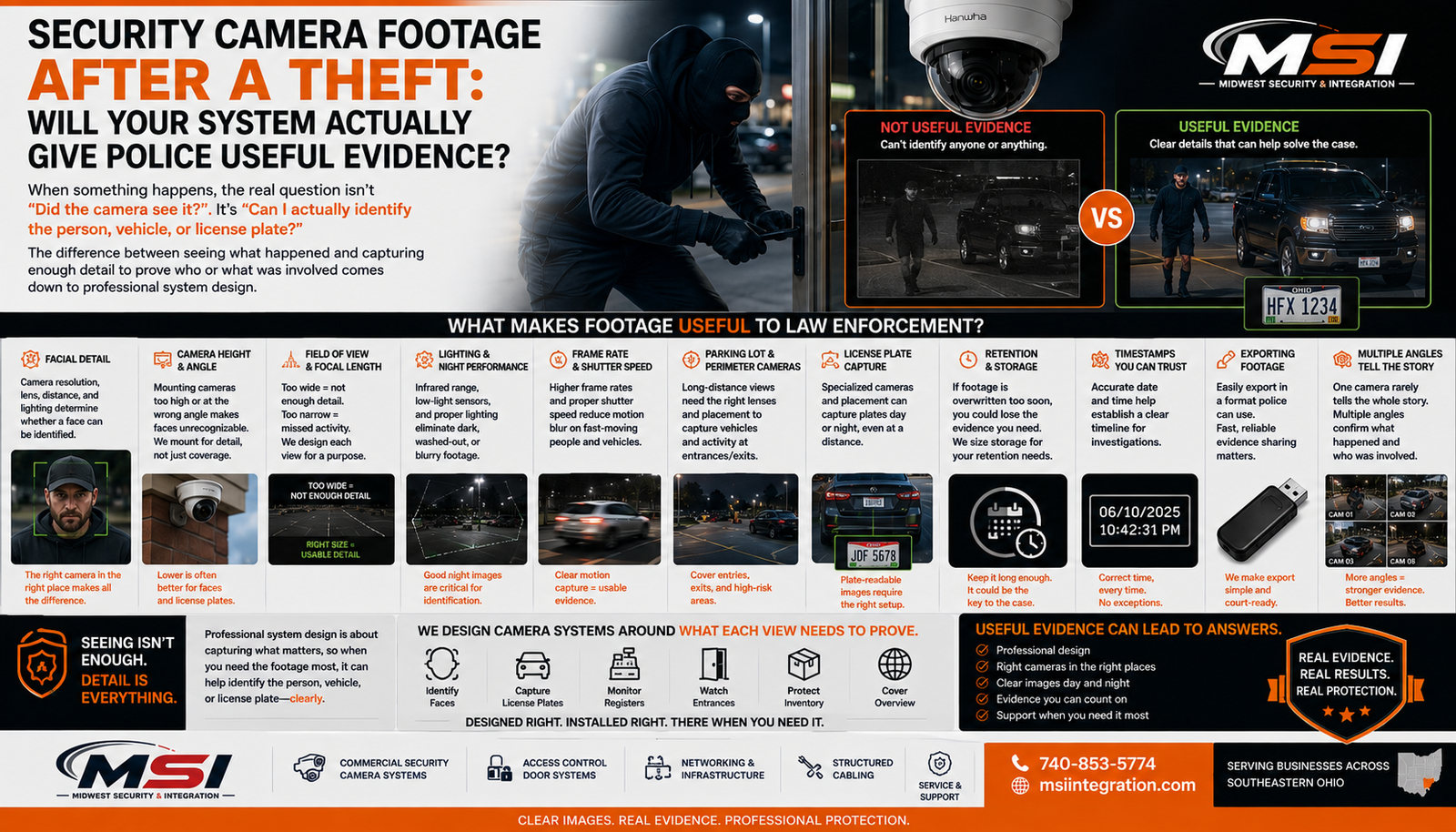
There is a major difference between having video that shows something happened and having video that provides useful evidence.
At Midwest Security & Integration (MSI), we design commercial security camera systems throughout Southeastern Ohio around the purpose of each view. One camera may need to show a face. Another may need to capture a vehicle. A different camera may need to cover a cash register or provide an overview of a parking lot.
That is why professional system design matters.
Seeing an Incident Is Not the Same as Identifying Someone
A camera may clearly show that a person entered your building.
However, that does not automatically mean the image contains enough detail to identify that person.
The same is true for vehicles.
You may see a car pull into the parking lot, but can you tell the make, model, color, or plate number?
This difference is important.
A wide-angle camera can be useful for general awareness. However, it may not provide the detail needed for identification.
That is why each camera should have a specific job.
Facial Detail Depends on More Than Resolution
Business owners often assume that a high-resolution camera will automatically provide clear faces.
Resolution matters, but it is only one part of the picture.
Other factors include:
- Camera distance
- Mounting height
- Lens selection
- Field of view
- Lighting
- Motion
- Camera angle
- Image compression
For example, a very wide view may show an entire room. However, a person’s face may only take up a small part of the image.
A camera placed closer to an entrance may provide much more useful facial detail.
Camera Height Can Make a Big Difference
Mounting cameras too high is a common mistake.
A high camera may provide a large overview.
However, it can also create a steep angle that shows the top of someone’s head instead of their face.
For some areas, a lower and more focused camera may provide better identification.
The correct height depends on the goal.
A camera designed for overview coverage may sit higher.
A camera intended to capture faces at an entrance may need a different position.
Field of View Matters
The wider the image, the more area the camera can see.
That sounds useful.
However, there is a tradeoff.
As the field of view becomes wider, individual people and objects may become smaller in the image.
This can reduce useful detail.
For example, one camera may show an entire parking lot. However, a vehicle at the far end may appear very small.
That is why MSI does not treat every camera location the same.
We ask:
What does this camera need to prove?
Nighttime Footage Can Be the Weakest Part of the System
Many cameras look excellent during the day.
The real test often comes at night.
Low light can create:
- Blurry faces
- Dark images
- Washed-out headlights
- Motion blur
- Poor color
- Weak detail
- IR reflection
If a theft happens after dark, poor nighttime performance can reduce the value of the footage.
That is why commercial security cameras should be evaluated in real nighttime conditions.
Frame Rate Can Affect Moving Detail
Frame rate is another factor.
A higher frame rate can capture motion more smoothly.
However, frame rate also affects storage and bandwidth.
The correct setting depends on the application.
For example, a camera covering a fast-moving vehicle area may have different needs than a camera watching a quiet hallway.
The system should balance motion detail, storage, and image quality.
Parking Lot Cameras Need Special Planning
Parking lots are especially difficult.
Distance, darkness, headlights, weather, vehicle speed, and camera height can all affect image quality.
A wide parking lot camera may provide a good overview.
However, it may not provide enough detail to identify a vehicle.
That is why large commercial parking lots often benefit from several different camera views.
For example:
- Overview cameras
- Entrance and exit cameras
- PTZ cameras
- Focused vehicle cameras
- Dedicated license plate cameras
Each camera can serve a different purpose.
License Plate Capture Requires the Right Camera and Location
A license plate is a small target.
It is also reflective and often moving.
Because of that, a general outdoor camera may not provide readable plates.
If license plate capture is important, the system should be designed around it.
A dedicated plate camera may need a tighter view of a driveway, gate, or vehicle entrance.
Distance, angle, lighting, speed, and camera settings all matter.
At Midwest Security & Integration (MSI), we can design license plate coverage around specific traffic paths instead of expecting one parking lot camera to do everything.
Multiple Camera Angles Can Provide Better Evidence
One camera may not tell the whole story.
For example, an overview camera may show how someone moved through the property.
An entrance camera may show facial detail.
A register camera may show the transaction area.
An exterior camera may show the vehicle.
A license plate camera may capture the plate.
Together, these views can provide much more useful information.
This is why camera placement should be planned as a system.
Timestamps Matter
Accurate timestamps can be very important when reviewing footage.
A business may need to know exactly when an event happened.
If camera clocks are incorrect, reviewing multiple views can become confusing.
The system should be properly configured so recordings use consistent time settings.
This can make it easier to review footage from several cameras around the same incident.
Video Retention Matters Too
Useful footage is only helpful if it still exists.
Imagine discovering a theft two weeks after it happened.
If your system only keeps seven days of footage, the recording may already be gone.
Businesses should think about how long they want to keep video.
Common retention goals may include:
- 30 days
- 60 days
- 90 days
The right amount depends on the business, number of cameras, resolution, storage capacity, and recording method.
MSI can help size storage around the customer’s retention goals.
Can You Export Footage Easily?
Another important question is:
Can you quickly provide the video when it is needed?
A business may need to export footage for law enforcement, insurance, management, or internal review.
A good commercial video system should make it reasonably easy for authorized users to locate and export recordings.
Older systems can make this process difficult.
Slow playback, confusing software, or outdated export formats can create unnecessary problems.
Remote Access Can Help After an Incident
Modern commercial systems can also provide remote access.
Depending on the platform, authorized users may be able to review live and recorded footage from a phone or computer.
This can help business owners respond faster when they are away from the property.
Cloud-based systems and VSaaS can provide additional remote-management options.
Traditional NVR systems may also support remote viewing.
The right choice depends on the business.
AI Search Can Help Find Events Faster
Modern commercial cameras may use AI analytics to help classify people and vehicles.
This can make recorded video easier to search.
For example, instead of manually reviewing hours of footage, an authorized user may be able to narrow a search to person or vehicle events.
At Midwest Security & Integration (MSI), we work with professional commercial surveillance technology, including Hanwha Vision, and can help determine when AI features provide useful value.
AI can make searching easier, but it does not replace good image quality.
The camera still needs to capture useful detail.
Good Evidence Starts With System Design
This is the key point.
A commercial security camera system should not be designed by asking only:
“How many cameras do we need?”
A better approach asks:
What does each camera need to show?
For example:
One camera may need to show a face.
Another may need to capture a plate.
Another may need to cover a register.
Another may need a wide overview.
Another may need to cover a loading dock.
Once the goal is clear, the correct camera, lens, angle, and placement can be selected.
Security Cameras Cannot Guarantee Theft Will Stop
Security cameras can help deter some unwanted activity.
However, no camera system can guarantee that theft, vandalism, or other crime will never happen.
The real value of a professionally designed surveillance system includes better visibility and the ability to review what happened.
If an incident occurs, the system should give your business the best chance of having useful video available.
What Types of Businesses Need Useful Evidence?
Almost every commercial property can benefit from properly designed surveillance.
Midwest Security & Integration (MSI) works with retail stores, grocery stores, gas stations, convenience stores, restaurants, car dealerships, warehouses, manufacturing plants, industrial properties, offices, schools, government facilities, parks, healthcare facilities, apartment properties, storage facilities, construction sites, road construction projects, temporary work sites, utilities, and other commercial environments.
Each business has different evidence needs.
A retail store may need register and entrance footage.
A warehouse may focus on loading docks and inventory.
A gas station may need strong nighttime exterior coverage.
A car dealership may care about long-distance vehicle detail.
That is why every system should be designed around the property.
Commercial Security Camera Installation in Southeastern Ohio
If you are searching for commercial security camera installation, security camera evidence, parking lot cameras, license plate cameras, or business video surveillance in Southeastern Ohio, Midwest Security & Integration can help.
MSI proudly serves businesses and organizations throughout Chillicothe, Waverly, Jackson, Portsmouth, Circleville, Washington Court House, Athens, Gallipolis, Logan, Ironton, McArthur, Pomeroy, New Lexington, Caldwell, Woodsfield, McConnelsville, Marietta, and surrounding Southeastern Ohio communities.
Our service area also includes Ross County, Pike County, Jackson County, Scioto County, Athens County, Gallia County, Hocking County, Lawrence County, Meigs County, Monroe County, Morgan County, Noble County, Perry County, Vinton County, Washington County, and surrounding areas of Southeastern Ohio.
In addition to commercial security cameras, MSI provides access control installation, commercial Wi-Fi, point-to-point wireless networking, structured cabling, and network infrastructure installation.
Will Your Current Security Cameras Give You Useful Evidence?
The answer should not be:
“We can see that something happened.”
The better answer is:
“We can see enough detail to understand who or what was involved.”
That difference comes down to camera placement, lighting, lenses, distance, nighttime performance, frame rate, storage, retention, and system design.
Midwest Security & Integration (MSI) can evaluate your current system or design a new commercial surveillance solution around the evidence your business may actually need.
Whether you need commercial security cameras, license plate cameras, PTZ cameras, access control, commercial Wi-Fi, structured cabling, or network infrastructure, MSI provides professional commercial installation throughout Southeastern Ohio.
Check us out here: https://msiintegration.com/
Call Midwest Security & Integration (MSI): 740-853-5774