

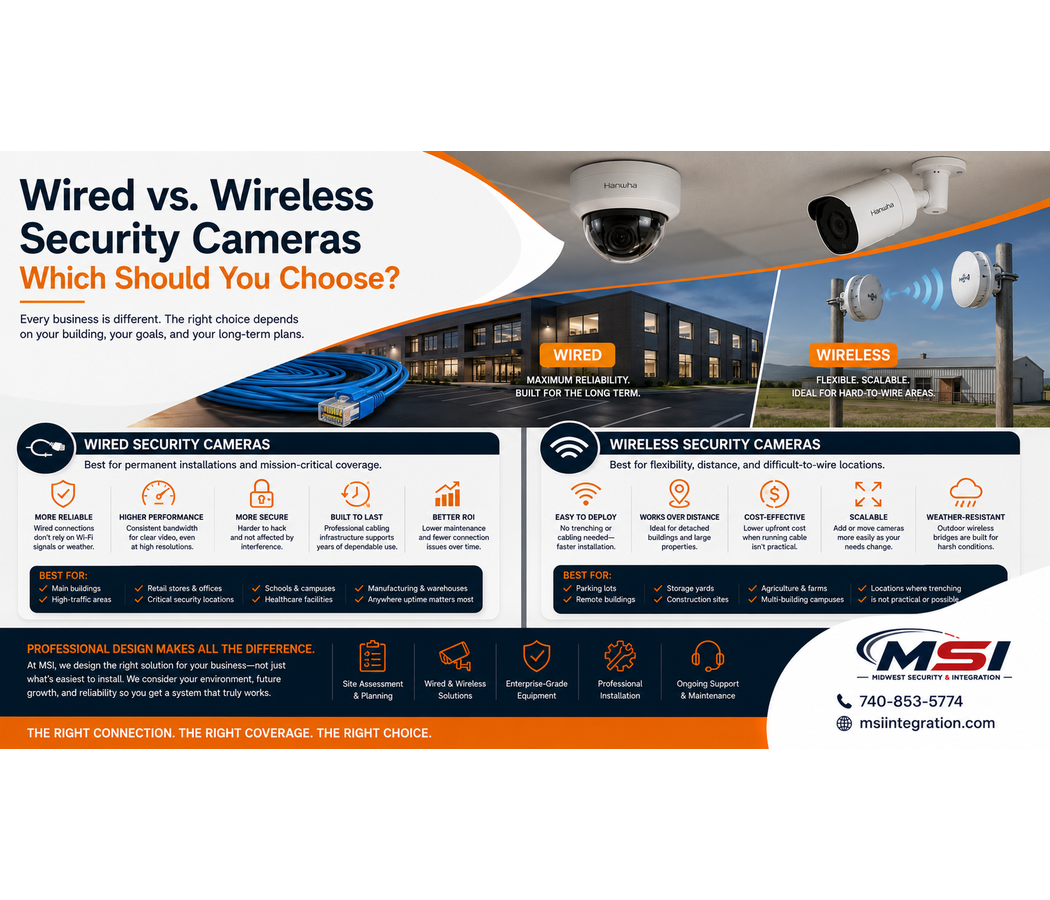
Wired vs. Wireless Security Cameras for Businesses: Which Should You Choose?
When businesses start looking for security cameras, one question comes up often:
Should we install wired or wireless security cameras?
Many people assume wireless cameras are easier to install, less expensive, and completely wire-free.
However, commercial security systems work differently.
For most permanent commercial installations, a professionally wired network provides a strong and reliable foundation. Still, wireless technology can be extremely useful when you need to connect detached buildings, parking areas, remote structures, or other difficult locations.
At Midwest Security & Integration (MSI), we design and install commercial security camera systems throughout Southeastern Ohio. We use wired and wireless technology based on what works best for the property.
The goal is not to choose wired or wireless because one sounds better.
Instead, the goal is to build a reliable system around the business.
What Is a Wired Security Camera System?
Most modern commercial security cameras are IP cameras.
A professionally wired IP camera typically connects to the network through Ethernet cabling. In many systems, that same cable can also provide power through PoE, or Power over Ethernet.
As a result, one properly installed network cable can provide both network communication and power to the camera.
The cameras may connect to network switches and an NVR, server, cloud platform, or video management system.
For permanent commercial installations, this approach can provide a stable foundation for the surveillance system.
Why Does MSI Often Prefer Wired Cameras?
Reliability is one of the biggest reasons.
A commercial security camera may operate 24 hours a day, seven days a week.
Therefore, the connection supporting that camera matters.
Professionally installed structured cabling can provide a dedicated physical connection between the camera and the network.
In addition, wired infrastructure can make it easier to manage power, network traffic, equipment, and future system expansion.
For many permanent installations, Midwest Security & Integration (MSI) prefers professionally wired infrastructure when it is practical.
Wireless Does Not Always Mean Wire-Free
This is an important point.
Wireless does not automatically mean there are no wires.
A commercial camera still needs power.
Even if video travels wirelessly, the camera usually needs a power source. In other situations, a wireless bridge may carry the network connection while cameras connect to a switch with normal Ethernet cables at the remote location.
Therefore, wireless technology often replaces one part of the physical connection. It does not necessarily remove all cabling.
Are Wireless Security Cameras Cheaper?
Not always.
It may seem logical that removing a long cable run would reduce the cost of an installation.
Sometimes it does.
However, professional wireless systems may require additional equipment. That can include wireless bridges, mounting hardware, network switches, power supplies, surge protection, outdoor enclosures, and other infrastructure.
The system also needs proper configuration.
Because of this, wireless should not automatically be viewed as the cheap option.
Instead, it should be used when it solves a real problem.
Why Wired Infrastructure Works Well for Permanent Installations
For a normal commercial building, professionally installed network cabling is often the preferred approach.
For example, wired connections can work well for:
- Retail stores
- Grocery stores
- Gas stations
- Restaurants
- Offices
- Schools
- Government buildings
- Warehouses
- Manufacturing facilities
- Healthcare facilities
- Industrial properties
Once the infrastructure is installed correctly, the business has a physical network connection available at each camera location.
That infrastructure can also support future upgrades and expansion.
When Does Wireless Make Sense?
There are situations where running a physical cable is difficult, expensive, or simply not practical.
This is where professional wireless networking can become extremely useful.
For example, imagine a business has a warehouse and a detached building across the parking lot.
The company wants security cameras on both buildings.
One option may involve trenching between the buildings and installing underground conduit and cable.
However, another option may be a properly designed point-to-point wireless bridge.
The wireless bridge can create a network connection between the two structures without requiring a traditional network cable between them.
For the right property, this can be an excellent solution.
Connecting Detached Buildings With Wireless Bridges
Detached buildings are one of the best examples of where wireless networking can benefit a commercial security system.
A business may have:
A main office and warehouse
Multiple industrial buildings
A detached garage
A maintenance building
A remote storage building
A construction trailer
An outbuilding
If the structures have suitable conditions for a wireless connection, MSI can evaluate whether a professional point-to-point or point-to-multipoint wireless solution makes sense.
The remote building can then have its own network switch and wired cameras.
In other words, the connection between buildings may be wireless while the cameras themselves remain professionally wired.
This gives businesses the benefits of both technologies.
Wireless Bridges for Parking Lots
Large parking lots can create another challenge.
A business may want cameras on a pole far away from the main building.
However, running new underground cable to that pole may require trenching, conduit, pavement work, or other construction.
Depending on the property, a wireless bridge may provide another option.
MSI can evaluate whether a remote camera location can connect back to the main network wirelessly.
The cameras at that location can still use a local PoE switch and wired network connections.
This type of design can work well for certain parking lots, equipment yards, campuses, and large commercial properties.
Wireless Can Help When Trenching Is Difficult
Sometimes the biggest challenge isn’t distance.
It is what sits between two locations.
A camera may need to connect across:
- A parking lot
- A roadway
- Concrete
- Landscaping
- Existing utilities
- Large open areas
- Difficult terrain
- Multiple structures
Trenching through these areas may be difficult or expensive.
Therefore, a properly designed wireless link may provide a practical alternative.
However, every property is different.
MSI evaluates the location before deciding whether wireless technology is the right solution.
What Is a Point-to-Point Wireless Bridge?
A point-to-point wireless bridge creates a network connection between two locations.
For example, one wireless device may be installed on the main building while another is installed on a detached warehouse.
The two devices communicate wirelessly.
As a result, the remote building can connect back to the main network without a traditional Ethernet cable running the entire distance.
Security cameras, access control, computers, or other network devices at the remote building may then use that connection, depending on the system design.
This technology can be extremely useful for commercial properties with multiple structures.
What About Point-to-Multipoint Wireless?
Some properties have more than two buildings or remote areas.
In those cases, a point-to-multipoint wireless network may be an option.
Instead of connecting only Building A to Building B, the system may connect a central location to several remote locations.
For example, this approach may benefit:
- Industrial facilities
- Campuses
- Parks
- Construction projects
- Storage facilities
- Large commercial properties
- Government facilities
- Utility properties
- Agricultural operations
Again, the correct solution depends on distance, available power, network requirements, line of sight, interference, and the physical property.
Wireless Networks Still Need Proper Design
Professional wireless networking is not the same as putting a camera on ordinary Wi-Fi and hoping for the best.
Distance matters.
Interference matters.
Building materials matter.
Network capacity matters.
Line of sight can also be very important.
In addition, trees, structures, terrain, and other obstacles may affect a wireless link.
Therefore, wireless systems need proper planning.
At Midwest Security & Integration (MSI), we look at the complete network requirements before recommending a wireless solution.
When Is Fiber a Better Choice?
Wireless is not the only way to connect distant buildings.
In some situations, fiber optic cabling may be the better long-term solution.
Fiber can provide high bandwidth over long distances. It can also work well for permanent connections between buildings.
However, fiber may require underground pathways, conduit, trenching, or existing infrastructure between locations.
Therefore, the best option may depend on the property.
For one customer, fiber may make the most sense.
For another, a wireless bridge may provide a better solution.
A professional commercial integrator should evaluate both options rather than forcing every project into the same design.
Can Wired and Wireless Technology Work Together?
Absolutely.
In fact, many commercial systems can benefit from using both.
Imagine a manufacturing property with three buildings.
Inside each building, the security cameras may use professionally installed Ethernet cabling.
Meanwhile, wireless bridges may connect the buildings to each other.
The result is a hybrid network.
The cameras receive reliable wired connections at each structure, while the wireless bridges eliminate the need to trench between certain buildings.
For the right property, this approach can provide a practical and professional solution.
What About Temporary Security Camera Installations?
Wireless technology can also make sense for temporary locations.
For example, construction projects and road construction sites may need video surveillance even though the property does not have permanent network infrastructure.
In those situations, a temporary network and camera solution may provide greater flexibility.
MSI can evaluate connectivity, power, camera locations, and the expected length of the project before recommending equipment.
Don’t Choose Based on Convenience Alone
The easiest installation is not always the best long-term installation.
A business may save time by placing several cameras on an existing Wi-Fi network. However, that does not automatically create a professional commercial surveillance system.
Likewise, trenching hundreds of feet simply because “wired is better” may not make sense when a professional wireless bridge can solve the problem.
The right question is:
What type of connection will provide a reliable and practical solution for this location?
That is where system design matters.
The Network Behind Your Cameras Is Important
Modern IP security cameras depend on the network.
Therefore, a commercial security camera project should consider more than camera models.
The complete system may include:
- Structured cabling
- PoE network switches
- Fiber optic connections
- Point-to-point wireless bridges
- Point-to-multipoint wireless
- Equipment racks
- Outdoor network equipment
- NVRs
- Cloud video surveillance
- VSaaS
- Remote access
- Network infrastructure
At Midwest Security & Integration (MSI), we provide both commercial security and network infrastructure services.
This allows us to design the connection behind the cameras instead of simply hanging equipment on a building.
Wired vs. Wireless: Which Should Your Business Choose?
For many permanent commercial installations, professionally wired infrastructure is an excellent choice.
It provides a dedicated physical connection and creates a strong foundation for the security system.
However, wireless technology can be extremely useful when traditional cabling is difficult or impractical.
Wireless bridges may make sense for detached buildings, remote parking areas, construction sites, equipment yards, parks, multiple structures, and locations where trenching is not practical.
In many cases, the best answer is not wired or wireless.
It is a properly designed combination of both.
Commercial Security Camera and Network Installation in Southeastern Ohio
If you are searching for wired security cameras for businesses, wireless security cameras, commercial security camera installation, point-to-point wireless bridges, structured cabling, or commercial network installation in Southeastern Ohio, Midwest Security & Integration can help.
MSI proudly serves businesses and organizations throughout Chillicothe, Waverly, Jackson, Portsmouth, Circleville, Washington Court House, Athens, Gallipolis, Logan, Ironton, McArthur, Pomeroy, New Lexington, Caldwell, Woodsfield, McConnelsville, Marietta, and surrounding Southeastern Ohio communities.
Our service area also includes Ross County, Pike County, Jackson County, Scioto County, Athens County, Gallia County, Hocking County, Lawrence County, Meigs County, Monroe County, Morgan County, Noble County, Perry County, Vinton County, Washington County, and surrounding areas.
What Types of Businesses Does MSI Serve?
Midwest Security & Integration (MSI) provides commercial security and network solutions for retail stores, grocery stores, gas stations, convenience stores, restaurants, car dealerships, warehouses, manufacturing plants, industrial properties, schools, government facilities, parks, healthcare facilities, offices, apartment properties, storage facilities, construction sites, road construction projects, temporary work sites, utilities, and many other commercial environments.
Our services include commercial security camera installation, access control installation, commercial Wi-Fi, point-to-point wireless networking, structured cabling, fiber connectivity, and network infrastructure installation.
Build the Right Infrastructure From the Start
Wired and wireless technology both have an important place in commercial security.
For permanent camera locations inside or around a building, professionally installed structured cabling is often the preferred foundation.
However, when cameras need to reach a detached building, remote parking lot, equipment yard, or another difficult location, a professional wireless bridge may solve a problem that traditional cabling cannot solve easily.
The important part is choosing the technology based on the property.
Midwest Security & Integration (MSI) can evaluate your business and design the cameras, cabling, wireless links, network infrastructure, and recording system to work together.
Whether you need commercial security cameras, access control, commercial Wi-Fi, wireless bridges, structured cabling, or network infrastructure, MSI provides professional commercial installation throughout Southeastern Ohio.
Check us out here: https://msiintegration.com/
Call Midwest Security & Integration (MSI): 740-853-5774